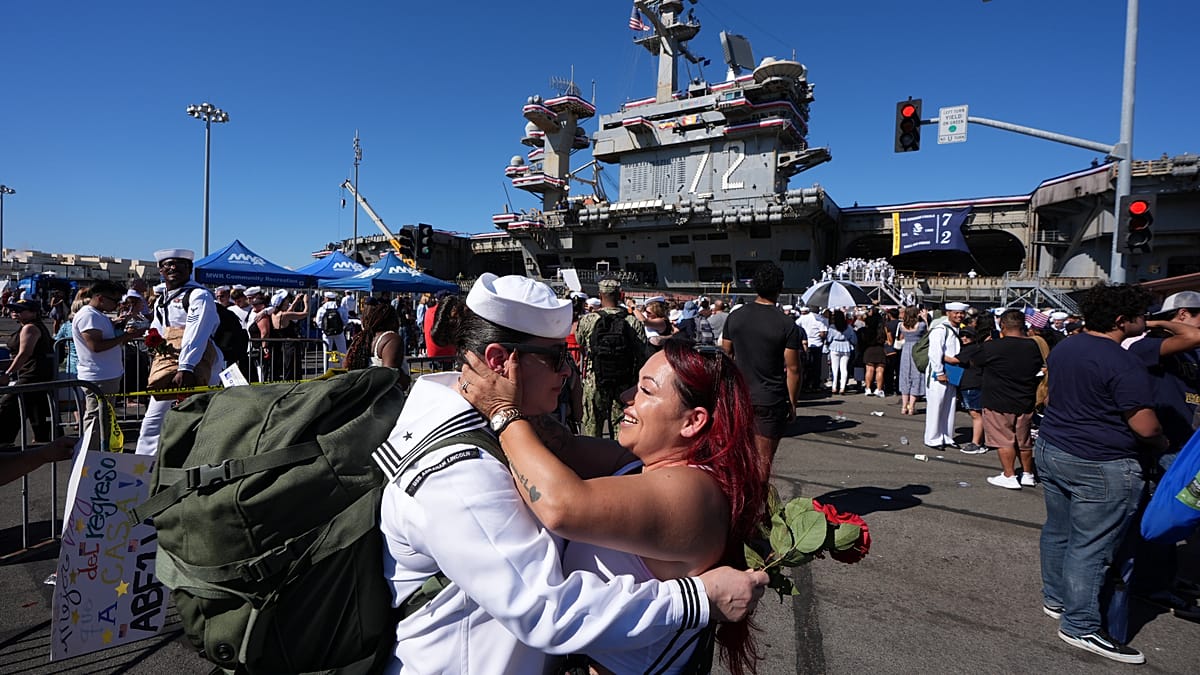
The USS Abraham Lincoln sailed into San Diego Bay on Tuesday, ending a 265-day deployment that set a modern record for a US aircraft carrier. Families lined the pier with flowers and balloons as sailors disembarked, marking the close of a mission that stretched from the South China Sea to the Persian Gulf.
The carrier left California in November 2025 for routine patrols in the Indo-Pacific, but was abruptly rerouted to the Middle East as tensions with Iran escalated. It ultimately supported US and Israeli military operations against Iranian targets, a role that kept the ship at sea far longer than originally planned.
For the crew, the homecoming was emotional. "I've missed birthdays, anniversaries, and my daughter's first steps," said Lieutenant Maria Gonzalez, an officer on board. "But we knew the mission mattered, and we're proud to be back."
A deployment under scrutiny
The extended tour also drew attention for less celebratory reasons. Reports emerged during the deployment of supply shortages, including delays in food and spare parts, and concerns about crew morale. The US Navy acknowledged logistical challenges but insisted that the ship remained combat-ready throughout.
"The Abraham Lincoln's crew demonstrated extraordinary resilience," said Rear Admiral James Carter, commander of the carrier strike group. "We are reviewing the lessons learned to improve support for future long-duration deployments."
The deployment's length reflects a broader trend in US naval operations, where carriers are spending more time at sea as the Pentagon juggles commitments in Europe, the Middle East, and the Pacific. The strain on sailors has become a recurring issue, with some lawmakers calling for shorter rotations and better shore leave.
For European observers, the carrier's return is a reminder of the strategic weight the US still projects in the Middle East and beyond. While the Abraham Lincoln was not directly involved in European operations, its rerouting underscored how global crises can pull US naval assets away from other regions, including the Mediterranean and the Atlantic.
The timing also coincides with broader debates in Europe about defense readiness. As EU member states discuss increasing military spending and the bloc's strategic autonomy, the US Navy's operational tempo offers a case study in the costs of sustained power projection.
In the Black Sea, meanwhile, the risks to sailors remain stark. Eighteen sailors were recently rescued after a drone strike on a cargo ship, highlighting the dangers that persist in Europe's eastern waters.
The Abraham Lincoln's crew will now undergo a period of maintenance and rest. For many, the immediate priority is simple: reconnecting with loved ones and adjusting to life on land after nearly nine months at sea.
"It's surreal to be home," said Petty Officer Second Class David Chen, holding his young son. "We did our job, and now it's time to recover."
The Navy has not announced when the carrier will deploy again, but officials say the ship will remain in San Diego for the foreseeable future. The record deployment is likely to fuel further discussion about the sustainability of such long missions, both in Washington and among European allies who watch US naval commitments closely.