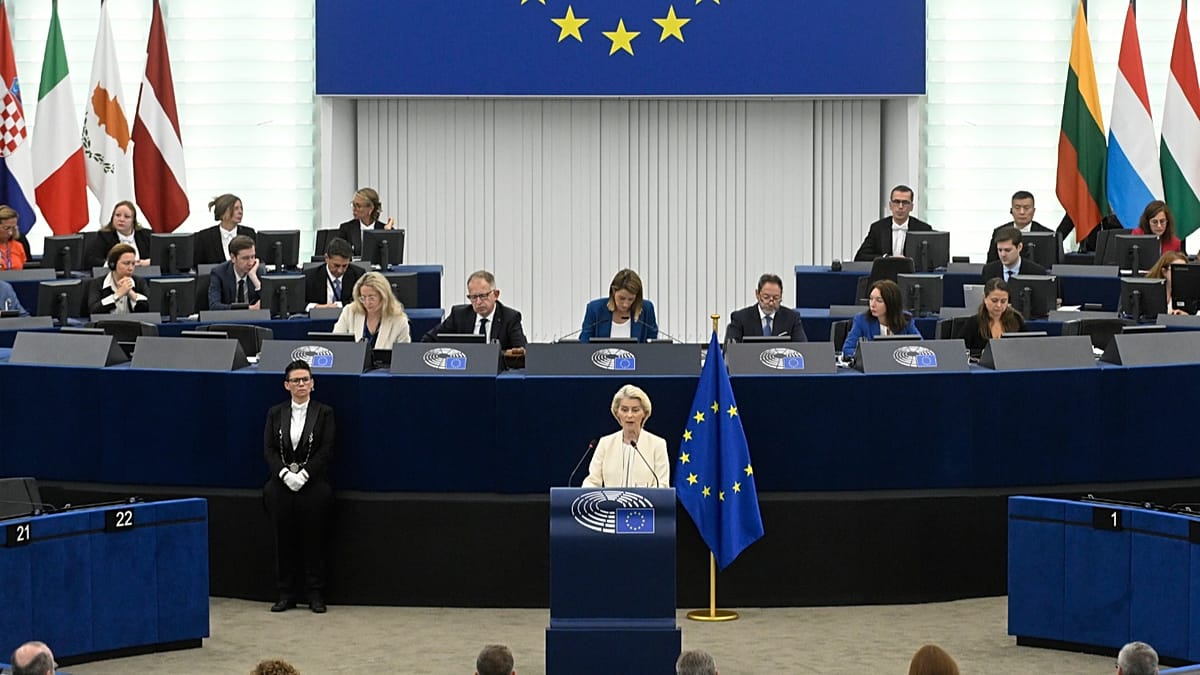
In her annual State of the Union address to the European Parliament in Strasbourg, European Commission President Ursula von der Leyen made clear that artificial intelligence has a place in European healthcare—but only as a tool to assist, never to replace, human clinicians.
Speaking as a former doctor, von der Leyen said she would welcome AI that gives physicians instant access to the data they need for accurate diagnoses and treatment decisions. But she drew a firm line: “I do not want a robot to tell me whether I have cancer or not.”
Her remarks came amid a broader push to position Europe as a leader in trustworthy AI, an ambition she has repeatedly tied to the bloc’s values of privacy, safety, and fundamental rights. The Commission president argued that AI’s capacity to process vast datasets can transform medicine, from earlier detection of diseases to more efficient drug development.
AI’s promise in cancer screening
Von der Leyen pointed to AI-supported mammography as a concrete example of how the technology can save lives. Studies and clinical trials have shown that AI can identify breast cancers earlier and more consistently than traditional screening methods, improving survival rates. “So we need AI for health,” she said.
Beyond oncology, AI is already being deployed across the sector—helping to interpret medical images, accelerate pharmaceutical research, and reduce administrative burdens on overstretched healthcare staff. The European Commission has funded numerous projects exploring these applications, from AI-driven diagnostic tools in hospitals in Berlin and Paris to telemedicine platforms in rural parts of the Baltics.
Yet the rapid expansion of AI in medicine has also raised alarms. Recent research has shown that large language models can give dangerously inaccurate medical advice, often failing to assess the urgency of symptoms correctly. Experts have also warned about the sensitivity of biological data and the need for robust legal frameworks to govern how AI systems access and use it.
The World Health Organization, in a recent report, highlighted gaps in legal accountability, uneven investment in workforce training, and the risk of excluding vulnerable populations. It noted that only 8% of its member states have a national health-specific AI strategy—an “urgent reminder that ambition must be matched with concrete action.”
Von der Leyen’s insistence on a “European way” for AI in health reflects a broader continental debate. While some member states, such as France and Germany, are investing heavily in medical AI research, others are more cautious, wary of data protection and ethical pitfalls. The EU’s forthcoming AI Act, which is set to classify medical AI as high-risk, will impose strict requirements on transparency, human oversight, and data quality.
The Commission president also used her speech to announce “game-changing initiatives” to be presented in November, focusing on sectors where industrial AI has the greatest potential and where Europe holds significant data advantages: health, transport, agri-food, advanced manufacturing, and defence and space. These initiatives are expected to include measures to boost data sharing across borders, support AI research and testing, and encourage public-private partnerships.
For now, von der Leyen’s message is clear: Europe wants to harness AI’s power without surrendering human judgment. As she put it, the goal is not to replace doctors but to give them better tools—so that patients can benefit from the best of both worlds.