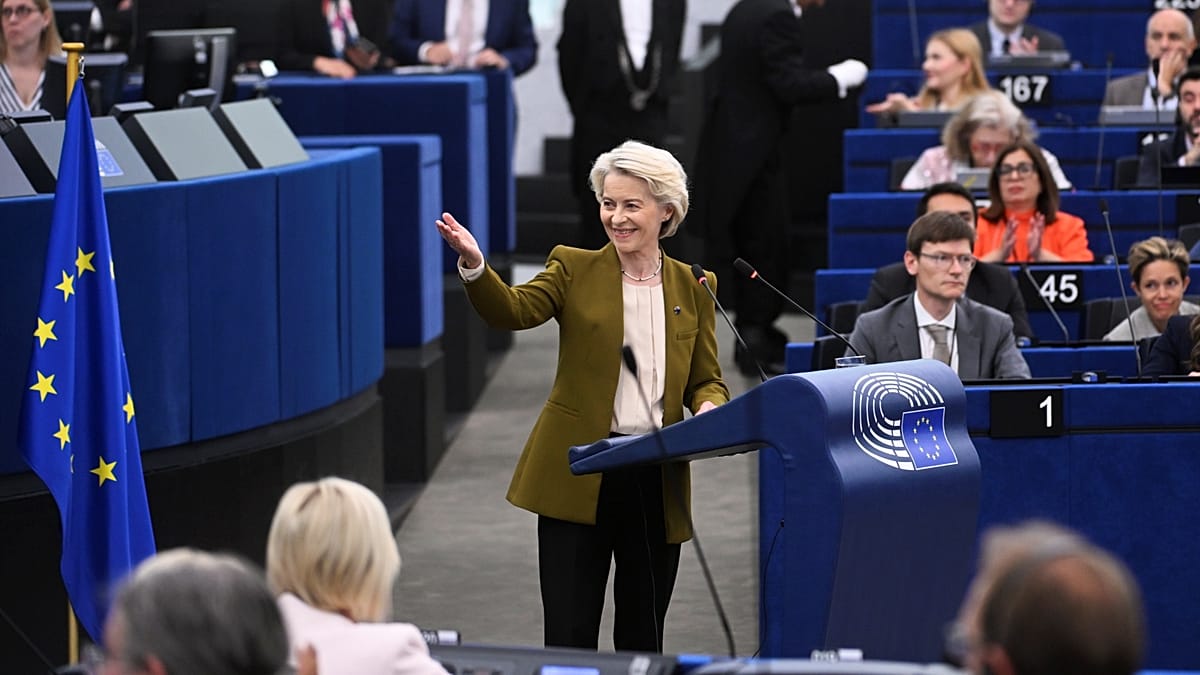
When Ursula von der Leyen took the stage in Strasbourg last September, her State of the Union address was a sprawling manifesto of ambition. From a reparations loan for Ukraine to a drone wall on the eastern flank, the European Commission president promised a more assertive, more secure Europe. A year on, the record is decidedly mixed: some initiatives have quietly died, others have been rebranded, and a few have actually delivered.
Ukraine: the loan that fizzled, the drones that flew
Perhaps the most striking proposal was the so-called reparations loan, a scheme to channel the €210 billion in immobilised Russian Central Bank assets into a financial lifeline for Ukraine. The idea was bold, even unprecedented: make the aggressor pay for the victim. But it met fierce resistance, particularly from Belgium, which hosts the bulk of those assets at Euroclear. Prime Minister Bart De Wever led a campaign that culminated in a dramatic December summit where the proposal collapsed. In its place, EU leaders resorted to traditional common borrowing, setting up a €90 billion loan.
Yet the Russian assets are back on the table. Kyiv has flagged a massive gap in its finances, raising questions about how long the €90 billion will last. Von der Leyen, meanwhile, has made progress on other fronts. She signed an EU-Ukraine drone deal in July, the first of its kind, and the inaugural meeting of the EU-Ukraine Drone Alliance took place last week. Ukraine's accession process has also moved forward, with two of six negotiation clusters now open.
Defence: the drone wall that wasn't
Last year's speech came amid a series of drone incursions into NATO airspace, prompting von der Leyen to propose a "drone wall" along the eastern flank. The phrase puzzled diplomats – there is no physical wall, but rather a concept of integrated air defence. A year later, the frequency and volume of incursions have only increased, alongside other hybrid attacks, including an attempted sabotage at Leipzig airport that Berlin attributed to Moscow. From a deterrence perspective, the promise has not materialised.
The Commission has, however, advanced its defence roadmap, prioritising drone and anti-drone technology. The "drone wall" has been discreetly renamed the European Drone Defence Initiative, shedding negative connotations and broadening its scope. It is a classic Brussels move: rebranding a failure as a work in progress.
Middle East: big words, little action
One of the most dramatic moments of the speech was von der Leyen's proposal to partially suspend the EU-Israel Association Agreement over the war in Gaza, alongside sanctions on extremist Israeli ministers and violent settlers. "What is happening in Gaza is unacceptable," she said. But the suspension quickly bogged down in member state divisions. Spain, Ireland and Belgium pushed for action; Germany, Austria and the Czech Republic urged dialogue. The proposal still languishes.
Sanctions on violent settlers were finally adopted in May, after Hungary's government change lifted its veto. But the sanctions on ministers remain blocked. A coalition of member states has asked the Commission to propose a ban on trade with illegal Israeli settlements, but Brussels has declined, pointing instead to the Association Agreement. The gap between rhetoric and reality is stark.
Trade: living under Trump's shadow
The EU-US trade deal signed by von der Leyen and Donald Trump, which imposed a 15% tariff on the bloc while removing duties on American goods, was still controversial when she spoke. "The deal provides crucial stability in our relations with the US," she argued. That stability has proved elusive. Trump officials have spent the year pressuring Brussels to dismantle green and digital laws, labelling them "non-trade barriers."
Brussels has refused to concede its right to regulate and has set up a formal digital dialogue with Washington. Meanwhile, von der Leyen has pushed ahead with diversification, signing major trade deals with India, Indonesia, Mexico and Australia. The strategy is clear: reduce dependence on any single partner, even as the transatlantic relationship remains fraught.
What the scorecard means
Von der Leyen's State of the Union promises were always a mix of the visionary and the vague. A year on, the pattern is familiar: bold ideas that require unanimity often die in the Council, while those that can be advanced by the Commission alone tend to survive, albeit in modified form. The drone wall became an initiative; the reparations loan became a conventional loan; the Middle East sanctions became a partial, delayed reality.
For an institution that thrives on incrementalism, that may be the best one can expect. But as the EU faces growing pressure in the Arctic and beyond, the gap between promise and delivery is increasingly costly. Von der Leyen's next speech will be judged against this record – and against the €200 million pledge to Greenland that signals a new geopolitical front. The question is whether she can turn ambition into action, or whether the State of the Union remains a theatre of good intentions.