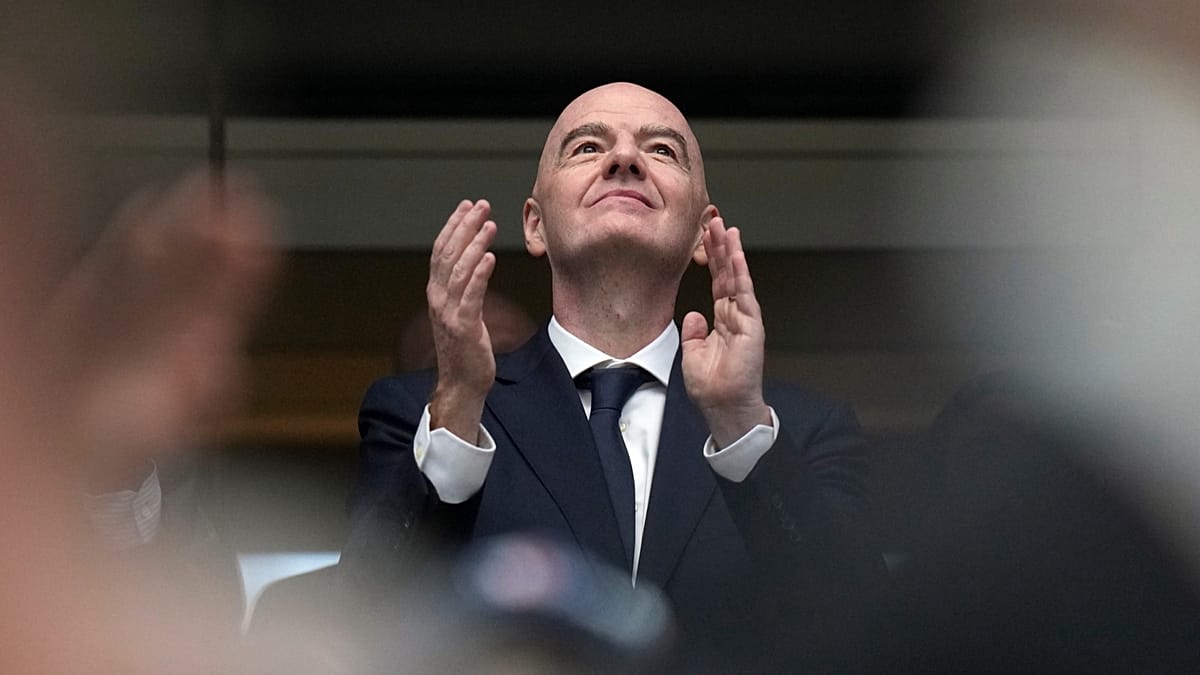
The Football Association of Wales (FAW) has become the first national federation to publicly withdraw its support for Gianni Infantino's bid for a third term as FIFA president. In a statement issued on Monday, the FAW said it could no longer back Infantino's candidature for the 2027–2031 term, citing "failures in good governance, process, leadership."
The move comes in the wake of FIFA's abrupt decision to abandon a proposal that would have allowed private investors to acquire minority stakes in its major competitions, including the World Cup. The plan, known as the FIFA Forward Enterprise (FFE), was unveiled in late July and aimed to raise up to $4.2 billion (€3.6 billion) based on an initial equity valuation of $20 billion (€17 billion).
"Failing to put the best interests of football first is a failure we cannot accept," the FAW said in its statement, which was reported by several European media outlets. The Welsh federation's decision marks a significant crack in Infantino's support base, even as he prepares to seek re-election at the FIFA Congress scheduled for early next year.
FIFA's U-turn and the fallout
On Saturday, FIFA announced it was shelving the FFE project after facing intense opposition from European federations and other stakeholders. In a statement, Infantino acknowledged that the proposal had "created divisions" that were "no longer in the interest of the objective set out in the first place." He added: "Our purpose has always been - and will always be - to unite and improve. As a result, this proposal will not proceed."
The plan had been pitched as a way to boost funding for FIFA's 211 member associations through a new subsidiary that would manage the organisation's commercial operations and events. Infantino had touted the sport's "remarkable commercial value" as a lure for potential investors. But critics argued that the scheme lacked transparency and was being rushed through without proper consultation.
UEFA, the European governing body, welcomed FIFA's decision to drop the plan but made clear that its confidence in Infantino's leadership had been severely shaken. In a statement on Saturday, UEFA said it would work with its associations and other confederations to "devise a plan" to prevent such a situation from recurring. "We cannot keep going on like this with secret schemes on fast track timescales, cooked up by faceless individuals and of dubious benefit to the game. We must identify those responsible and hold them to account," UEFA said. "The current FIFA leadership has not only lost UEFA's confidence but also that of many other members of the football family."
The FAW's decision is the first formal withdrawal of support from a national association, but it may not be the last. Several European federations have privately expressed similar concerns, and UEFA's strong language suggests that a broader coalition could form against Infantino in the coming months.
Infantino, who has led FIFA since 2016, has faced repeated controversies during his tenure, including allegations of ethical misconduct and a lavish lifestyle. His critics have also pointed to the expansion of the World Cup to 48 teams and the awarding of the 2034 tournament to Saudi Arabia as decisions that prioritised commercial interests over sporting integrity.
The Welsh federation's move comes at a delicate time for FIFA, which is also dealing with legal challenges and ongoing investigations into its governance. The FFE debacle has further eroded trust among member associations, particularly in Europe, where there is growing appetite for reform.
As the race for the FIFA presidency heats up, Infantino's position appears increasingly vulnerable. While he has not yet formally announced his candidacy, he is widely expected to run for another term. The FAW's withdrawal of support is a clear signal that his re-election bid will face significant opposition, especially from European federations that have grown weary of his leadership style.
For now, the football world is watching to see whether other national associations will follow Wales's lead. The coming weeks are likely to bring more public statements from federations across Europe and beyond, as the battle for the future of FIFA's leadership intensifies.