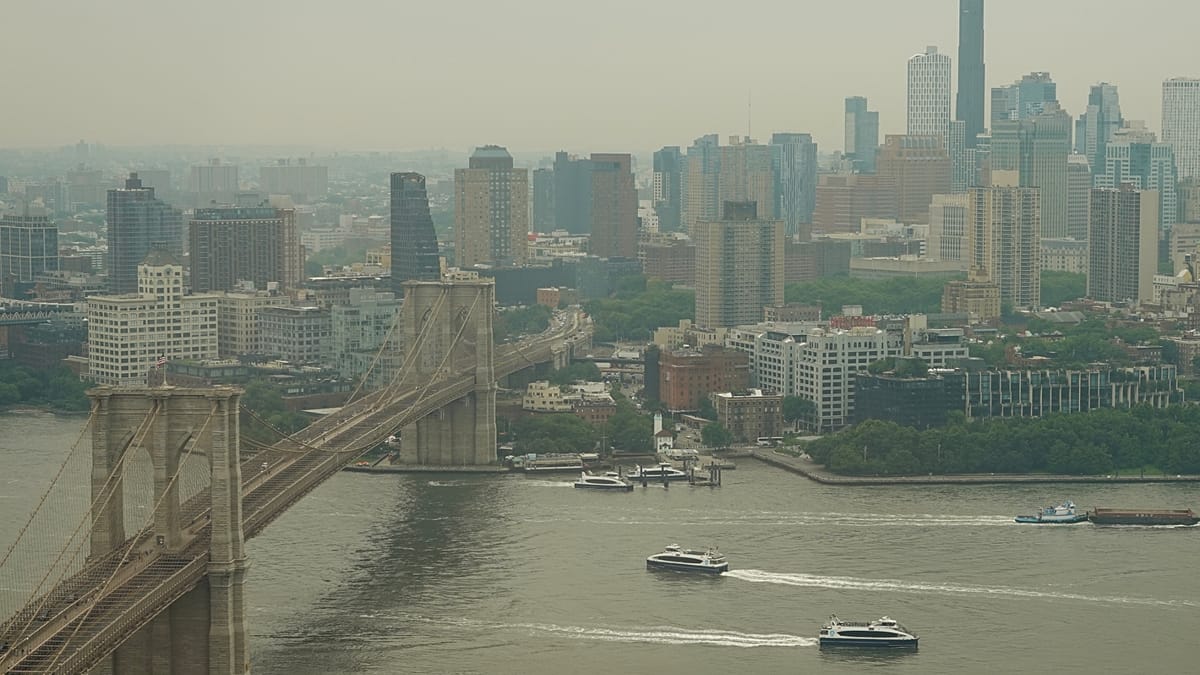
New Yorkers woke on Thursday to an orange sky, a haunting replay of the 2023 smoke events but with far higher stakes: in less than 72 hours, Spain and Argentina will contest the 2026 World Cup final at MetLife Stadium in East Rutherford, New Jersey, and a thick plume of smoke from Canadian wildfires has descended on the region.
The source is unambiguous. Canada is battling several hundred active fires, many out of control, and air currents have driven the smoke south-east, blanketing much of the north-eastern United States from the Great Lakes to New Jersey. A heat dome is trapping the particles close to the ground, preventing dispersion.
Health warnings and a roofless stadium
Since Thursday morning, New York authorities have issued alerts. The air quality index has reached levels classified as unhealthy, and the Department of Health recommends limiting time outdoors, avoiding strenuous exercise, and paying special attention to children, older people, and those with respiratory conditions. The city has begun distributing KN95 masks at libraries, police stations, and fire stations.
The most worrying structural detail for Sunday's final is that MetLife Stadium has no roof. That means the 82,500 expected spectators and the players will be directly exposed to whatever air quality conditions prevail. Specialists warn that a full day of exposure to this type of smoke is equivalent to smoking ten cigarettes.
Training disrupted, match still on
The pollution has already affected preparations. The Spanish squad, based in New Jersey, had to adjust Thursday's training session, with media allowed to watch only the first few minutes of what was meant to be an hour-long practice. Argentina, by contrast, have been training in the Atlanta area, where the smoke has been barely noticeable.
Forecasts suggest that rain expected over the weekend could clear the air before kick-off, scheduled for 21:00 Argentina time on Sunday. In the meantime, tracking air quality has joined team line-ups as one of the most closely watched issues in the build-up to the final.
The European dimension is clear: Spain, a member state of the European Union, is one of the two finalists, and the match is a major cultural event for the continent. The health risks to players and fans from European countries, as well as the broader implications of climate change-driven wildfires, make this a story of direct relevance to European Pulse readers.
For more on the tournament, see EU Sport Commissioner Backs Spain as World Cup's Strongest Team Ahead of Final and From a Camp Nou Bath to the World Cup Final: Messi and Yamal's Unlikely Reunion.