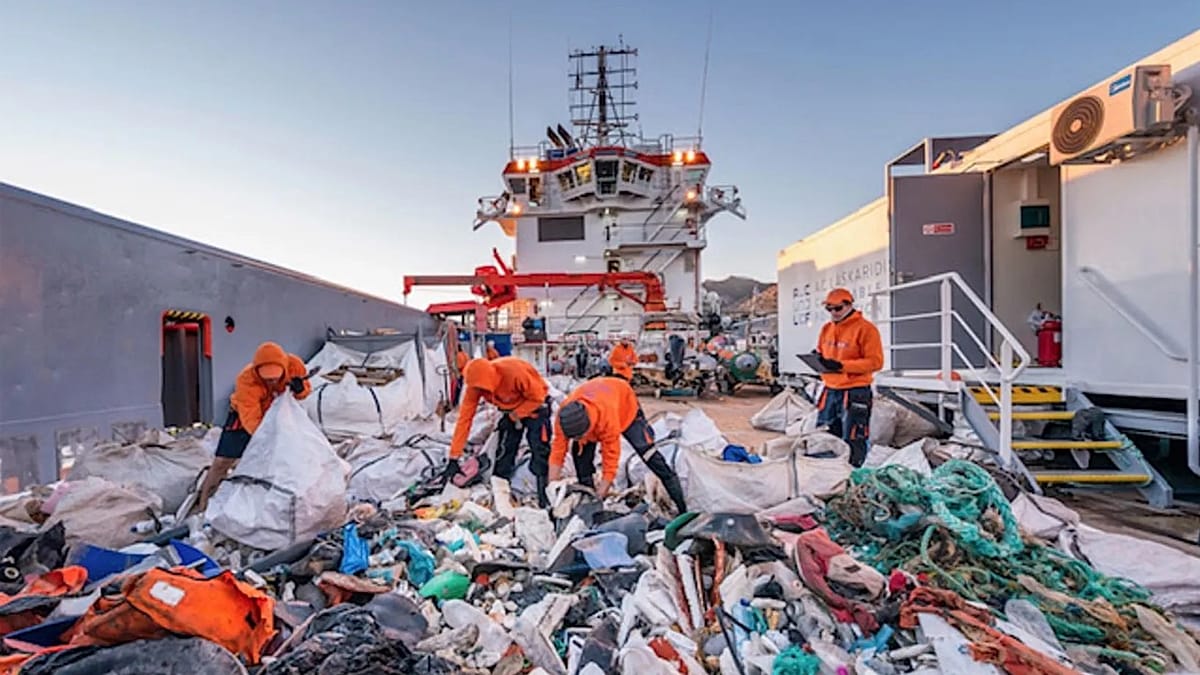
Six islands in the Cyclades have seen a marked improvement in coastal cleanliness, according to results from the second round of the Typhoon Project, a long-running initiative by the Athanasios C. Laskaridis Public Benefit Foundation. Now in its seventh year, the project has cleaned more than 4,800 stretches of coastline across Greece and removed over 1,090 tonnes of waste, building one of the country's most comprehensive databases on coastal pollution.
The latest operations focused on Syros, Mykonos, Delos, Antiparos, Despotiko, and Keros. In every case, pollution levels fell compared to the first clean-up cycle, demonstrating that sustained, repeated intervention yields measurable results. The foundation noted that the improvements also reflect a growing environmental awareness among local populations.
Sharp reductions in pollution
Teams surveyed 575 beaches in total. Of these, 468 were already clean, while clean-up operations were carried out on the remaining 107. Hundreds of thousands of waste items and dozens of tonnes of material were removed, helping restore fragile coastal ecosystems.
The most dramatic improvement was recorded on Delos, where pollution dropped by 75%. Keros followed with a 60% reduction, Despotiko with 50%, Syros with 33%, Antiparos with 31%, and Mykonos with 29%. The Mykonos figure is notable given the island's high volume of waste from tourism and other sources.
Community engagement
Local involvement was a key factor. On Mykonos, 918 school pupils participated in cleaning three beaches over six days, sending a strong signal about the importance of protecting the natural environment. On Syros, the Typhoon Project worked with students from the Merchant Marine Academy, fostering environmental responsibility among future maritime professionals.
The detailed results for each island are as follows:
- Syros: 140 beaches visited, 124 already clean, 16 cleaned. 53,539 items (4.7 tonnes) collected. Pollution down 33%.
- Mykonos: 109 beaches surveyed, 78 clean, 31 cleaned. 744,048 items (11.3 tonnes) collected. Pollution down 29%.
- Delos: 39 beaches, 30 clean, 9 cleaned. 57,113 items (2.5 tonnes) collected. Pollution down 75%.
- Antiparos: 205 beaches, 181 clean, 24 cleaned. 77,210 items (3.5 tonnes) collected. Pollution down 31%.
- Despotiko: 69 beaches, 51 clean, 18 cleaned. 90,038 items (4.9 tonnes) collected. Pollution down 50%.
- Keros: 13 beaches, 4 clean, 9 cleaned. 17,972 items (1.6 tonnes) collected. Pollution down 60%.
The Typhoon Project's approach—combining systematic data collection with community action—offers a model for coastal protection that could be replicated elsewhere in the Mediterranean. As tourism continues to grow in Greece, with projections showing a surge in visitors through 2026, such initiatives become increasingly vital. For more on the broader tourism trends, see Greece, Italy, and Malta Lead 2026 Surge in European Tourism Growth.
The project also highlights the environmental pressures facing popular destinations. A recent study found that cruise ships often enjoy tax breaks despite contributing to pollution and overtourism, a dynamic that affects many Greek ports. Read more in Cruise Ships Enjoy Tax Breaks Despite Pollution and Overtourism, Study Finds.
For Greece, balancing economic benefits from tourism with environmental protection remains a challenge. The Typhoon Project demonstrates that with consistent effort and local participation, significant progress is possible.