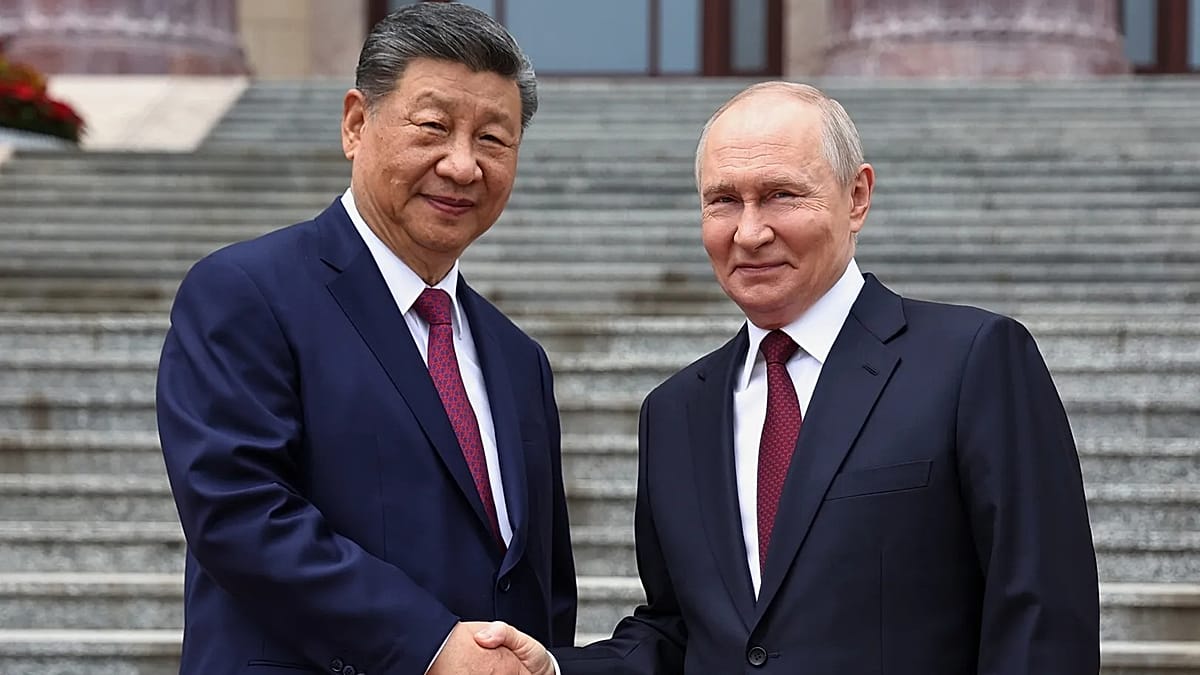
Chinese President Xi Jinping welcomed Russian President Vladimir Putin to Beijing on Wednesday morning for talks that underscored Beijing's selective approach to global conflicts. While Xi called for an immediate halt to hostilities in the Middle East, he notably avoided pressing Putin on the war in Ukraine, a dynamic that continues to frustrate European capitals.
“In the current tense situation on the international stage, our close partnership is particularly needed,” Putin told Xi, addressing him as “a dear friend.” The Russian leader's visit comes just days after Xi hosted US President Donald Trump, highlighting China's balancing act between the two rival powers.
Xi's Four-Point Proposal for the Middle East
According to Chinese state media, Xi described the Middle East conflict as being at a “critical juncture” and said it is “imperative” to stop the fighting. He reiterated his four-point proposal, first outlined last month during a meeting with the crown prince of Abu Dhabi, which promotes “peaceful co-existence, national sovereignty, international rule of law, and a coordinated approach to development and security.”
Russia's Deputy Foreign Minister Sergei Ryabkov said Moscow is ready to facilitate talks between the US and Iran, a move that could reshape regional dynamics. Iran's foreign minister, Abbas Araqchi, visited Beijing shortly before Putin's arrival, signaling Tehran's reliance on Chinese and Russian support.
For European travellers and businesses, the ongoing instability in the Middle East has direct consequences. The EU has issued updated travel advisories, and many airlines have rerouted flights away from conflict zones. For more on how to navigate these disruptions, see our guide on Navigating Summer Travel Amid Middle East Crisis: EU Rights and Tips.
Ukraine: The Elephant in the Room
Despite the extensive agenda, Xi did not publicly urge Putin to end the war in Ukraine. German Chancellor Friedrich Merz expressed hope that Xi would use the meeting to persuade Putin “to end this war in Ukraine which he cannot win.” Merz noted that Berlin is monitoring the visit closely, but does not expect a fundamental shift in Sino-Russian relations.
“We naturally associate this visit with the hope that President Xi will also urge President Putin to end this war in Ukraine, which he cannot win. On the contrary, it is a war that is causing heavy loss of life for Russia every single day,” Merz told reporters on Tuesday.
Since the full-scale invasion of Ukraine, China has become Russia's most important international partner, providing economic and diplomatic support that Western analysts say has sustained Moscow's war effort. Beijing has not explicitly endorsed the invasion, but it has also refrained from using its leverage to stop it. This stance has been a growing concern in Brussels, where EU leaders have repeatedly called for China to play a more constructive role. The EU's top military official recently reiterated that Ukraine remains Europe's top security priority.
The visit also comes amid broader European security debates. Former German Chancellor Angela Merkel recently warned that Europe's security assumptions are outdated after the Ukraine invasion, a sentiment that resonates as Putin deepens ties with Beijing.
Deepening Bilateral Cooperation
Beyond geopolitics, the two leaders are expected to sign around 40 documents, with Putin and Xi personally overseeing 21 of them. According to Russian state media, two key agreements will take centre stage: a joint statement on strengthening the comprehensive partnership and strategic interaction, and a “declaration on the emergence of a multipolar world and a new type of international relations.”
Chinese state media also reported that the “Treaty of Good-Neighbourliness and Friendly Cooperation between China and Russia” has been extended. This treaty outlines the basis for peaceful relations, economic collaboration, and diplomatic and geopolitical reliance between the two countries, including provisions on military cooperation and defence pacts.
The deepening ties between Moscow and Beijing are a stark reminder of the shifting global order, one in which Europe must navigate a landscape where traditional alliances are tested and new power blocs emerge. As the EU Parliament recently reached a deal on a US trade pact, the contrast between transatlantic cooperation and Sino-Russian alignment becomes ever more pronounced. For more on this, see our report on the EU Parliament Reaches Deal on US Trade Pact as Putin Meets Xi in Beijing.