The first ski lifts on Germany's highest peak, the Zugspitze, began operating on Friday, signalling the official start of the ski season in the Bavarian Alps. But with the snow comes a less welcome companion: avalanche season. Temperatures on the summit are hovering around -7°C, and a monitoring station at roughly 2,070 metres has recorded a snow depth of 47 centimetres. Nearby, on the Nebelhorn, the snowpack is already 67 centimetres deep.
Experts from the Bavarian Avalanche Warning Service point to a combination of older snow layers and wind as the primary ingredients for instability. These factors can create weak layers within the snowpack and form wind slabs – accumulations of windblown snow that are among the most common triggers of avalanches.
The deadly mechanics of a slab avalanche
Thomas Feistl, head of the Bavarian Avalanche Warning Service, told Euronews that by the time a skier sees an avalanche coming, it is usually too late to react. “People often trigger avalanches themselves,” he said, emphasising that prevention is critical. Most fatal avalanches occur when skiers, snowboarders or snowshoers venture off marked and secured pistes. The most frequent type in such cases is the slab avalanche.
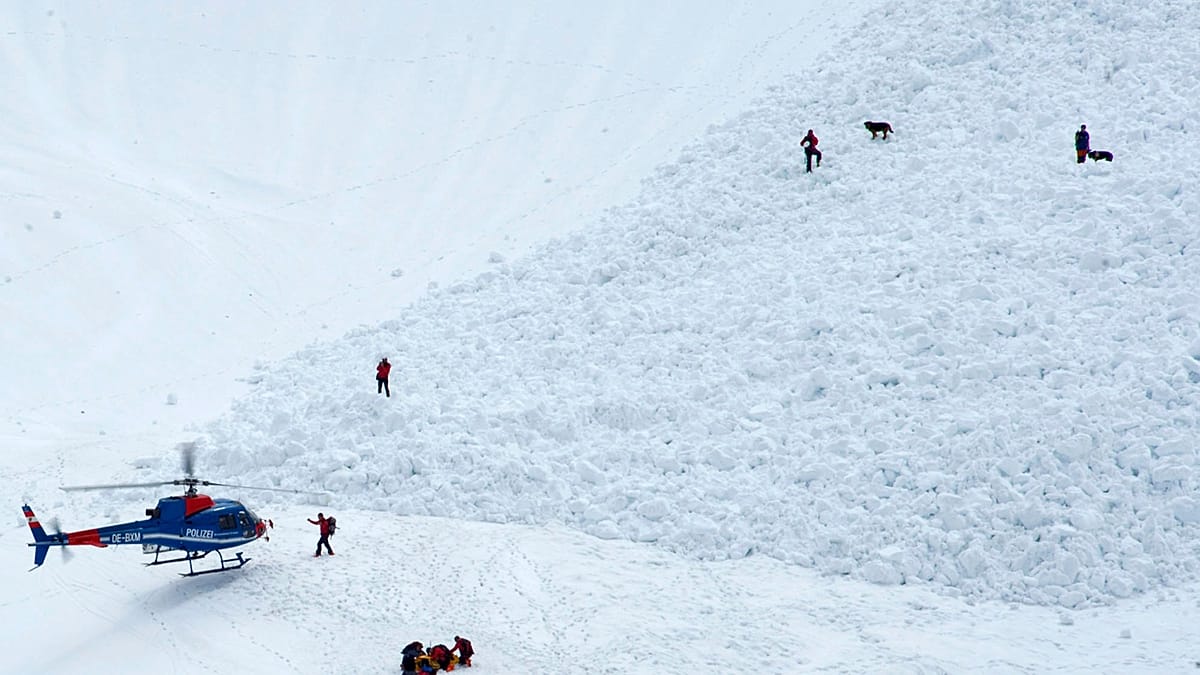
Throughout the winter, successive snowfalls build up layers of varying stability. The weight of a skier can cause a weak layer to collapse, setting off a fracture that spreads rapidly across the slope. Within seconds, a slab of snow breaks free and thunders downhill. Avalanche debris is extraordinarily heavy, Feistl explained, and those completely buried are usually unable to move or free themselves. “The forces exerted on the body when someone is caught in an avalanche are enormous. In most cases, you are at the mercy of the avalanche and there is little you can do to save yourself.”
It does not take a large displacement of snow to trigger an avalanche. A single fracture in a weak layer can propagate over hundreds of metres, meaning that even a skier moving below an unstable slope can set off a slide.
What increases the risk?
Several factors amplify the danger. Heavy snowfall is particularly hazardous, as fresh snow can form unstable layers. Strong winds carry snow across the mountainside and deposit it in specific areas, creating wind slabs. Slopes with an incline between 30 and 45 degrees are especially prone to avalanches. Weak layers of older snow and rapid temperature changes can also undermine the snowpack's stability – a concern in the coming days.
At lower and medium altitudes in the Bavarian Alps, snow is currently lying on relatively warm ground, according to the warning service. The base of the snowpack is already moist and is expected to become increasingly so as temperatures rise. This could trigger spontaneous glide-snow avalanches on smooth ground, regardless of slope orientation.
Survival depends on swift rescue
“How long you can survive beneath the snow depends on how much oxygen is available,” Feistl said. “If your airways become blocked by snow while the avalanche is still moving, you will suffocate within minutes. If you have a larger air pocket, you can survive beneath the snow for several hours.”
The chances of survival drop sharply with each passing minute, making the first 15 minutes after burial critical. “Digging yourself out is almost never possible,” Feistl admitted. That is why a rapid response from companions is vital. “If the buried person and their companions are equipped with avalanche transceivers, probes and shovels, the search should begin immediately.”
Rescuers must also consider their own safety, and the emergency services should be alerted as soon as possible. The treacherous nature of avalanches lies in the fact that a slope can appear perfectly stable even when the underlying snowpack is unstable. Even years of alpine experience offer no guarantee of safety.
Where are accidents most common?
Most avalanche accidents in Germany, Austria and Switzerland occur in the Alps, particularly in high-altitude regions with heavy snowfall and popular ski touring areas away from secured pistes. In Germany, the Allgäu Alps, the Wetterstein mountains and the Berchtesgaden Alps are among the most at-risk areas. Austria and Switzerland record considerably more accidents, as a much larger share of their territory lies within the Alps.
The start of the season is a reminder of the need for vigilance. As skiers take to the slopes, experts urge them to respect the mountains and the forces that lie beneath the snow. For those venturing off-piste, proper equipment and knowledge are not just recommendations – they can be the difference between life and death. For more on winter hazards, see our report on freezing rain and black ice threatening Germany's first Advent Sunday.