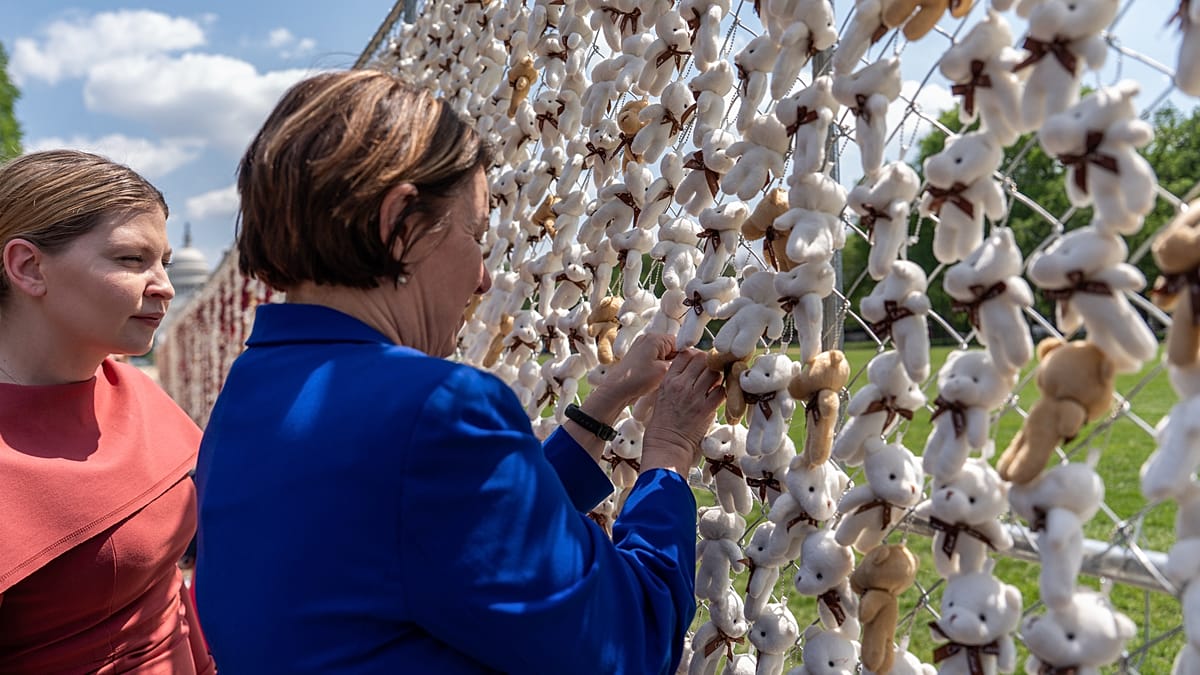
On the National Mall in Washington, D.C., a poignant installation of 20,000 teddy bears has drawn attention to the thousands of Ukrainian children forcibly taken from their families since Russia's full-scale invasion began in 2022. The display, organised by Ukrainian activists and international human rights groups, aims to pressure governments—particularly in Europe and the United States—to intensify efforts to locate and repatriate these children.
Each bear represents a child reported missing or abducted, a figure that has grown steadily as the conflict grinds on. According to Ukrainian authorities, at least 20,000 children have been illegally transferred to Russian-controlled territory or to Russia itself, often placed in state-run institutions or with foster families. The European Union and the International Criminal Court have classified these actions as potential war crimes, with the ICC issuing arrest warrants for Russian officials, including President Vladimir Putin, over the deportations.
A Visual Plea for Action
The teddy bear installation, which opened on 15 March 2025, is the work of the Ukrainian NGO "Children of War" and the U.S.-based advocacy group "Bring Kids Back UA." Organisers say the soft, familiar toys are meant to evoke the innocence of childhood and the urgency of the crisis. "Each bear is a child who should be playing, learning, and growing up in a safe home," said Olena Rozvadovska, a Ukrainian children's rights activist who helped coordinate the event. "Instead, they are in the hands of a regime that seeks to erase their identity."
The display has drawn visitors from across the United States and Europe, including diplomats from EU member states. Several European ambassadors to Washington attended the opening, underscoring the continent's stake in the issue. The European Parliament has repeatedly condemned the abductions, and the European Commission has allocated funds for tracing and reunification efforts. However, activists argue that more concrete action is needed, including sanctions on individuals and entities involved in the transfers.
Recent developments have highlighted the scale of the challenge. In February 2025, a Europol hackathon identified 45 deported Ukrainian children using open-source intelligence, a small but significant step in a much larger puzzle. The event, which brought together analysts from across the EU, demonstrated how digital tools can help track missing children, but activists stress that diplomatic pressure remains essential to secure their return.
The war's toll on families extends beyond abductions. Millions of Ukrainians have fled the country, with Germany, Poland, and Czechia leading the EU in hosting Ukrainian refugees after four years of conflict. Many of these families have been separated, with children sometimes sent ahead for safety or left behind with relatives. The abductions add a layer of trauma, as parents search for children taken by force.
International efforts to address the crisis have included diplomatic initiatives, such as the "Bring Kids Back UA" plan launched by Ukraine in 2023, which has secured the return of several hundred children. Yet the vast majority remain unaccounted for. The teddy bear installation is a reminder that behind the statistics are real lives, and that the window for action is narrowing as the war continues.
For European readers, the issue resonates deeply. The EU has been a primary destination for Ukrainian refugees, and many member states have taken in children who fled the war. The abductions, however, represent a deliberate strategy by Moscow to sever ties between Ukrainian children and their homeland, a tactic that echoes historical patterns of forced assimilation. As the display in Washington shows, the fight to bring these children home is far from over.