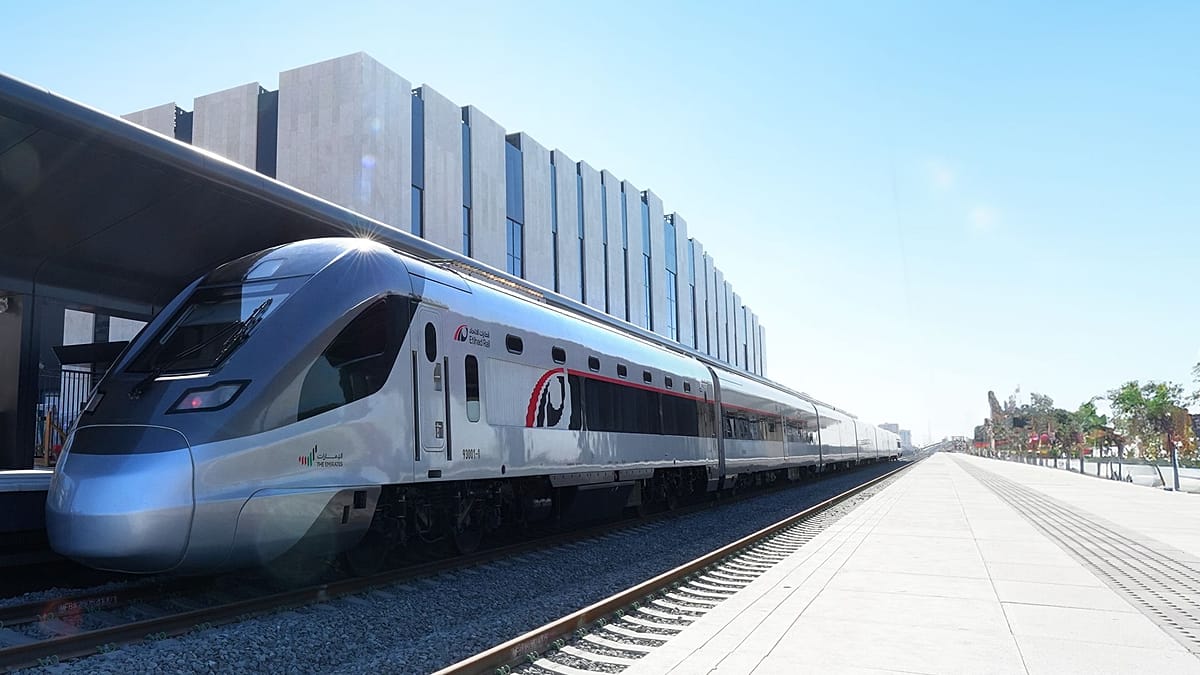
Etihad Rail has officially launched its passenger service between Abu Dhabi and Dubai, marking the first time the two emirates are connected by train. The route, which began operations on 30 September, cuts travel time between the UAE's capital and its largest city to just over an hour.
Tickets are priced at AED39 (€9.35) for comfort class and AED109 (€26.13) for premium seats. The service is part of a broader national rail network that Etihad Rail has been rolling out since late June, when trains first began running from Abu Dhabi to Fujairah on the country's east coast.
Expanding network and station details
The network will grow further in the coming months. On 30 December, Al Dhafra station in Abu Dhabi will open, followed by Sharjah station on 30 March next year. Several other stops in Abu Dhabi are planned, though dates have not yet been announced. These include Al Mirfa, near the mangrove destination Al Mugheirah Bay, and Liwa, known for its vast desert and annual motorsports festival. A station at Al Sila, close to the Saudi border, is also in the pipeline.
Because the stations are located outside city centres, Etihad Rail is providing shuttle services. In Abu Dhabi, shuttles will connect the main station at Mohamed Bin Zayed City with key downtown points such as the Corniche, Reem Mall, and ADNEC Centre, for AED10 (€2.40). In Dubai, the station at Jumeirah Golf Estates links directly to the metro, the only such system in the UAE.
The launch comes as rail travel gains momentum across the region. In Europe, trains have recently overtaken buses in EU travel for the first time in a decade, reflecting a broader shift towards sustainable transport. The UAE's new service is a significant step for the Gulf, where passenger rail has been limited.
Gulf-wide ambitions
Plans to connect the six Gulf Cooperation Council states – the UAE, Saudi Arabia, Oman, Qatar, Bahrain, and Kuwait – have been discussed for years, but no concrete timeline has been set. Saudi Arabia remains the only other Gulf nation with operational passenger trains. Its modern network links Riyadh with Quruyyat near the Jordanian border and with the port city of Dammam, as well as a route between the holy cities of Medina and Mecca. Historically, the region was part of the Ottoman railway network in the early 20th century, with lines connecting Damascus to Medina, though that service was halted during the Arab Revolt.
Metro systems are also sparse in the Gulf, with only Riyadh (opened 2024), Dubai (2009), and Doha (2019) having them. The UAE's new rail link is thus a pioneering effort, and its success could influence broader regional connectivity.
For European travellers, the new route offers an alternative to road travel between two of the Gulf's most visited cities. The UAE has become a major hub for international tourism, and the rail link may ease congestion on the busy highway corridor. As climate concerns reshape travel patterns, rail is increasingly seen as a viable option, a trend highlighted by the European Travel Commission's warnings about climate change as tourism's biggest threat.
Etihad Rail's phased approach – starting with the Abu Dhabi–Dubai line and then expanding to other emirates – mirrors the gradual development of rail networks elsewhere. The company has not yet announced pricing for future segments or international connections, but the initial response suggests strong demand.
With more stations set to open in 2026, the UAE is positioning itself as a regional leader in modern transport infrastructure. Whether the Gulf-wide network materialises remains to be seen, but the Abu Dhabi–Dubai link is a concrete step towards greater mobility in the region.