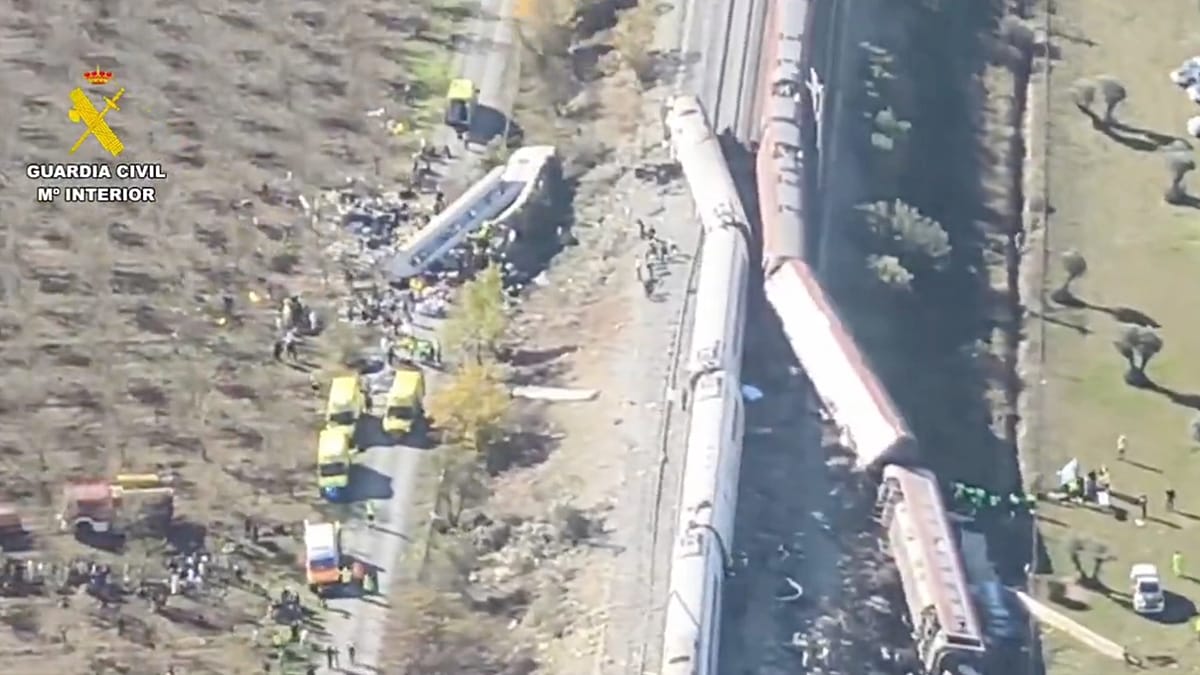
The first aerial images of Wednesday's high-speed train collision near Urda, in Spain's Toledo province, have been released by the Civil Guard, offering a stark view of the crash site. The footage shows damaged trains and derailed carriages, some of which have come to rest down an embankment, underscoring the severity of the incident.
The collision occurred on a stretch of the Madrid–Andalusia high-speed line, a key artery for rail travel in central Spain. While the exact sequence of events remains under investigation, early reports indicate that two trains collided head-on, a rare occurrence on Spain's modern high-speed network, which is generally regarded as one of the safest in Europe.
Emergency response under way
Emergency services, including firefighters, police, medical teams, and helicopters, have been deployed to the scene. The regional government of Castilla-La Mancha has activated its emergency plan, and rescue operations are ongoing. Authorities have not yet confirmed the number of casualties, but local media report that several people have been injured, with some in serious condition.
The Civil Guard's aerial footage, captured by drone, provides a comprehensive overview of the crash site, showing the twisted metal of the trains and the surrounding countryside. The images are being used to coordinate the rescue effort and to assess the full scale of the damage.
Spain's high-speed rail network, known as AVE, is a source of national pride and a model for other European countries. This incident is likely to raise questions about safety protocols and infrastructure maintenance, though officials have stressed that investigations are at an early stage.
This tragedy comes just months after another deadly train collision south of Madrid, which killed at least ten people. That incident, which occurred on a conventional line, prompted calls for increased investment in rail safety across the country.
The European Union has long championed rail as a sustainable alternative to air travel, and Spain's network is a cornerstone of that vision. The European Railway Agency, based in Valenciennes, France, is expected to monitor the investigation closely, as any findings could have implications for cross-border rail standards.
Local residents in Urda, a small town in the sparsely populated La Mancha region, have expressed shock at the accident. Many have gathered near the scene, offering support to emergency workers and waiting for news of loved ones.
As rescue efforts continue, the focus remains on saving lives and supporting the injured. The Spanish government has pledged a full inquiry, and transport minister Óscar Puente is expected to visit the site in the coming hours.
This incident also highlights the broader challenges facing Europe's rail networks, from aging infrastructure to the need for enhanced safety measures. While high-speed rail remains one of the safest modes of transport, accidents like this serve as a sobering reminder of the risks involved.
For now, the people of Toledo and the wider region are in mourning, and the nation is united in hope for the recovery of the injured. The coming days will bring more clarity on the causes of this tragedy, but the immediate priority is clear: to provide all necessary assistance to those affected.