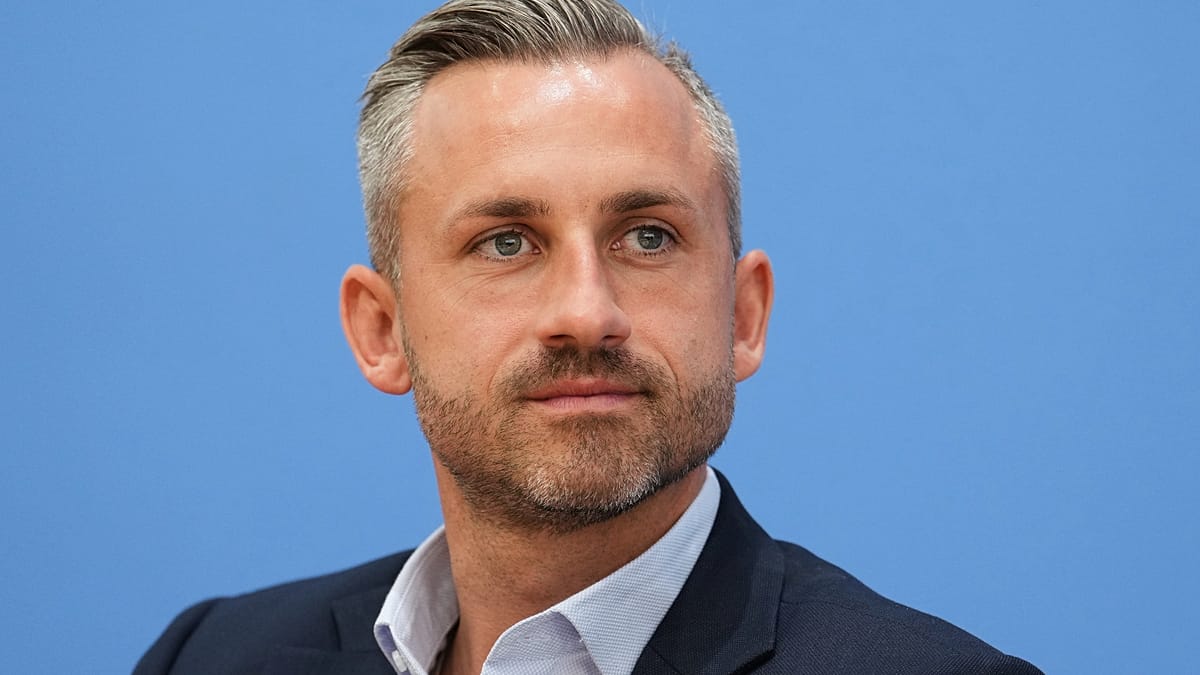
Ulrich Siegmund, the AfD's lead candidate in Saxony-Anhalt, has ignited a political firestorm after suggesting that military equipment could be used in a future 'remigration and deportation offensive.' The comments, made at a press conference in the context of a planned Israeli defence factory in Sangerhausen, have drawn sharp rebukes from across the political spectrum.
At the press conference, Siegmund addressed the proposed production site of Elbit Systems, an Israeli defence company, in the town of Sangerhausen. He stated that the AfD did not fundamentally oppose arms production, arguing that it could be vital for domestic security, national stability, and defence. He then linked this to his party's migration policy, saying that 'suitable means' would be needed for 'remigration and deportation offensives.'
Following the backlash, Siegmund sought to clarify his remarks. He emphasised that arms production encompasses not only weapons but also vehicles, protective technology, and other equipment relied upon by the Bundeswehr, police, and security agencies. He argued that strengthening these areas was necessary to enforce the law, carry out deportations consistently, and enable a 'genuine remigration offensive.'
He also stressed that the AfD rejects supplying military equipment for 'foreign wars,' drawing a distinction between domestic production and exporting arms to conflicts abroad. The party, he said, would closely examine what would be produced in Sangerhausen and under what conditions.
Political reactions
The remarks have provoked fierce criticism. Katja Pähle, leader of the SPD parliamentary group in the Saxony-Anhalt state parliament, described them as a political threat. 'Anyone who brings military equipment into play in connection with a planned mass expulsion of people is talking about violence as a means of politics,' she said, calling on the BSW to clarify its position.
The BSW, which has been open to talks with the AfD, also reacted sharply. Fabio De Masi, the party's federal co-chair, accused the AfD of backing rearmament and justifying the arrival of the Israeli defence company by linking it to the use of military technology for 'remigration.' He argued that this showed the AfD had no real intention of governing and was instead seeking provocation.
The controversy is particularly sensitive because the BSW is the only party in the new Saxony-Anhalt state parliament willing to hold talks with the AfD, though no cooperation decision has been made. The CDU, SPD, Greens, and Left Party continue to rule out working with the far-right party.
The potential Elbit Systems plant in Sangerhausen has already been a source of local tension, with protests from residents supported by the BSW. Elbit, based in Haifa, develops drones, howitzers, rocket launchers, and self-protection systems. Its German headquarters are in Ulm, and it already supplies the Bundeswehr with aircraft self-protection systems.
The town's mayor, Torsten Schweiger, has stated that no final assembly of drones or munitions is planned at the 130-hectare site. A final decision on the plant has not yet been made, and Siegmund acknowledged that the AfD has not adopted a definitive position, citing security, foreign policy, and economic considerations.
In the recent state election, the AfD emerged as the strongest party in Saxony-Anhalt with 43.8 percent of the vote, though short of an absolute majority. The party's rise has been accompanied by controversy over its 'remigration' policy, which critics have likened to ethnic cleansing. Siegmund's own political journey from CDU member to AfD lead candidate has been closely watched.
The debate over arms production and migration policy is likely to continue as the AfD seeks to translate its electoral success into political influence. The party's stance on such issues will be tested in coalition negotiations and parliamentary debates in the coming months.