Baku Energy Week 2026, held across the Caspian Oil & Gas exhibition and the Baku Energy Forum, underscored a shift in the global energy sector toward artificial intelligence, upstream automation, and regional gas diplomacy. As geopolitical uncertainty persists, companies and officials used the annual gathering in Azerbaijan to signal that competitiveness now hinges on digital infrastructure and commercially viable emissions reduction.
Abid Malik, President for Central Asia at ACWA Power, described the event as a growing international platform that brings together stakeholders from hydrocarbons to renewables and infrastructure investment. “This forum also provides an extremely good opportunity for exploring more investment opportunities, not only in Azerbaijan, but in Central Asia, in Caucasus, and in the Eastern Europe as well,” he said.
ACWA Power currently has around $740 million invested in Azerbaijan, including the Khizi-Absheron 240-megawatt wind project, which entered operations earlier this year and has already contributed more than 400 million kilowatt hours to the national grid. Malik also highlighted the company’s Caspian Sea desalination project, described as the first of its kind in Azerbaijan and the wider Caucasus region, with first water production expected in 2028.
Looking ahead, Malik said Azerbaijan’s geographical position places it at the centre of emerging regional green energy corridors connecting Central Asia and Europe. “Azerbaijan is going to play a very important role. Because of its geographical location, with all these initiatives they are working along with Central Asia and Europe, they’re going to elevate themselves at a different level on the global map.”
AI and Digitalisation in Upstream Operations
At the Baku Expo Center, commercial focus centred on operational technology. Companies unveiled AI-assisted drilling systems, predictive analytics platforms, and automated monitoring tools designed to reduce production costs and improve efficiency across upstream operations. Digital optimisation has become a major priority for producers attempting to protect margins while maintaining output in a volatile pricing environment.
Executives said the use of artificial intelligence in exploration and drilling is moving rapidly from experimental projects into large-scale deployment. Real-time operational analysis, automated maintenance systems, and digital field management tools are increasingly being adopted to reduce technical risks and improve recovery rates.
This trend mirrors broader European efforts to modernise energy infrastructure, though challenges remain. As Europe's €100 billion clean energy queue shows, grid bottlenecks can stall the green transition even when investment is available.
Methane Reduction and Climate Pressure
The event also reflected how climate pressure is reshaping investment priorities within the hydrocarbon sector. Methane reduction technologies emerged as a dominant theme, with firms presenting leak-detection systems, emissions-monitoring platforms, and carbon-management solutions aimed at lowering operational emissions without slowing production growth.
Bilal Khadra, Power and Energy Segment Leader at Borusan CAT, described Baku Energy Week as “one of the leading energy events in the Caspian region,” bringing together governments, investors, and energy companies from across global markets. “The event is important because it promotes international energy cooperation, attracts foreign investment, and supports discussions on energy security, oil and gas development, and renewable energy.”
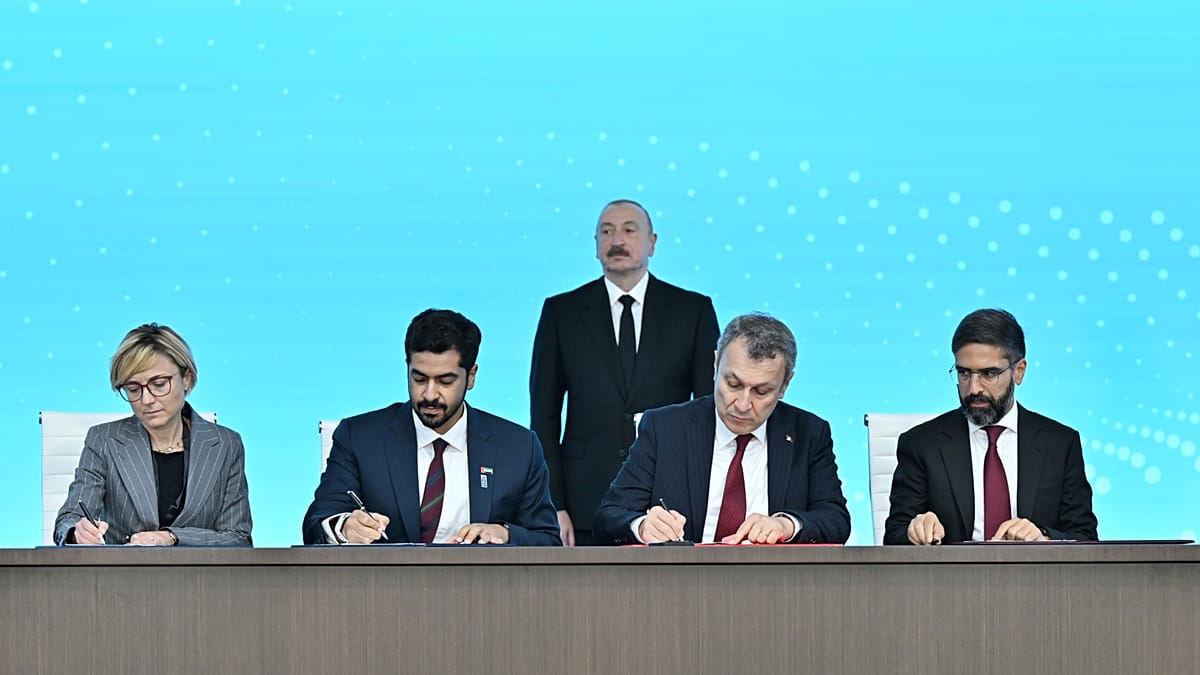
Khadra also pointed to major commercial agreements announced around the forum, including a 15-year natural gas agreement involving Turkey’s BOTAŞ, SOCAR, TotalEnergies, and ADNOC tied to Azerbaijan’s offshore Absheron field. According to Khadra, the event also reflects Azerbaijan’s strategic position between the energy resources of the Caspian region and European markets, while serving as a platform for discussions on AI, digital infrastructure, and cleaner energy investment.
For many companies attending, emissions reduction is no longer presented solely as an environmental obligation but increasingly as a financial and regulatory necessity tied to long-term competitiveness and investor confidence. Industry representatives said international financing institutions and shareholders are paying closer attention to operational transparency, sustainability performance, and emissions reporting as energy markets evolve.
Security and Regional Cooperation
Konstantin Grigorenko, Security Expert at Motorola Solutions, said the event had become increasingly important for companies seeking regional partnerships and investment opportunities across the wider Caspian energy sector. “Yes, we choose specially to take part in this event because it’s also not about Azerbaijan, it’s Caspian and a lot of different companies coming here to show who they are, what they’re doing and a whole lot of interesting people with whom we can discuss what kind of they are interested for and how we can be helpful for them.”
Grigorenko also highlighted how energy security discussions are expanding beyond oil and gas infrastructure into renewable energy protection and digital monitoring systems. “If you build something, you need to understand it must be secure,” he said, referring to large-scale solar energy investments. “Usually, they are staying somewhere outside where no people is and you need to understand that nobody going into this area.”
He said security systems are increasingly integrated into energy production itself, including perimeter protection, video surveillance, and centralised monitoring systems for renewable energy parks. “The main question is that it must be very easy to use and that’s why people choose this kind of solution.”
Meanwhile, discussions at the Baku Convention Center focused more heavily on geopolitics and gas infrastructure, reinforcing Azerbaijan’s role as a key transit country for Caspian gas to Europe. The event underscored how energy security and digitalisation are converging, with AI and automation becoming central to both operational efficiency and the protection of critical energy assets across the continent.