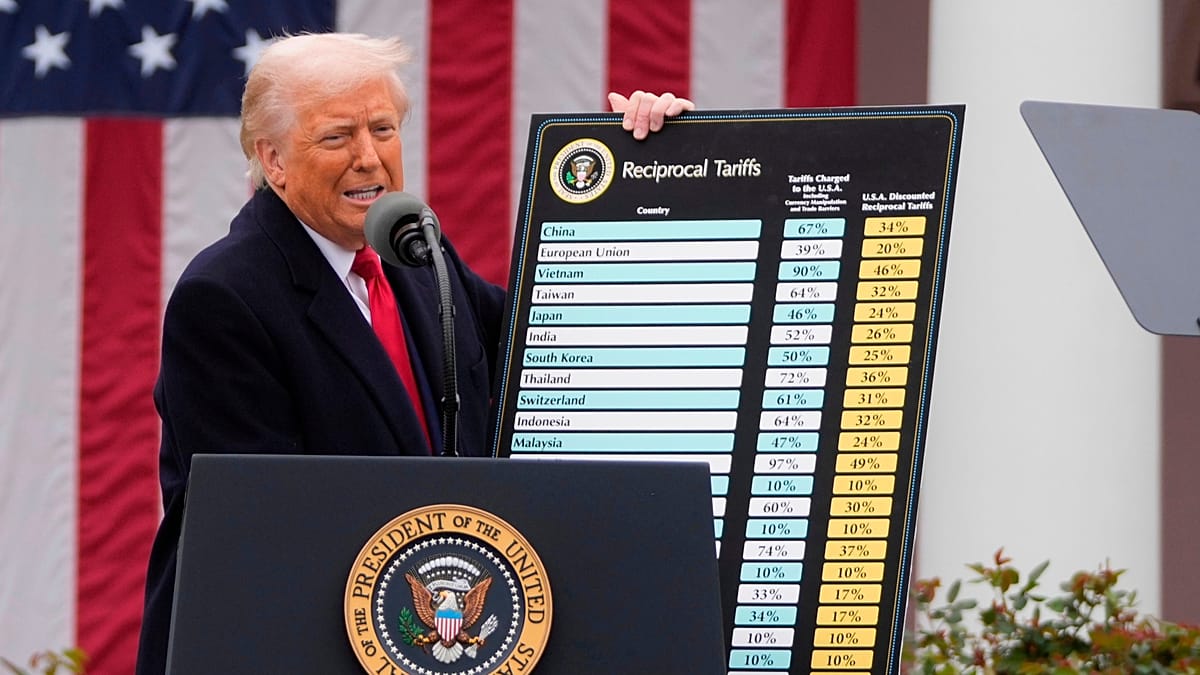
Washington has announced a fresh wave of tariffs targeting 60 countries, including all European Union member states, over claims that they have failed to adequately prevent forced labour in their supply chains. The new duties, ranging from 10 to 12.5 percent, will take effect on Friday, replacing the global 10 percent tariffs introduced earlier this year under President Donald Trump.
The expiring tariffs, imposed under Section 122 of the Trade Act of 1974, were limited to 150 days and were due to lapse at midnight Friday. The new levies are enacted under Section 301 of the same act, which grants the president broader authority to retaliate against what the US deems “unjustifiable” or “unreasonable” trade practices. This legal basis is considered more resilient to court challenges, following a Supreme Court ruling in February that struck down earlier tariffs imposed under the International Emergency Economic Powers Act.
Differentiated Rates for Trading Partners
The tariffs are not uniform. Countries that have either implemented a forced labour import prohibition or committed to doing so—including Canada, the European Union, India, and the United Kingdom—will face the lower rate of 10 percent. Others, such as China, Japan, and South Korea, will be subject to the higher 12.5 percent rate. The US Trade Representative, Jamieson Greer, stated: “The United States has had a forced labour import ban for nearly a century, and rigorously enforces it; it's well past time for our trading partners to do the same.”
Certain products are exempt from the new duties, including oil and gas, fertiliser, and goods covered under the US-Mexico-Canada Agreement. The measures affect nations that collectively account for 99 percent of US imports, making this one of the most sweeping trade actions in recent years.
European and Global Reactions
The announcement has drawn sharp criticism from affected nations. Brazil, which faces the higher 12.5 percent rate, called the decision “arbitrary and unjustified” and announced plans for retaliatory tariffs. The Brazilian government accused Washington of “choosing to manipulate an issue of great importance to human rights and the struggles of workers worldwide in order to accuse 59 countries and the European Union of unfair practices.”
Chile, also hit with 12.5 percent tariffs, responded through its Undersecretary for International Economic Relations, Paula Estévez, who emphasised that Chile has “solid labor institutions, a robust regulatory framework and a firm commitment to the prevention and eradication of forced labour.”
Within Europe, the EU has been preparing for this scenario. As reported by European Pulse, the bloc is ready to accept new US tariffs as long as they remain under a 15 percent cap, signalling a pragmatic approach to avoid a full-blown trade war. The UK, which secured the lower 10 percent rate, has not yet announced retaliatory measures but is monitoring the situation closely.
Human Rights Concerns and Skepticism
Human rights advocates have expressed mixed reactions. While some acknowledge that the tariffs could help curb forced labour practices, others question the administration’s motives. The International Labour Organization’s Forced Labour Convention of 1930 defines forced labour as “all work or service which is exacted from any person under the menace of any penalty and for which the said person has not offered himself (or herself) voluntarily.”
The move also comes amid broader scrutiny of labour practices in global supply chains. In a related development, Italian police recently raided luxury brands including Bulgari and Chanel over labour abuse allegations, highlighting that forced labour concerns are not limited to developing economies.
For European businesses, the new tariffs add another layer of uncertainty to transatlantic trade relations. The differentiated rates could incentivise EU member states to strengthen their own forced labour enforcement mechanisms to avoid higher duties in the future. However, the broader geopolitical implications remain unclear, as the US continues to use trade policy as a tool to address human rights issues—a strategy that critics argue risks politicising a serious global problem.