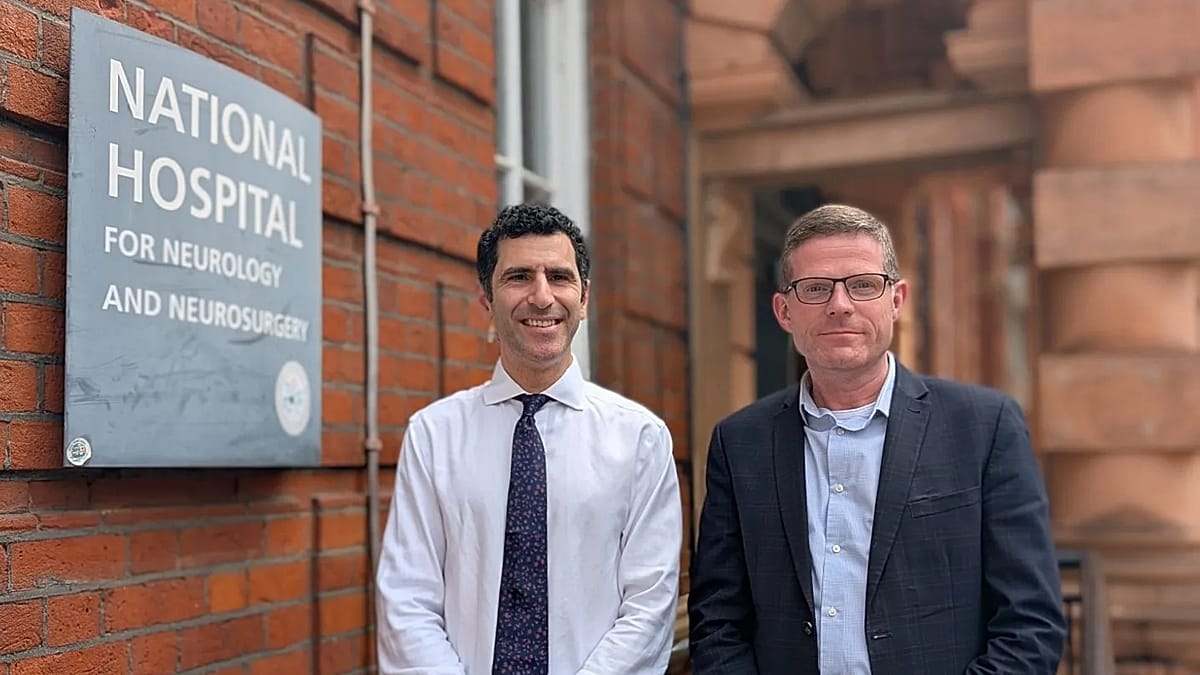
In a world first, surgeons at the National Hospital for Neurology and Neurosurgery in London have used artificial intelligence to guide a live brain operation, saving a patient's sight. The procedure, announced by University College London Hospitals (UCLH) on Thursday, marks a significant step in the use of AI within European medicine.
Rhys Hibbert, a 48-year-old from Bedfordshire, was diagnosed with a brain tumour in December 2024 after collapsing during a walk and suffering a seizure. As his symptoms worsened, he chose surgery and volunteered for the research trial. “If patients are not prepared to join research how can doctors ever learn and how can medicine ever progress?” he said. “Asked if I would be prepared to be the world's first patient to have this technology used live… I said, yes, of course.”
The tumour was located near the pituitary gland, a marble-sized structure at the base of the brain, surrounded by delicate blood vessels and the nerves that control vision. A margin of error of just one millimetre could have led to blindness, stroke, or even death. The AI system, developed in-house at University College London and funded by the National Institute for Health and Care Research (NIHR), analysed the live surgical video feed in real time, rather than relying on pre-operative scans. This allowed the surgical team to identify and avoid high-risk areas while removing as much of the tumour as safely possible.
Hibbert's recovery was remarkable. “When I came round… I could see everything in the room clearly,” he said, noting that his vision had dramatically improved after the operation. The success of the procedure highlights the potential of AI to assist surgeons in complex operations, tracking instruments and tissue interactions to provide real-time feedback.
A new era for surgical precision
This breakthrough is part of a broader trend across Europe, where AI is increasingly being integrated into healthcare. The technology's ability to process live data during surgery could revolutionise how delicate procedures are performed, reducing risks and improving outcomes for patients across the continent. As Europe's peak season for medical innovation continues, the UK's National Health Service is positioning itself at the forefront of this digital transformation.
James Frith, the UK's Health Innovation Minister, praised the achievement: “This is an example of AI at its best: patients getting care previously deemed unimaginable thanks to the latest groundbreaking technology.” His comments reflect a growing confidence in AI's role in medicine, a sentiment echoed by health officials in other European capitals, from Berlin to Paris.
The clinical trial at UCLH is one of several initiatives across Europe exploring AI's potential in surgery. While the technology is still in its early stages, the success of this operation offers a glimpse of a future where AI supports surgeons in real time, making procedures safer and more precise. For patients like Hibbert, who was willing to take a chance on innovation, the benefits are already tangible.
As Europe continues to invest in digital health, the lessons from this London operating theatre could soon be applied in hospitals from Stockholm to Barcelona. The challenge now is to ensure that such breakthroughs are accessible to all, not just a fortunate few. With continued research and collaboration, AI-guided surgery may become a standard part of European healthcare, saving sight and lives across the continent.