From Budapest to Edinburgh, artificial intelligence is leaving its mark on the tattoo industry. Clients are increasingly walking into studios with AI-generated images, while artists are using the technology to refine their own reference material and restore old photographs. The result is a quiet but significant shift in how permanent body art is conceived and created across Europe.
A new tool in the artist's kit
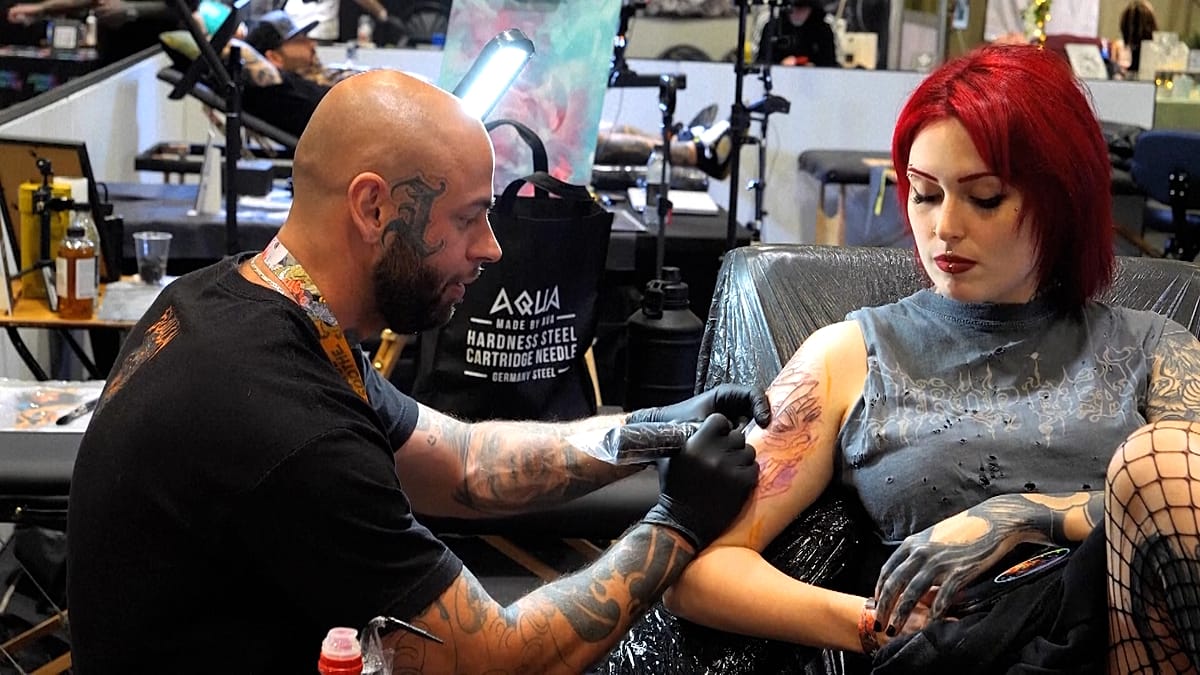
Brigi Fuzes, a Hungarian tattoo artist with a background in fine art, has embraced AI as a creative aid. She uses it to produce reference images that help her visualise designs before they touch skin. “This is also edited with AI. But this is my tattoo. It's not going to look like my reference exactly. Because I want that to look more realistic on the skin than on the photo itself,” she explains. “That's something you do from your head. You can't do that with photos all the time.”
Fuzes estimates that around 70% of her clients now arrive with AI-generated images. Yet she cautions that these images often fail to account for the realities of tattooing. Light, shadow, and fine details that look convincing on a screen may not translate well into ink, or may blur as the tattoo ages. “They think that's something possible on the skin. Like way too detailed. It might not stay in,” she says. “Don't get me wrong, I do love details and my work is known for details, but at the same time, you want to make it right so it's going to last forever.”
In Edinburgh, tattoo artist David Corden views AI as the latest addition to a toolbox that already included software like Photoshop. He uses AI to enhance old or blurry photographs, including pictures of deceased relatives that clients want commemorated in ink. But he is frustrated by the growing assumption that any highly detailed digital artwork must be AI-generated. “You see videos come up on Instagram and somebody's zooming in on an iPad that an artist is working from going, 'Oh, AI image.' No it's not,” he says. “Some artists are better than you can possibly imagine.”
Keeping the human touch
Not all artists are on board. Tiago Miranda of Disturbia Ink, a studio known for dark horror designs, deliberately keeps AI out of his creative process. He works from his own imagination, relying on hundreds of pencil sketches in his books rather than reference photos. For him, the spontaneity of the moment is irreplaceable.
Ellie Diamond, another tattoo artist, is similarly wary. She sees more clients bringing AI-generated mock-ups, but she remains confident in her own craft. “If somebody brings us an idea and they're like, 'I've mocked this up,' I'm like, 'Okay, well, we can take that, but I'm going to draw you something much better than a computer can,'” she says. “Most of the time the best tattoos come out of somebody just saying, 'Here's my idea, I love your work, you do your thing with this idea.'”
The debate comes as tattooing becomes increasingly mainstream across Europe. A 2026 study found that 29% of adults in Sweden aged 20 to 68 have at least one tattoo, while a 2025 study involving more than 111,000 adults in France found that 11.5% were tattooed. The growing popularity has also sparked broader conversations about art and technology, similar to those seen in other creative fields, such as the recent boycott by Portuguese artists over political stances, or the nature-led designs celebrated at architecture festivals.
Can AI replace the tattoo artist?
Veteran tattoo artist Dan Gold does not expect AI to take over his job. His bigger concern is how generative AI systems obtain the material used to train them. “There ought to be some kind of AI tax or something like that,” he says, “because they are using all of this data for free.”
Diamond also remains unconvinced that machines can replicate the human appeal of tattooing. “There's obviously something very innate and human about it,” she says. “So I'm not worried that the machines are going to take over.”
As AI continues to permeate creative industries, the tattoo world offers a microcosm of the broader debate: technology can assist, but it cannot replace the artist's eye, the hand, or the connection with the client. For now, the needle remains firmly in human hands.