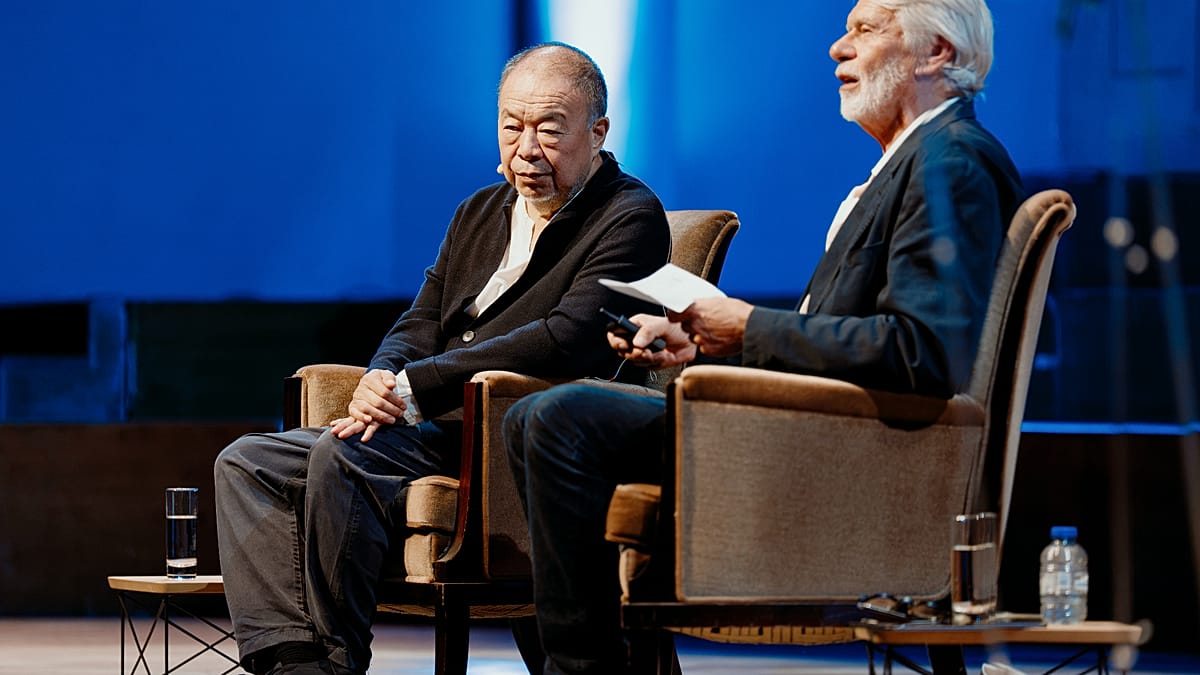
Few artists carry the moral authority of Ai Weiwei. Exiled as a child under Mao, persecuted for exposing the deaths of thousands of schoolchildren in the 2008 Sichuan earthquake, and now living quietly in Portugal's Alentejo, he remains a sharp critic of power—wherever it resides. At 69, his focus has shifted westward, toward the subtle censorship he sees embedded in Western democracies' embrace of artificial intelligence.
"It may be too late to avoid its dangers. We no longer have privacy and when individuals have no privacy they are no longer individuals, but become the perfect product," Ai Weiwei told a packed auditorium at Brussels' Bozar Centre for Fine Arts. The occasion was a conversation with Belgian cultural manager Chris Dercon, of the Fondation Cartier, about his latest book Ai Weiwei on Censorship (Thames & Hudson, 2026).
For Ai, art and political dissent are inseparable. He argues that the greatest threat to citizens in Western societies is not overt repression but self-censorship—the internalized fear of stepping outside accepted norms. When Dercon countered that "here everyone is free to express and think whatever they like," Ai replied: "In reality it is not like that, because there is always a shared agreement guided by authority, by the state, which sets what is correct and acceptable and what is not." He insisted on "the power of the individual" to change unjust realities, since "each of us is different."
Art as a mirror of mass and individual
This respect for difference, often rendered invisible by those in power, runs through Ai's work. In Sunflower Seeds (2010), he filled London's Tate Modern with millions of handcrafted ceramic seeds, each unique yet part of a vast, uniform mass—a meditation on the tension between the individual and the collective. More explicit was Remembering (2009), where he covered the façade of Munich's Haus der Kunst—a building once used by the Nazis to propagate their cultural ideology—with 9,000 school backpacks belonging to children who died in the Sichuan earthquake. The backpacks formed the Chinese phrase: "She lived happily for seven years in this world." The words came from a mother who lost her daughter; Ai had promised to help her share her child's brief joy.
His activism has come at a cost. After denouncing the poor state of school infrastructure in China and the state's secrecy over the earthquake's true death toll, Ai was arrested at 3 a.m. "The police came for me at three in the morning and I realised how weak I was because a single blow knocked me to the ground," he recalled. He showed selfies from the hospital, flipping his middle finger at the camera—a gesture aimed at the Chinese government. He endured more violence, house arrest, and years of passport confiscation.
Asked why his artworks are often either very small or very large, Ai dismissed the distinction as an illusion. "Planet Earth may seem big, but the Earth is so small within the universe that you could not even find it," he said. "Thousands of people have been killed in Uganda; and in Ukraine thousands of soldiers have lost limbs in the war and they may even consider themselves lucky because they are not dead. Compared with all that, what I do with my art is nothing."
The evening was laced with irony, as befits an artist aware of his contradictions. "I have never considered myself a Chinese artist, although my stomach is certainly made for Chinese restaurants," he joked. He recounted how Lego refused to sell him bricks for a political work—"as if that statement were not political in itself."
Reflecting on his life, shaped by his father, the poet Ai Qing, he described himself as "someone with a great curiosity about the human condition, freedom of expression, human rights and artistic creation." He also touched on Belgium's colonial past, noting that "some people are not more civilised because they make others suffer more," a reference to the suffering of Congo under Belgian rule.
Ai Weiwei's autumn retrospective at Bozar, The Art of Defiance, opens this season, cementing Brussels as a focal point for his ongoing dialogue between art and resistance. As Europe grapples with the rise of AI and surveillance, his warnings resonate beyond the art world—a reminder that privacy is the bedrock of individuality, and that losing it may mean losing ourselves. For more on how European security debates are evolving, see NATO's sustainability concerns and threats to democratic institutions.