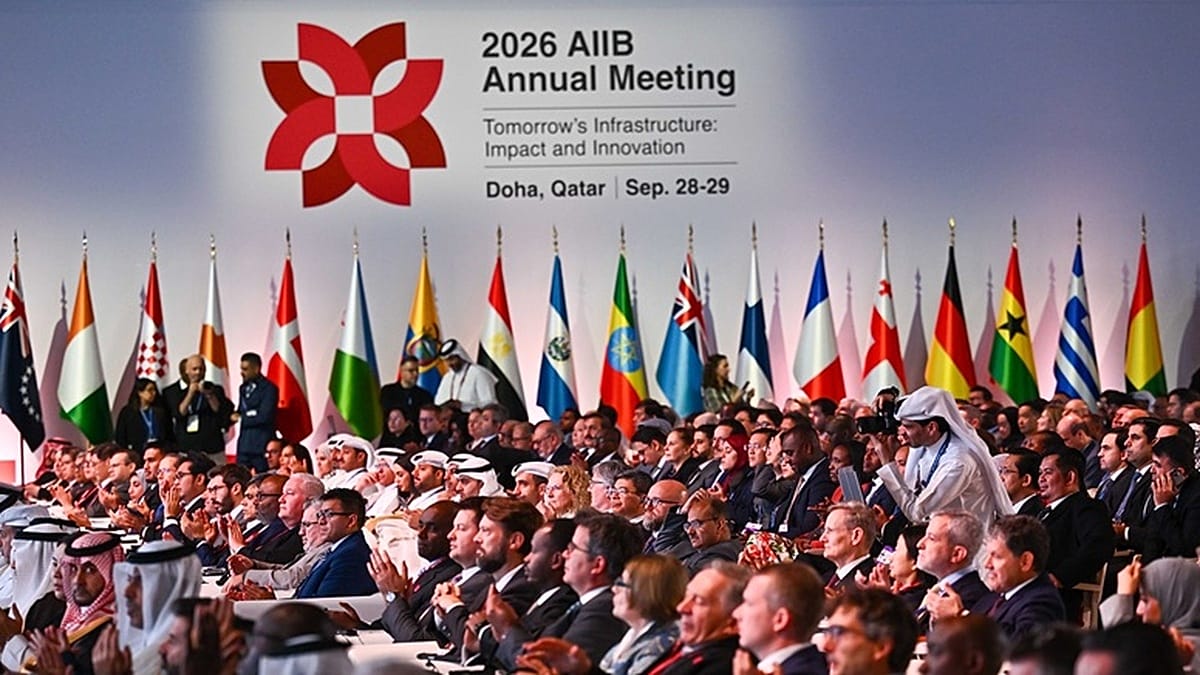
Financing the infrastructure of the future has become a pressing global challenge, as governments strive to meet development goals amid rising demand for climate-resilient and digitally connected systems. At the 11th annual meeting of the Asian Infrastructure Investment Bank (AIIB) in Doha, policymakers, investors, and business leaders gathered to explore how technology, sustainability, and connectivity are reshaping urban and economic development.
In her first annual meeting as president of the Beijing-based institution, Zou Jiayi outlined an ambitious target: to roughly double the bank's annual financing to around €17.6 billion by 2030. The focus will be on areas where the AIIB believes it can add the most value, including climate resilience, renewable energy, digital transformation, regional connectivity, nature conservation, and people-centred development.
“We will focus on infrastructure that supports climate resilience, renewable energy, digital transformation, regional connectivity, nature conservation, and people-centred development. We will leverage modern technology and mobilise private capital. Innovation is how we deliver impact,” Zou said.
In 2025, the AIIB approved €9.4 billion in financing for 57 projects, with 71% of that sum supporting climate-positive outcomes—exceeding its own target. The bank also mobilised €4.3 billion in private capital, underscoring its role as a catalyst for sustainable investment.
Building on multilateralism
The AIIB has deepened its collaboration with other multilateral development banks to pool resources and share expertise. It has established co-financing agreements with the World Bank, the Asian Development Bank, the African Development Bank, and the European Bank for Reconstruction and Development, while also working with major banking institutions across regions. By the end of 2024, 131 of the AIIB's 303 approved projects had been co-financed with other multilateral lenders.
This cooperative model has gained added significance at a time when global trade is becoming more fragmented and protectionist pressures are rising. For the AIIB, cooperation remains central to its mission. “Cooperation is also at the heart of infrastructure. Infrastructure facilitates connections, and building it requires collaboration across borders, institutions, and markets,” Zou added.
Qatar’s role as host and founding member
Qatar, a founding member of the AIIB and host of this year’s meeting, sees itself as an integral part of that effort. Finance Minister Ali bin Ahmed Al Kuwari reaffirmed the Gulf state’s commitment to advancing the bank’s goals, even as the region faces uncertainty. “Qatar comes to these discussions as a founding shareholder, as an investor in infrastructure across Asia and beyond, and as a country that has learned this year how much resilient infrastructure matters,” he said.
Qatar joined the AIIB in 2015, when the institution had just a handful of members. Today, the bank counts 111 approved members worldwide and has a capital base of $100 billion, with a mandate that extends beyond Asia. Its growing portfolio includes projects in Europe, Africa, and the Middle East, reflecting its global ambitions.
Creating impactful change through partnerships
Beyond its role within the AIIB, Qatar has sought to combine development assistance with longer-term investment through the Qatar Fund for Development (QFFD). The fund supports infrastructure, healthcare, and education projects internationally, and believes that institutions like the AIIB can help create partnerships and identify co-investment opportunities while increasing the capital available for sustainable development.
Noora Khalid Mohammed, assistant manager of the investment department at QFFD, explained the broader strategy: “We want to empower them to be development partners and to shift from grants to loans and investment to enable them to grow and generate income and have a more sustainable life, which eventually helps in developing others' lives.”
Infrastructure in action
The AIIB’s strategy is being put into practice across a wide range of projects, from Indonesia to the Maldives, Turkey to Egypt, and Uzbekistan. In 2025 alone, the bank approved financing for climate-resilient roads in the Ivory Coast, a public-private partnership hospital in Kazakhstan, and climate-adaptive water management in Cambodia. These projects illustrate the bank’s commitment to blending innovation with practical, on-the-ground impact.
The 12th annual meeting is scheduled for next year in Baku, Azerbaijan. The Central Asian country is already working with the AIIB on green energy and infrastructure projects, including railway and solar initiatives. As the bank expands its reach, its role in bridging the global infrastructure financing gap will likely grow—particularly as Europe and other regions grapple with the need for modern, sustainable infrastructure.
For European readers, the AIIB’s trajectory is worth watching. The bank’s partnerships with European institutions like the EBRD and its investments in European-adjacent projects signal a deepening transcontinental connection. As Europe’s weakest borrowers face a refinancing crunch, the AIIB’s focus on mobilising private capital could offer lessons for the continent’s own infrastructure financing challenges.