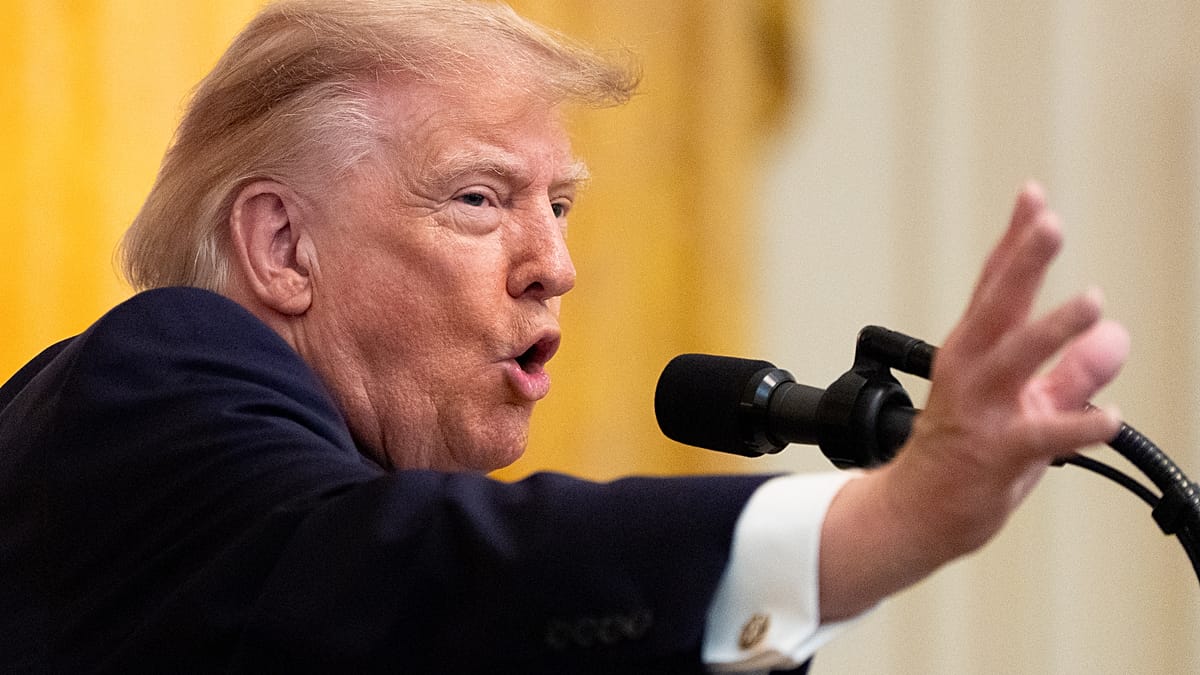
US President Donald Trump has unveiled plans for $200bn (€176bn) of South Korean investment in American energy projects, including a long-mooted liquefied natural gas (LNG) scheme in Alaska. But officials in Seoul have been quick to stress that the deals are not yet final and will hinge on commercial and legal scrutiny.
The announcement, made on Wednesday, covers a $54bn (€47.6bn) contribution to the Alaska LNG project and pipeline, plus a $22.3bn (€19.6bn) gas-fired power plant in Texas. Trump also said the two countries were "moving forward" with a $120bn (€105.7bn) nuclear power programme to build eight large-scale reactors in the United States.
South Korea had already agreed to invest $350bn (€308bn) in the US and increase purchases of American energy under a July 2025 trade deal that set 15% tariffs on South Korean imports. The new projects would build on that framework, but the details remain fluid.
Seoul sets conditions for investment
South Korean President Lee Jae-myung confirmed on Thursday that both sides intended to proceed with the Texas facility, which will have a generating capacity of 6,472 megawatts and supply electricity to data centres in Encinal. The US Commerce Department said the plant is expected to be fully operational by 2032.
However, Lee was more cautious about the Alaska LNG project. "No decision has been made regarding whether to invest in the project or the scale of any potential investment," South Korea's trade ministry said in a statement. Lee added that Seoul would begin work on the project only if it proved commercially viable and complied with South Korean legal procedures.
The caution reflects the complexity of the negotiations. Lee said last month that talks had been "very complex and difficult," and that he had found some terms "difficult to accept" without elaborating.
The nuclear power programme, which includes $100bn (€88.1bn) for construction and $20bn (€17.6bn) in contingency reserves, would also depend on the "commercial viability" of each reactor, Lee said. The trade ministry reiterated that the projects would be "pursued in a manner that serves the national interest."
Alaska pipeline and workforce challenges
The Alaska project, led by New York- and Houston-based developer Glenfarne Group, would involve an 800-mile (1,300-kilometre) pipeline carrying gas from Alaska's North Slope to a liquefaction facility near Anchorage for export to Asia. While Alaska has produced oil for decades, environmental concerns have historically constrained some developments. The Trump administration has largely brushed aside those concerns, cancelling regulations aimed at reducing greenhouse gas emissions.
The expansion of US energy infrastructure faces a potential labour shortfall. The United States needs to fill an estimated 1.7 million skilled-trade vacancies each year through 2035, according to a report released Wednesday by the Alliance for America's Skilled Trades, a group comprising Ford, Blackstone, Nvidia and other large companies. The report found that current training programmes produce just 55 workers for every 100 needed.
For Europe, the scale of these investments underscores the competitive pressure on the continent's own energy transition. As the EU seeks to diversify its energy sources and reduce reliance on Russian gas, the US is aggressively courting Asian capital for fossil fuel projects. The EU energy chief's warning of a harsh winter despite adequate supply highlights the fragility of Europe's energy security.
Meanwhile, the US is also pushing a different regulatory approach to technology and energy, as seen in Trump's voluntary AI accord, which contrasts with Brussels' binding rulebook. This divergence could shape how future energy and tech investments are governed on both sides of the Atlantic.
South Korea's cautious stance is a reminder that even large announced deals can be subject to lengthy review. For European observers, the episode illustrates the growing importance of energy partnerships in a world where supply chains are increasingly politicised.