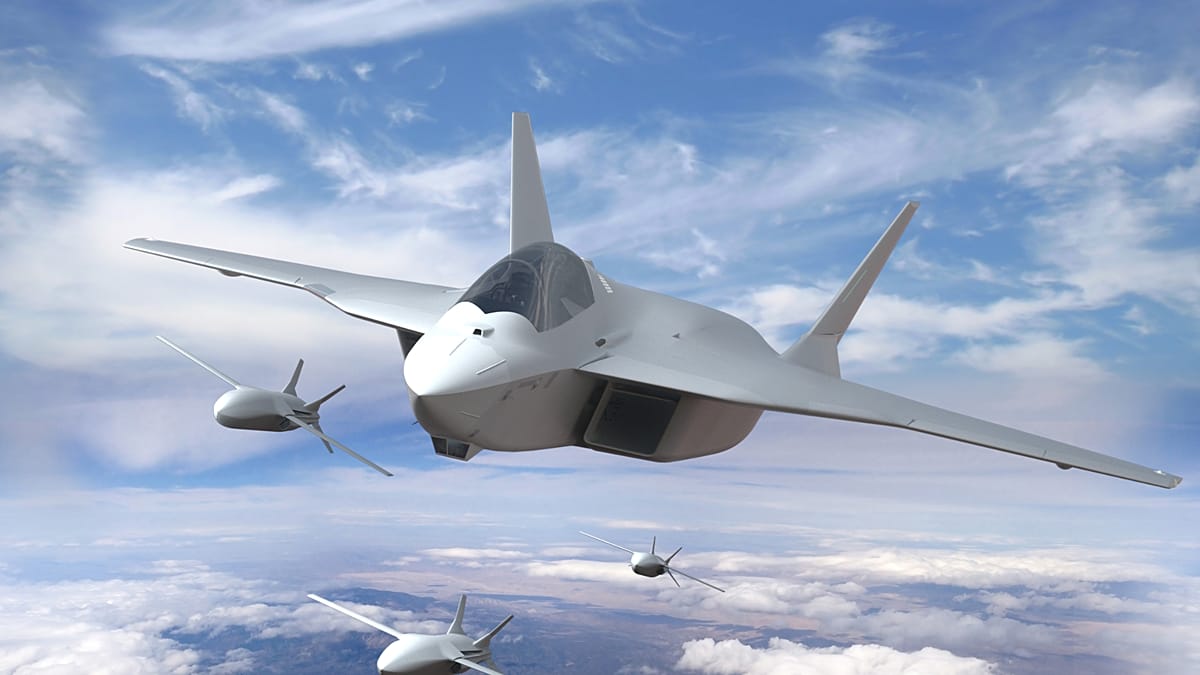
A consortium led by Airbus has proposed developing a next-generation fighter jet after the collapse of the high-profile Franco-German Future Combat Air System (FCAS) programme, one of the companies involved confirmed on Tuesday.
Munich-based defence electronics firm Hensoldt said it had joined forces with Airbus Defence and Space, Autoflug, Diehl Defence, Rohde & Schwarz, Liebherr, MBDA and MTU Aero Engines to draw up an alternative plan. A company spokesperson said the proposal had been submitted to German Defence Minister Boris Pistorius. The Financial Times, which first reported the initiative, said it had also been sent to the office of Chancellor Friedrich Merz.
The companies have “jointly drawn up a position paper on the Future Combat Air System (FCAS) and the associated Next Generation Weapon System (NGWS),” the spokesperson said. More details are expected on Thursday during an announcement at the Berlin ILA Air Show.
A setback for European defence integration
Germany’s defence ministry confirmed the proposal’s existence. Pistorius said Berlin was assessing “which direction we take.” “We’ve also been in discussions on this for months with various stakeholders,” he added.
Pistorius said the collapse of the original Franco-German project had “pained” him. “I know how important Franco-German cooperation is in Europe, but ultimately you have to draw a line between head and heart,” he said.
The FCAS programme had been viewed as a flagship European defence project, aimed at strengthening military cooperation as Europe faces a more assertive Russia and increasingly strained relations with the United States. However, the initiative was hampered by long-running disputes between France’s Dassault Aviation and Airbus, the lead industrial partner for Germany and a major partner for Spain in the FCAS programme. German partners opposed efforts by Dassault to assume greater control over building the aircraft. Merz has also argued that Germany, unlike France, does not require fighter jets capable of carrying nuclear weapons or operating from aircraft carriers.
The collapse of the original project, as reported by European Pulse, underscores the persistent challenges in European defence integration. The new proposal, led by Airbus, aims to fill the void left by the failed Franco-German venture, but it remains unclear whether Paris will participate or pursue its own path.
Germany’s industrial base is heavily invested in the project, with companies like Hensoldt and MTU Aero Engines relying on the programme for future revenue. The alternative plan could also involve other European partners, such as Spain, which was part of the original FCAS framework. However, the absence of France—a key player in European defence—raises questions about the project’s viability and its impact on broader EU defence cooperation.
The timing of the proposal is significant, as Europe grapples with security challenges from Russia and uncertainty over US commitments. The UK, France, and Germany have recently backed direct Ukraine-Russia talks, highlighting the need for a coherent European defence strategy. Yet, the failure of the FCAS project suggests that industrial rivalries and differing national requirements continue to hinder progress.
Pistorius’s comments reflect the delicate balance between national interests and European solidarity. “I know how important Franco-German cooperation is in Europe,” he said, but acknowledged that practical considerations must prevail. The new proposal may offer a way forward, but it also risks deepening divisions if France opts out.
As the Berlin ILA Air Show approaches, all eyes will be on the consortium’s detailed plans. The success of this alternative will depend on whether it can attract broad European support and overcome the industrial disputes that doomed its predecessor.