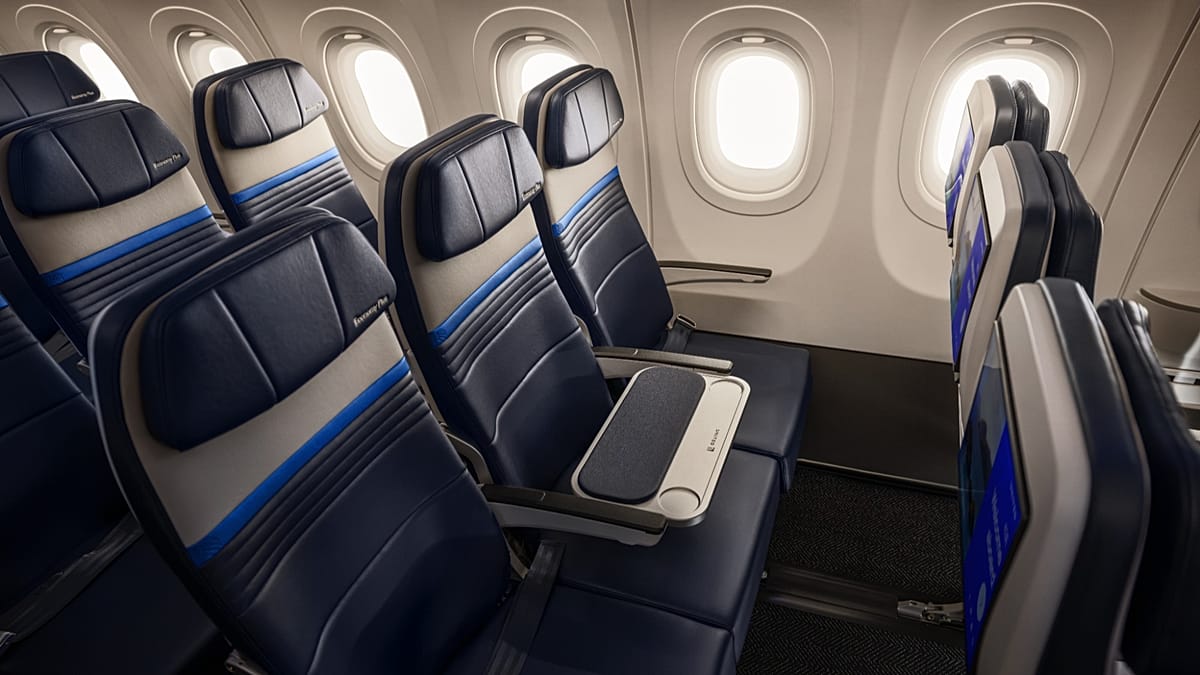
For anyone who has ever squeezed into an economy-class middle seat, the dream is simple: the doors close, and the seat beside you stays empty. That coveted gap between passengers has long been a matter of luck, but airlines are increasingly turning it into a product.
United Airlines this week announced plans to introduce a row in its Economy Plus cabin where the middle seat is replaced by a shared table, giving aisle and window passengers more elbow room. The configuration will debut on United's 50 new Airbus A321XLR aircraft, with the first seats expected to go on sale later this year for flights beginning soon after. The carrier said it expects to be the only US airline offering such rows.
The move follows United's March announcement of a “Relax Row” — launching in 2027 — that will allow economy passengers on some Boeing widebodies to convert a three-seat row into a couch for sleeping or lounging after takeoff.
European airlines already ahead
In Europe, the trend is already well established. Wizz Air and Air France both allow passengers to purchase a neighbour-free seat or an entire row for an additional fee. Lufthansa and Finnair have long offered empty middle seats to business-class travellers. The practice is part of a broader industry push to unbundle services and charge extra for comfort, a strategy that has reshaped air travel over the past decade.
“We're investing nose-to-tail across our fleet and giving customers choice and value in every cabin,” said Andrew Nocella, United's Executive Vice President and Chief Commercial Officer. “The XLR is our newest aircraft and not only offers all-aisle access lie-flat seats in United Polaris but now also includes seats in Economy Plus with extra leg and elbow room. Our customers are going to love all these new options.”
United's announcement comes as airlines worldwide experiment with ways to differentiate economy-class offerings. Delta Air Lines has embraced a strategy of providing what it calls “the best” — not the cheapest — options, while budget carriers like Ryanair and easyJet continue to compete on price.
The empty middle seat is just one of many add-ons that can dramatically change a passenger's experience on the same flight. But for budget-conscious travellers, the proliferation of fees and tiers can feel like a widening gap between the front and back of the plane. Recent EU reforms to air passenger rights have sought to address some of these disparities, but airlines retain wide latitude to price seat selection and extra legroom.
United's new no-middle-seat rows will initially be limited to a single row on each A321XLR, but the airline has suggested it could expand the concept to other aircraft. The A321XLR is a long-range narrowbody that United plans to use on transatlantic routes, potentially connecting European cities like Berlin, Madrid, or Rome with US hubs.
For European travellers, the development is a reminder that the continent's own carriers have been at the forefront of monetising space. The EU Parliament's recent finalisation of air passenger rights — including rules on cabin luggage and delay compensation — has not stopped airlines from introducing new paid options. The empty middle seat, once a random gift of fate, is now a commodity.