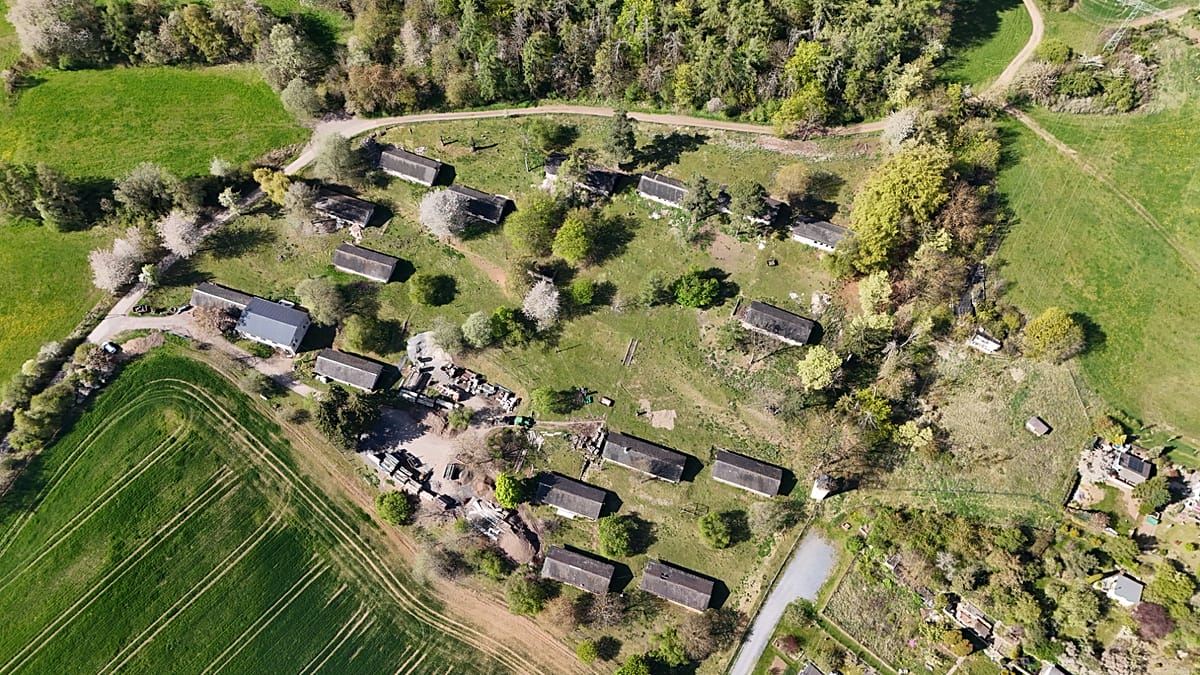
For the price of a modest one-bedroom flat in Munich or Frankfurt, an entire mini-village in the Thuringian countryside is on the market. The asking price for 15 single-storey buildings, a central dining hall, and 24,000 square metres of land near the Hohenwarte reservoir is €390,000. But the bargain comes with a legal tangle that has kept the site empty for years.
A GDR-Era Holiday Camp with a Complicated Past
The complex in Kamsdorf, in the Saalfeld-Rudolstadt district, was built in 1954 as a dormitory for apprentices at the Thuringia steelworks. After 1990, it served as a holiday and recreation centre until the turn of the millennium. From 2000 onward, individual houses were used for residential purposes, with residents officially registered and even receiving housing benefits, according to the current owner, Franz Eberitsch.
Eberitsch, who returned to Germany from New Zealand in 2014, bought the site with a vision: “to create a place where people can live close to nature, experience community and build something new together.” He stripped the buildings back to the shell, connected electricity and mains water, and installed a cesspit for wastewater. But when he sought to carry out more extensive refurbishment, the local authorities informed him that the site’s grandfathered planning status had lapsed.
The Planning Law Catch
The problem lies in German building and planning law. The plot is classified as being in the Außenbereich—land outside the built-up area—even though it lies only about 200 metres from the edge of Kamsdorf. Because the complex was not used between 1990 and 2000, the authorities argue that its original permitted use has expired. Permanent residential use would now require a new local development plan or special planning consent, a process that Eberitsch describes as mired in bureaucracy.
“We were informed that the registrations at the time did not change the planning status and that the grandfathering had already expired due to the long interruption in use,” he told European Pulse. The authorities fear that allowing residential use could create a so-called Splittersiedlung—a scattered settlement in the outer zone—which is generally prohibited under German law.
A Health Village Vision—and a Plea to Elon Musk
Despite the legal hurdles, Eberitsch sees potential for a holistic health and regeneration village, with houses for physiotherapy, osteopathy, naturopathy, and yoga, plus a central community building for seminars and shared meals. The listing notes that all construction work could be carried out by his associated construction company.
Eberitsch argues that the case highlights a fundamental flaw in German planning policy. “Here you have a complete small village with existing buildings and infrastructure. From my point of view, it should be easier, under clear legal conditions, to return such existing complexes to meaningful use,” he said. He wonders whether, given the housing shortage and the need for sustainable reuse, the legal framework should be adapted.
Lacking the initial capital to realise the project himself, Eberitsch has made an unusual appeal: “Perhaps it really does take someone like Elon Musk. If Elon Musk actually reads this article, I would be delighted with seed funding of around one million euros.” In return, he offers the Tesla and X owner a break on his alpaca farm in nearby Unterwellenborn, “should Elon ever need to get his feet back on the ground instead of feeling weightless.”
The listing, available on popular property platforms, calls for “not a buyer of a plot of land, but for someone with a vision who recognises the potential to create something extraordinary here.” Whether that vision will overcome Germany’s planning bureaucracy—or attract the attention of a billionaire—remains to be seen.
For context on how other European countries are tackling housing and land-use challenges, see our coverage of Belgium’s planned road tax for all drivers by 2027 and Germany’s tightening of e-scooter liability rules.