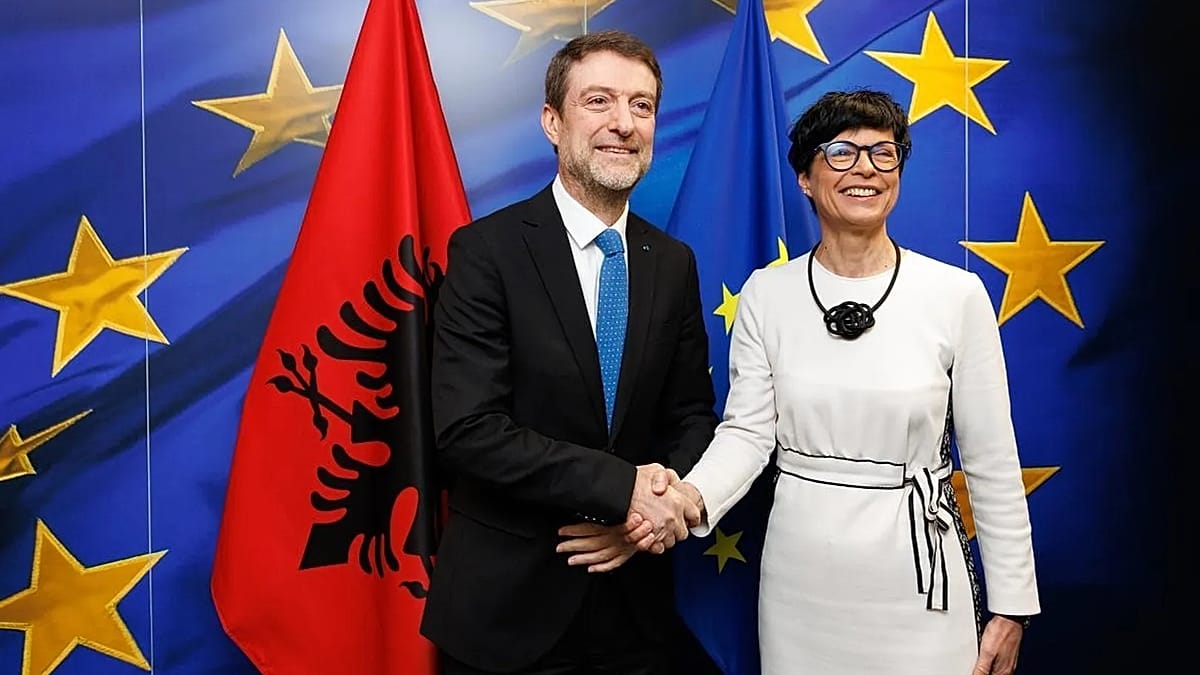
Albania has assured the European Commission that a €1.4 billion luxury tourism project linked to Jared Kushner, former US President Donald Trump’s son-in-law, will undergo a full environmental impact assessment and adhere to EU standards, Enlargement Commissioner Marta Kos stated on Monday.
“We have received assurance from the government of Albania that a full environmental impact assessment will be carried out and that European environmental standards will be respected,” Kos told a press conference in Brussels.
The project, backed by Kushner’s investment firm Affinity Partners, has sparked mass protests in the Western Balkan nation over recent weeks, with demonstrators concerned about its effects on an ecologically protected stretch of the Adriatic coast. Protests have now entered their 14th day, reflecting deep unease among citizens and environmental groups.
EU Accession at Stake
Albania is widely considered the second most advanced candidate for EU membership, trailing only Montenegro. To complete its accession process, Tirana must align its legislation with the EU’s legal framework, including stringent environmental protections. The Commission’s annual progress report last year flagged concerns about a February 2025 amendment to Albanian law that introduced special exemptions for investments worth €50 million or more—a threshold that the Kushner-linked project easily surpasses.
Last week, EU enlargement spokesman Guillaume Mercier warned that Albanian authorities should “act without delay” to avoid jeopardising the country’s membership bid. That statement drew irritation from Tirana, as it seemed to prejudge the outcome of an ongoing environmental assessment. Kos adopted a more conciliatory tone, emphasising that the right to protest is a fundamental liberty for both EU members and aspiring ones.
“The fact that this is happening while Albania is going through the accession process is important. This process is legally and politically binding and subject to constant scrutiny and assessment. So this offers the strongest guarantee that Albania’s nature and environment will be protected in line with the European standards,” she said.
The controversy has also fuelled a wave of misinformation online, with false claims circulating about the scale and nature of the development. Analysts have noted that the project has become a lightning rod for disinformation, complicating public debate.
Kos’s remarks signal a careful balancing act by Brussels: acknowledging Tirana’s assurances while maintaining pressure for full compliance. The Commission will monitor the environmental assessment closely, as any deviation from EU norms could delay Albania’s accession timeline. For now, the Albanian government has pledged transparency, but the protests show no sign of abating, and the political stakes remain high for Prime Minister Edi Rama’s administration.