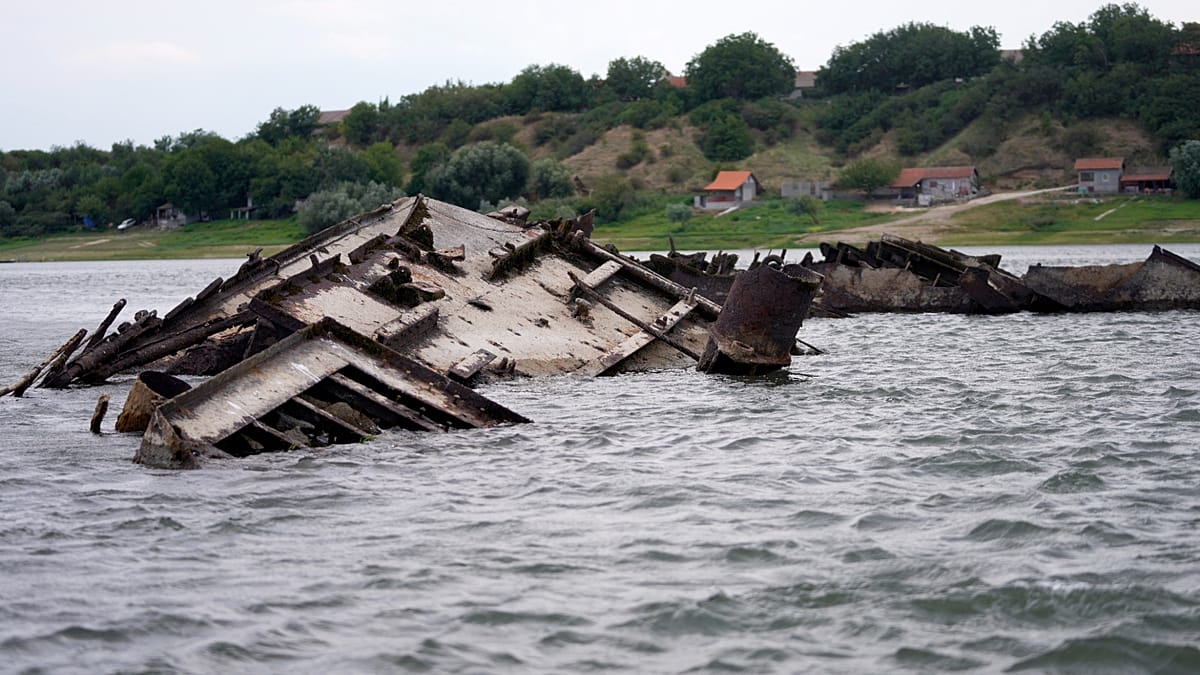
Persistent heat and drought across the Balkans have driven the Danube to historic lows, exposing relics of the Second World War that have lain on the riverbed for eight decades. Near the Serbian town of Prahovo, the skeletal remains of German warships — scuttled by their crews in the autumn of 1944 as the Wehrmacht retreated from the Red Army — are now visible above the waterline. The European Union, through the Western Balkans Investment Framework (WBIF), is financing the removal of the most obstructive wrecks to restore safe navigation on one of Europe's most important inland waterways.
A blockade that never ended
In September 1944, as Soviet forces advanced along the Danube, Hitler's soldiers received orders to deny the enemy any usable military equipment. The Kriegsmarine units operating on the river responded by scuttling their own vessels — warships, tugs, and barges — in the narrow channel near Prahovo. The intention was to create a physical barrier that would slow the Red Army's upstream movement. That barrier, however, has remained in place ever since, obstructing civilian freight traffic and posing a hazard to modern shipping.
According to the European Investment Bank (EIB), which acts as the strategic partner for the WBIF, an estimated 200 wrecks lie on the riverbed in a five-kilometre stretch of the Danube. The first 21 of these — identified as the most dangerous to navigation — are now being hauled ashore. Some were already recovered in 2024, pulled from the mud with ropes and cleared of debris. The work is scheduled for completion by 2028.
“The salvage is complex because some of these vessels may still contain live ammunition,” said an EIB spokesperson. “Divers and pumps are being used to remove sand and silt, but a few wrecks are too large to lift and have been buried deeper to clear the channel.”
Economic and environmental stakes
The economic cost of the wrecks has been significant. Serbia’s then deputy minister for construction, transport and infrastructure, Miodrag Banjac, told the EIB that the debris caused delays in freight transport costing the country an estimated five million euros per year. The Danube is a vital artery for trade between central and southeastern Europe, and any bottleneck disrupts supply chains for industries from agriculture to energy.
The removal project is part of the broader Economic and Investment Plan for the Western Balkans, a 30-billion-euro initiative that aims to modernise infrastructure and shift freight from road to water. In July 2024, the EIB granted a 16-million-euro subsidy specifically for the Danube salvage operation. The hope is that clearing the wrecks will make inland navigation more competitive and reduce the region’s reliance on truck transport, which is both more expensive and more polluting.
Low water levels have become a recurring problem across Europe, affecting not only the Danube but also the Rhine, as we reported earlier this year. Climate projections suggest that such droughts will become more frequent, making the removal of obstacles like the Prahovo wrecks an urgent priority for maintaining trade flows.
Danger beneath the surface
Salvaging armed vessels from the Second World War is inherently risky. The EIB has warned that some of the wrecks may still contain unexploded ordnance, which could detonate during recovery operations. Divers are working with extreme caution, and the larger wrecks that cannot be safely lifted are being buried deeper in the riverbed to prevent them from snagging passing ships.
The wrecks have also become a grim tourist attraction during low-water summers. In August 2022, when the Danube fell to its lowest level in nearly a century, the hulls of the scuttled ships were clearly visible from the riverbanks near Prahovo. Local authorities have since cordoned off the area during salvage work, but the sight of the rusting hulks serves as a stark reminder of the war’s enduring physical legacy.
For Serbia, which remains a candidate for EU membership, the project also carries political weight. The country’s stalled accession process has been a source of tension with Brussels, as we have previously covered. The successful completion of the Danube salvage could demonstrate Serbia’s commitment to European infrastructure standards and regional cooperation.
As the climate continues to warm and river levels drop more frequently, the wrecks of Prahovo are unlikely to remain hidden for long. The EU-backed clearance effort is a practical step toward ensuring that Europe’s waterways remain open for business — and a reminder that even the deepest scars of history can be addressed with coordinated action.