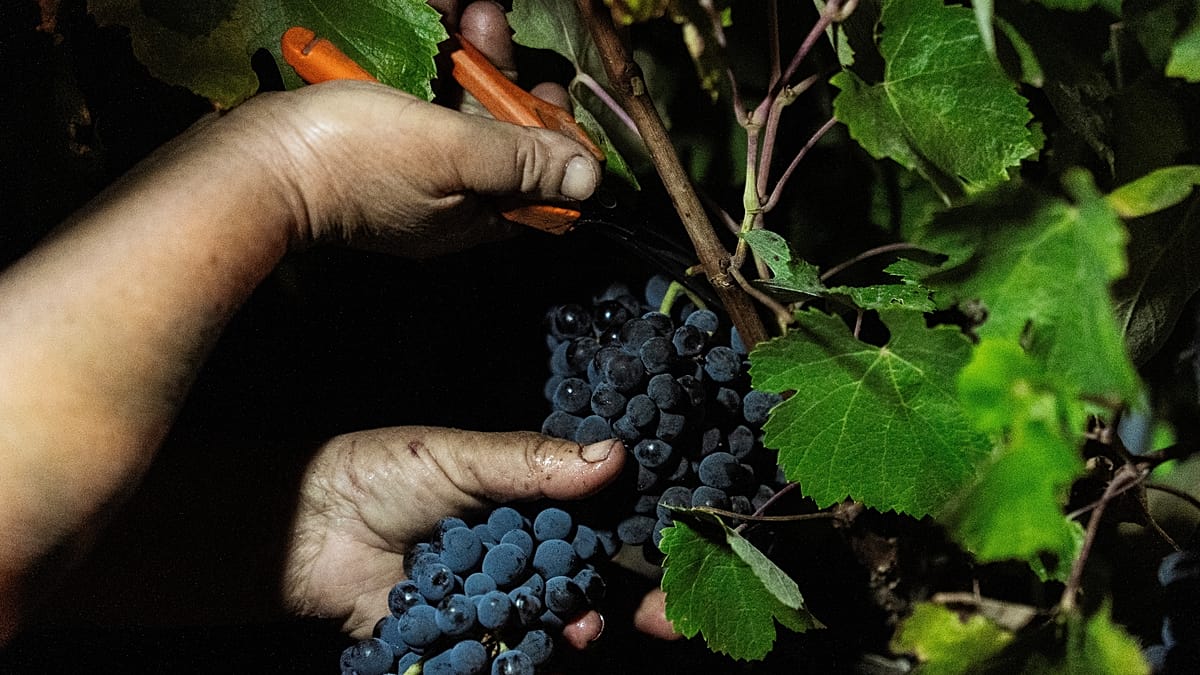
In the pitch-dark vineyards of Herdade das Servas, headlamps and tractor beams sweep across the rows as workers move swiftly between the vines. The estate, located in Portugal's Alentejo region, has shifted its grape harvest to the night — a change that those on the ground say has brought unexpected benefits.
Maria Jerónima Mendes, one of dozens of pickers, told AFP that the switch has not complicated the work. With her headlamp, she says, she actually "sees the grapes better than in daylight." She added: "It sounds like a lie, but it isn't. The body gets used to turning day into night and night into day."
The estate first tested night harvesting in 2024 and adopted it as standard practice last year. The motivation is straightforward: intense heat and increasingly frequent extreme weather events are making daytime work dangerous.
A response to a harsher climate
Renato Neves, a winegrower and oenologist at Herdade das Servas, explained that the night-time harvest "came from the need to provide better working conditions for the teams, because Alentejo has a very harsh climate in summer." For Neves, this is no longer a niche experiment but a necessity.
"In future, it will be inevitable," he said. "In my view, more and more companies will start picking at night, because it is going to become very hard for people to carry on harvesting from 11 am or midday, in temperatures of 40, 41 or 42 degrees."
Alentejo is one of the hottest and driest regions in mainland Portugal. Summer highs of 35 to 38 degrees are common, and during heatwaves — which scientists increasingly link to climate change — the mercury can climb even higher.
The shift is part of a broader adaptation across southern Europe's wine industry. As Portugal's wine regions contend with rising temperatures, producers are rethinking everything from grape varieties to working hours.
Night harvesting also offers practical advantages beyond worker comfort. Grapes picked in the cool of the night arrive at the winery at lower temperatures, which can reduce the need for pre-fermentation cooling and help preserve freshness and aromatics. That has made the practice attractive to quality-focused estates, not just as a safety measure but as a way to improve the final product.
For the workers, the adjustment has been smoother than many expected. Mendes noted that the team has adapted to the inverted schedule, and the cooler conditions make the physical labour more bearable. "The body gets used to it," she said.
Neves believes the trend will spread. "More and more companies will start picking at night," he predicted, pointing to the simple arithmetic of extreme heat. As summers grow hotter, the window for safe daytime work narrows, making the night shift an increasingly logical choice.
The experience at Herdade das Servas offers a glimpse of how European agriculture is responding to climate stress. While the region's winemakers have long prided themselves on tradition, necessity is driving innovation — and the night harvest may soon become as familiar as the vine rows themselves.