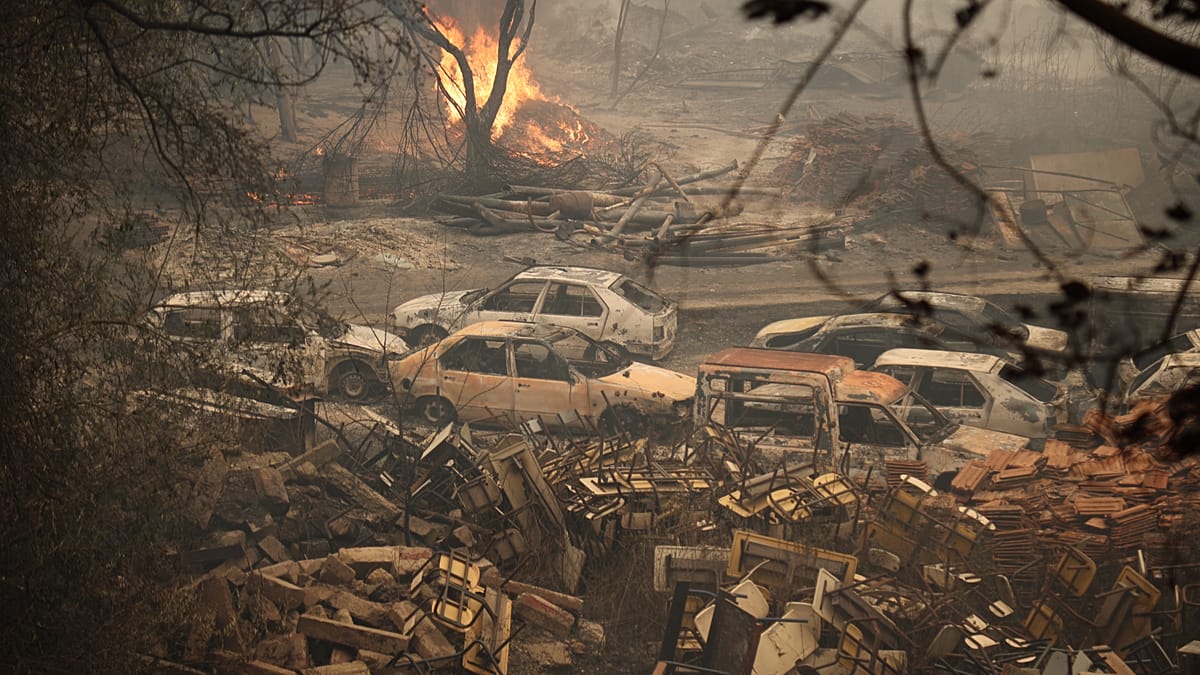
Algeria is in mourning after a series of wildfires tore through the northeastern province of Jijel, roughly 350 kilometres east of the capital Algiers, killing at least 25 people and forcing thousands to flee their homes. The blazes, which began on Monday, have devastated several villages, leaving behind charred forests, destroyed livestock, and a landscape that residents are only now beginning to assess.
Among the dead are 17 soldiers who were deployed to help evacuate residents and fight the flames, according to the Algerian defence ministry. The military said the soldiers died while trying to protect villages from the advancing fire, a tragedy that has deepened the national sense of loss. Civil protection units have also reported casualties among civilians, though the full toll is still being verified.
President Abdelmadjid Tebboune declared three days of national mourning starting Tuesday, a gesture that reflects the scale of the disaster. In a statement, he expressed condolences to the families of the victims and praised the efforts of emergency services. The government has mobilised water-bombing aircraft, including helicopters and planes, to support ground crews battling the flames in rugged, mountainous terrain.
Residents return to ruins
In villages like El Aouana and Ziama Mansouriah, residents have begun returning to find homes reduced to ash and livelihoods wiped out. Many families had fled at short notice as the fire front advanced, leaving behind possessions and animals. Local authorities are now working to restore electricity and clear affected areas, but the scale of the damage is immense.
“We lost everything in a few hours,” said one resident of El Aouana, speaking to local media. “The fire came so fast, we barely had time to grab our documents. Now we have nothing.” Such accounts are echoed across the province, where entire olive groves and cork oak forests—vital to the local economy—have been destroyed.
The wildfires are the latest in a series of climate-related disasters to hit the Mediterranean region. Algeria has experienced increasingly severe fire seasons in recent years, with 2021 seeing devastating blazes that killed dozens. Scientists point to rising temperatures and prolonged droughts as key factors, a trend that is also affecting southern European countries like Greece, Italy, and Spain, which have faced their own deadly fires this summer.
In neighbouring Tunisia, firefighters have also been battling blazes in the northwest, while in Italy, a heatwave has split the nation, with temperatures reaching 44°C in the south and storms in the north, creating conditions conducive to fires. The Mediterranean basin is warming at a rate 20% faster than the global average, according to the UN Environment Programme, making such disasters more frequent and intense.
Algeria’s government has faced criticism in the past for insufficient firefighting resources and prevention measures. In response to the current crisis, the interior ministry has promised compensation for affected families and a review of fire prevention strategies. However, experts argue that long-term investment in forest management and early warning systems is essential to mitigate future risks.
The European Union has offered assistance, with the European Commission’s Emergency Response Coordination Centre saying it is ready to provide support if requested. Algeria has previously accepted EU aid during major fires, and such cooperation could be crucial as the country grapples with the aftermath.
As the fires continue to smoulder, the immediate priority remains containing the blazes and supporting displaced families. But the longer-term challenge is clear: adapting to a hotter, drier climate that is turning the Mediterranean into a fire-prone region. For Algeria, and for its neighbours across the sea, the need for resilience has never been more urgent.