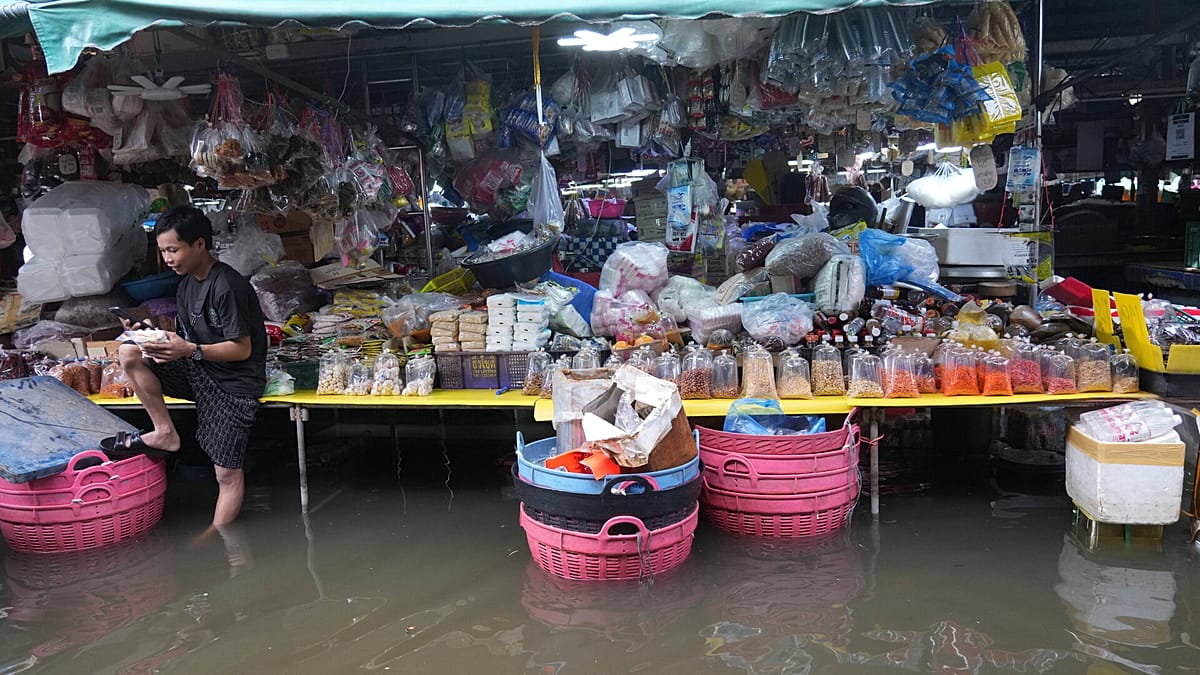
In the low-lying Thai province of Ayutthaya, Kamonchanok Sathaphonamonwut and her family sleep on makeshift platforms inside their home, raised more than three metres above ground. The toilet is waterlogged and unusable. Their village has flooded for six consecutive years, forcing some neighbours to leave and others to lift their houses ever higher.
“Our area simply cannot cope with this much water anymore,” the 34-year-old office worker says, wading through her soaked living space. While authorities prioritise protecting Bangkok and other commercial hubs, “when it comes to our residential communities, they neglect us,” she adds.
Defences that divert disaster
Thailand’s annual monsoon has always brought floods, but scientists say climate change is making heavy rain and inundations more frequent and severe. After catastrophic floods in 2011, the government expanded embankments, water gates and other infrastructure to steer water away from Bangkok, the historic city of Ayutthaya and the industrial zones along the Chao Phraya River.
Those defences have largely kept commercial centres dry, but communities outside the protected zones have been left to fend for themselves. About 20 kilometres from Ayutthaya’s UNESCO-listed temple ruins, residents say floods that once reached their knees now rise above their heads in some areas and can take months to recede. Kamonchanok commutes by boat and hoists appliances above the waterline. “All we can do is deal with the consequences,” she says. “There’s only so much we can do to adapt.”
The cruel cost of protection
Thanet Somboon, a spokesman for Thailand’s irrigation department, says climate change, the region’s low-lying geography and recently built embankments that have altered the Chao Phraya’s natural flow all contribute to more severe flooding downstream. “Even when water is released from the Chao Phraya Dam at the same rate as before, the impact is greater than it used to be,” he explains. Once irrigation channels are full, authorities have “no choice but to discharge the remaining water downstream.” He acknowledges that officials may need to review infrastructure to ensure floodwater stays within intended limits.
Environmental conservationist Sasin Chalermlarp credits the government with doing “an excellent job” managing floods across the central plains, but calls the effort “cruel” to those bearing the brunt. In low-lying riverside districts that serve as flood retention zones, stretches of villages were left underwater this October, with some homes abandoned and others submerged up to their roofs. Sasin notes that floodwater that once spread across much of Ayutthaya is now concentrated in just “five to 10 percent” of the province.
Rising costs of staying dry
As flooding worsens, many residents have paid to raise their stilt houses higher. Kamonchanok’s family lifted their home twice in the 1990s, the second time by 1.5 metres, but water still reached it in 2011 and every year since. Raising a house can cost between 100,000 and one million baht (about €2,700–€27,000), depending on size and height, residents say. Some families have done it twice in just a few years, exhausting savings and taking on debt.
Sawong Raksri, 87, spent more than one million baht (€27,000) to raise her home, but has become resigned. “It floods like this every year recently. What’s the point of complaining?” she says.
A ‘flood-free tax’ and a €700-million canal
Sasin, who lives in a protected part of Ayutthaya, has proposed a “flood-free tax” on those who benefit from the defences to help impacted families raise their homes and repair damage. Thanet says the idea warrants further study on “how to support people who sacrifice their land to accommodate floodwater.”
The government’s flagship solution is a €700-million flood diversion canal, designed to carry 1,200 cubic metres of water per second—about half the volume of an Olympic-size swimming pool—around the bottleneck where the Chao Phraya narrows through Ayutthaya. It is expected to be completed by 2030.
Until then, Kamonchanok says her community is not even demanding an end to intentional flooding, but rather a cap on water levels and financial support for those whose homes sit below the flood line.
This dilemma—protecting economic hubs at the expense of rural communities—is not unique to Thailand. As climate change intensifies, European cities and regions face similar trade-offs. The rising heat and pollution already threaten European health, and energy costs are climbing. The question is whether Europe can learn from Ayutthaya’s experience before making its own hard choices.