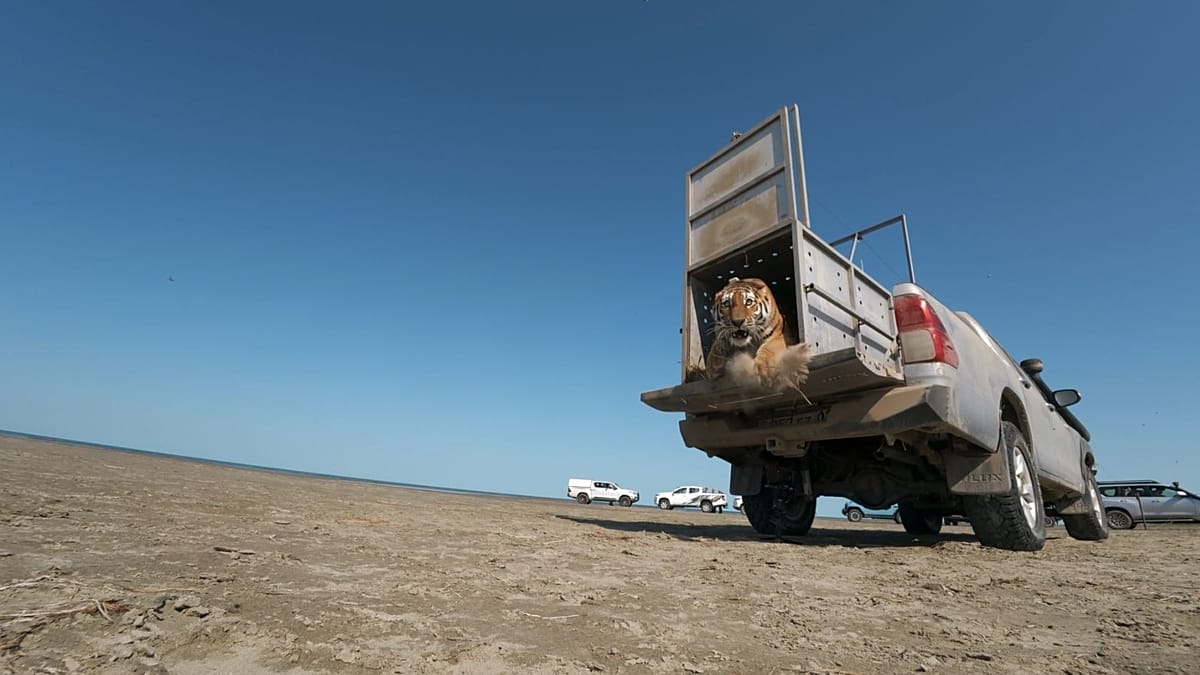
In a quiet corner of southeastern Kazakhstan, a female Amur tiger named Umit stepped out of a transport crate and into the tall reeds of the Ile-Balkhash Nature Reserve. The moment, captured on video, marked the first time in more than 70 years that a tiger has been released into the wild in Central Asia.
The release is the culmination of a long-running effort led by Kazakhstan's government in partnership with the World Wide Fund for Nature (WWF). The project aims to restore a viable tiger population to the region, where the Caspian tiger once roamed before disappearing in the mid-20th century due to hunting and habitat loss.
A historic return
Umit, whose name means "hope" in Kazakh, was born in a wildlife rehabilitation centre in the Netherlands and spent time in a quarantine facility in Kazakhstan before her release. Conservationists fitted her with a GPS collar to monitor her movements and ensure she adapts to her new surroundings.
The Ile-Balkhash reserve, located near the shores of Lake Balkhash, was chosen for its abundant prey, including wild boar and deer, and its extensive reed beds that offer cover. The area has been under protection since 2018, with efforts to restore the ecosystem and boost prey populations ahead of the tigers' arrival.
"This is a historic moment for biodiversity in Central Asia," said a spokesperson for Kazakhstan's Ministry of Ecology and Natural Resources. "The return of the tiger is not just about one animal; it is about restoring the health of an entire ecosystem."
Conservationists caution that the road to a self-sustaining tiger population will be long. Umit is the first of several tigers expected to be released in the coming years. The project's ultimate goal is to establish a breeding population of around 50 tigers in the region by 2035.
The Amur tiger, also known as the Siberian tiger, is the largest cat species in the world. While the Caspian tiger is considered extinct, genetic studies have shown that the Amur tiger is its closest living relative, making it a suitable substitute for rewilding efforts.
Kazakhstan's initiative is part of a broader global push to restore apex predators to their historical ranges. Similar projects have been carried out in Europe, where wolves and lynx have made comebacks in countries like Germany, France, and Spain, often with mixed reactions from local communities.
The release has drawn attention beyond conservation circles. It comes as Kazakhstan seeks to diversify its economy and image, moving from an oil-dependent state to a more modern, environmentally conscious nation. The country has also launched a crypto amnesty to attract digital assets back onshore, signalling a broader shift towards innovation.
For now, Umit's journey will be tracked closely by scientists. Her success will determine whether Kazakhstan can indeed become the first country in Central Asia to bring back the tiger, a symbol of wildness that has been absent for generations.
As one conservationist put it, "The tiger's return is a test of our commitment to nature. If we can make this work, it gives hope for other species on the brink."