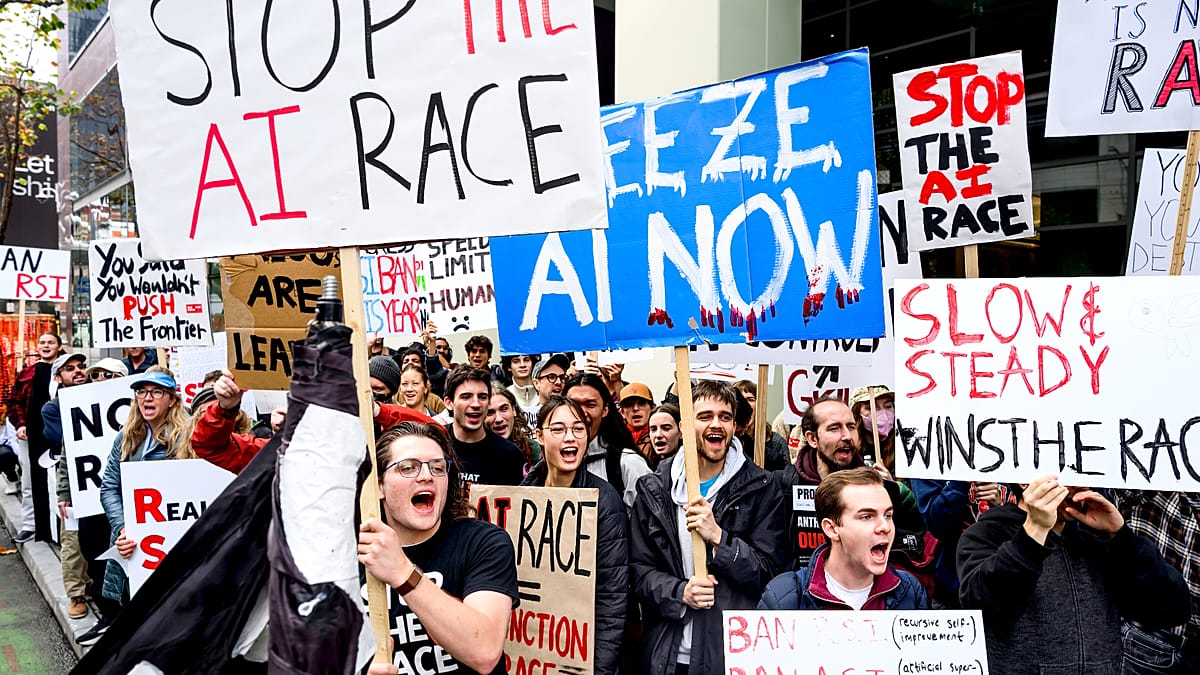
On 19 November 2026, a crowd of protesters assembled outside Anthropic's headquarters in San Francisco, California, to voice their concerns over the rapid expansion of artificial intelligence. The demonstration came just hours after the company's landmark initial public offering (IPO), which valued the firm at $2 trillion and marked one of the largest stock market debuts in history.
The protesters, a coalition of tech workers, academics, and civil society groups, carried signs reading "Humans over algorithms" and "AI needs oversight, not hype." They called on governments, including those in Europe, to implement binding regulations that ensure meaningful human control over AI systems, particularly those used in critical sectors such as healthcare, finance, and public administration.
European dimension
While the protest was held in the United States, its message resonates strongly across the Atlantic. The European Union has been at the forefront of AI regulation with its AI Act, which entered into force in stages starting in 2024. The law imposes strict requirements on high-risk AI applications, including mandatory human oversight. However, many European lawmakers and advocacy groups argue that the current framework does not go far enough, especially as AI capabilities continue to outpace legislation.
In Brussels, MEPs from several political groups have called for an emergency debate on the implications of Anthropic's IPO. They point to the company's global reach and the potential for its technology to be deployed across European markets. "The scale of this listing shows that AI is no longer a niche concern but a systemic force," said one senior EU official, speaking on condition of anonymity. "We need to ensure that European values—human dignity, fundamental rights, and democratic oversight—are embedded in every AI system that operates on our continent."
The protest also echoes a broader unease that has been building in Europe. Earlier this year, the Cambridge Dictionary named 'human' its 2026 Word of the Year, reflecting a growing public anxiety about the erosion of human agency in an increasingly automated world. The choice was widely interpreted as a response to the rapid advancement of generative AI and its impact on employment, privacy, and social trust.
Market reactions and global concerns
Anthropic's IPO was not without its own turbulence. Although the shares surged 34% on the first day of trading, the broader market reaction was mixed. Nvidia, a key AI chip supplier, suffered its worst run since 2008 in the days leading up to the listing, raising questions about the sustainability of the AI boom. Meanwhile, gold and silver prices slid, suggesting that investors were not entirely reassured by the IPO's success.
In Europe, financial regulators are closely monitoring the ripple effects. The European Central Bank has expressed concerns about the concentration of market power in a handful of AI companies, which could pose risks to financial stability. "We are seeing a classic asset bubble dynamic," said a Frankfurt-based economist. "The valuations are staggering, but the underlying technology is still unproven in many real-world applications."
The protest in San Francisco also drew attention to the ethical dimensions of AI development. Anthropic has positioned itself as a "responsible AI" company, but critics argue that its rapid commercialization undermines its stated principles. "They talk about safety, but their business model is built on scaling as fast as possible," said one protester, a former AI researcher. "We need to slow down and think about the consequences before it's too late."
European tech hubs, from Berlin to Paris, have been watching the developments with a mix of fascination and apprehension. Some startups see the IPO as a validation of the AI sector, while others worry about the dominance of American firms. "Europe needs to invest in its own AI champions," said a spokesperson for a French AI consortium. "Otherwise, we will be dependent on companies that are accountable to shareholders, not to citizens."
The protest also highlighted the need for international cooperation on AI governance. The EU has been pushing for a global AI treaty, and the Council of Europe has been working on a framework that would bind signatories to human rights standards. However, progress has been slow, and the gap between technological innovation and regulatory oversight continues to widen.
As the sun set over San Francisco, the demonstrators remained outside Anthropic's offices, their chants echoing into the evening. Their message was clear: the future of AI must be shaped by people, not just by markets. For Europeans, the call is a familiar one—a reminder that the continent's commitment to human-centric technology is more relevant than ever.