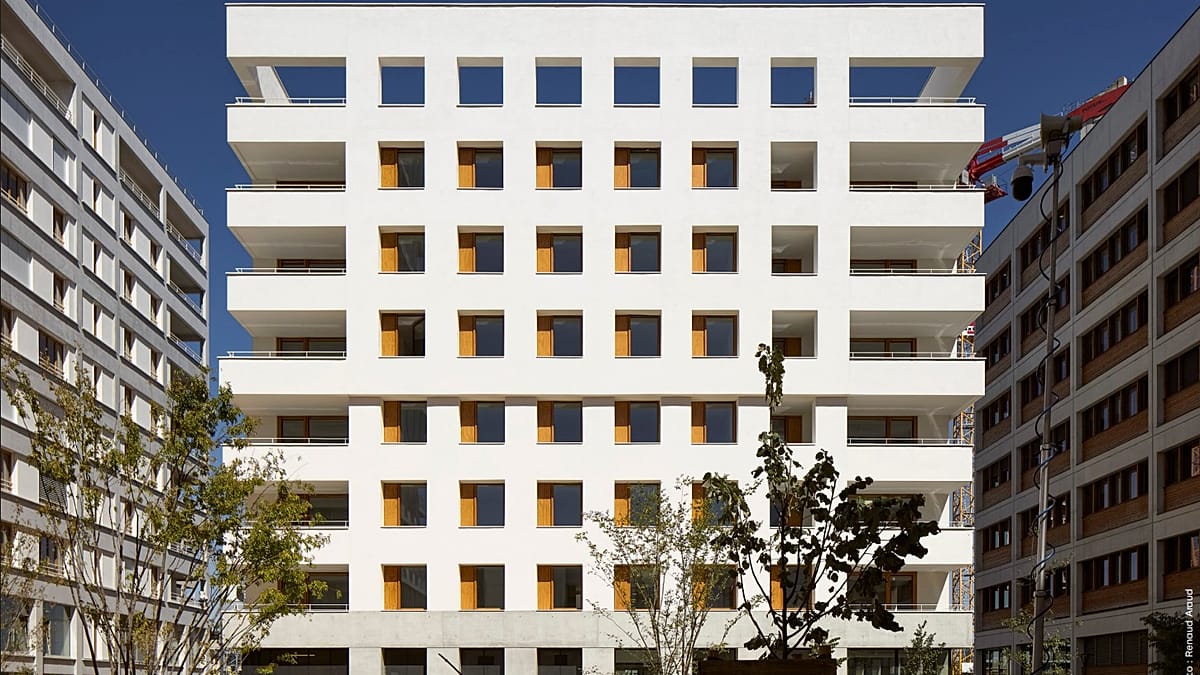
In Lyon's Confluence district, a new apartment block called 'Essentiel' has opened with a bold claim: it needs neither heating nor air conditioning. The building is the first French example of the '2226' method, developed by the Austrian architectural firm Baumschlager Eberle. Astrid Lampl, architect and project director at the firm, describes the approach as deliberately low-tech.
“It's not high-tech, we're talking about a low-tech building,” Lampl told Euronews. “A standard building with a suspended ceiling, mechanical ventilation systems, etc. – that’s high-tech; 2226 doesn't have all that.”
The name refers to the comfortable temperature range of 22 to 26°C that the building maintains passively. Instead of relying on energy-hungry systems, the structure itself does the work. Very high insulation, thick walls, and careful orientation allow the interior to be warmed by sunlight and by the heat given off by residents and their daily activities.
Building as a thermal battery
2226 projects are designed to minimise technical installations. The building envelope replaces central heating and cooling. Lampl explains that since 2020, the firm has focused on using heavy materials that can store heat. “Thick walls will provide protection from the heat in summer and retain the heat in winter,” she said.
In Lyon, the team chose a double brick wall because the production plants were nearby, reducing transport emissions and supporting local industry. The only high-tech element is a home automation system with sensors inside and outside each apartment that monitor temperature, humidity, air quality, and weather. Wooden slats on every window open and close automatically to create airflow.
Lampl is not a fan of filtered air in offices and homes. “I find it very pleasant to have fresh air that doesn’t pass through ventilation systems,” she says. Residents have responded positively, noting that the natural ventilation makes the space feel better.
The wooden vents also help regulate CO2 levels and are particularly useful during heatwaves. A weather station on the roof detects cooler night air and opens the vents automatically, so residents don’t have to wake up at 4 am to open windows. This system only works because of the building's thermal insulation; in a standard block, it would be far less effective.
In summer, the thick walls keep the interior cool, and the vents open as little as possible during extreme heat, maintaining a stable temperature. Ceiling fans provide additional cooling, making the air feel up to 5°C cooler, according to Lampl.
Cost considerations and future projects
The Lyon building cost about 15% more than conventional housing, a premium that Lampl attributes to local regulations. The project was required to connect to the city's heating system and to install a reversible dual-flow mechanical ventilation system, which added expense. “I’ve heard some people say that Building 2226 is too expensive, but I don’t believe that,” she said.
She points to a forthcoming project in La Garenne-Colombes, west of Paris, where central heating was not mandatory. There, the firm could install cheaper electric radiators that will rarely be used, and the additional cost was negligible. That project, with 80 housing units, is expected to be completed by the end of 2028.
The 2226 method is part of a broader movement in European architecture toward passive design and energy efficiency. As Europe grapples with unaffordable heating costs for millions, buildings that require almost no energy for climate control offer a compelling alternative. While the initial investment can be higher, the long-term savings and environmental benefits are significant.
Lampl believes the method is scalable, especially in regions with moderate climates. “We’ve had a lot of questions about the automatic opening,” she says, but the system is simple and robust. The key is to design with the local climate and materials in mind, as they did in Lyon.
As Europe pushes for greener construction and innovative materials, the 2226 approach shows that sometimes the best technology is no technology at all.