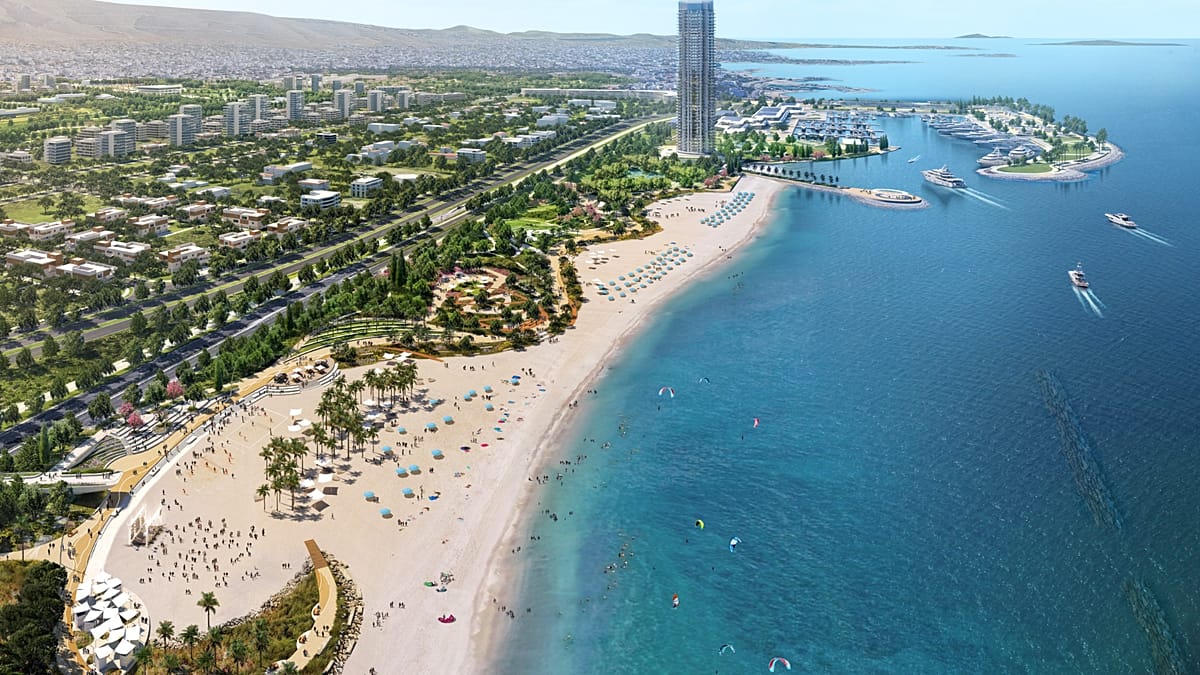
Athens is set to gain a vast new green lung as the city's former international airport makes way for one of Europe's most ambitious urban regeneration projects. The Ellinikon Park, located in the southern suburb of Elliniko, will cover 200 hectares and is scheduled to open to the public in early 2027, with further infrastructure completed by 2030.
Once fully developed, the park will boast more than 30,000 trees and around three million shrubs, with greenery covering 70 per cent of its area. This makes it the largest coastal urban park in Europe, surpassing other notable green spaces such as London's Richmond Park and Munich's Englischer Garten.
Designing for a cooler, more resilient city
The park's design goes beyond aesthetics, integrating advanced environmental engineering to combat the urban heat island effect. Digital simulations, including thermal mapping and computational fluid dynamics, have been used to plan shaded areas and airflow corridors. A network of "cool routes" is planned, where temperatures could be up to four degrees Celsius lower than in surrounding asphalt-heavy neighbourhoods.
Rest areas are designed with a shading ratio exceeding 60 per cent, while vegetation is selected to enhance evapotranspiration, naturally cooling the air. Water features—such as channels, misting systems, and low-consumption basins—are woven into the landscape to provide evaporative cooling.
The park's paths will be integrated into the natural terrain, creating a unified, accessible system with continuous shade. Individual trails will be embedded in vegetation, offering pockets of microclimatic protection and a play of light and shadow.
Smart water management for heatwaves
Water sustainability is a core pillar of the project. A tertiary wastewater treatment unit will produce up to 7,000 cubic metres of treated water per day, supplying all non-potable uses, including irrigation. A storage tank with a capacity of 10,000 cubic metres will hold irrigation water, bolstering the park's resilience during periods of intense heat stress.
A "smart" irrigation system, fed by weather and soil sensors, will adjust water volumes precisely to the needs of the vegetation, potentially saving up to 90 per cent of water compared to conventional methods. Rainwater will be managed entirely on site through green and blue infrastructure, and the restoration of the Trachones stream will aid flood protection.
The park will feature more than 520 species of flora, with around three-quarters being native or well-adapted species. This biodiversity will support local ecosystems and reduce maintenance needs.
Local materials, global inspiration
Construction will use Greek natural materials, including Kavala marble, white Dionysos-Penteli marble, Karystos slate, and Mandras sandstone. These choices not only ensure durability and thermal comfort but also help the park blend harmoniously into the Attic landscape. Materials salvaged from the former airport facilities will be repurposed—concrete slabs for retaining walls and crushed aggregates for gabions—reducing the project's environmental footprint.
The park is the subject of a guide to sustainable park design authored by landscape architect Dimitra Theochari and Lenio Myrivili, the UNEP Global Chief Heat Officer and Special Advisor for Climate Resilience. The study uses The Ellinikon Park as a model for how urban green spaces can be designed and operated to address the environmental challenges of modern cities.
As Europe grapples with rising temperatures and more frequent heatwaves, projects like this offer a blueprint for integrating nature-based solutions into urban planning. The Ellinikon Park is not just a leisure space but a piece of critical infrastructure, demonstrating how cities can adapt to a changing climate.
With its opening still a few years away, the park is already generating interest as a potential model for other European cities. Its scale and ambition place it among the most significant urban regeneration projects worldwide, and its success could influence future developments across the continent.