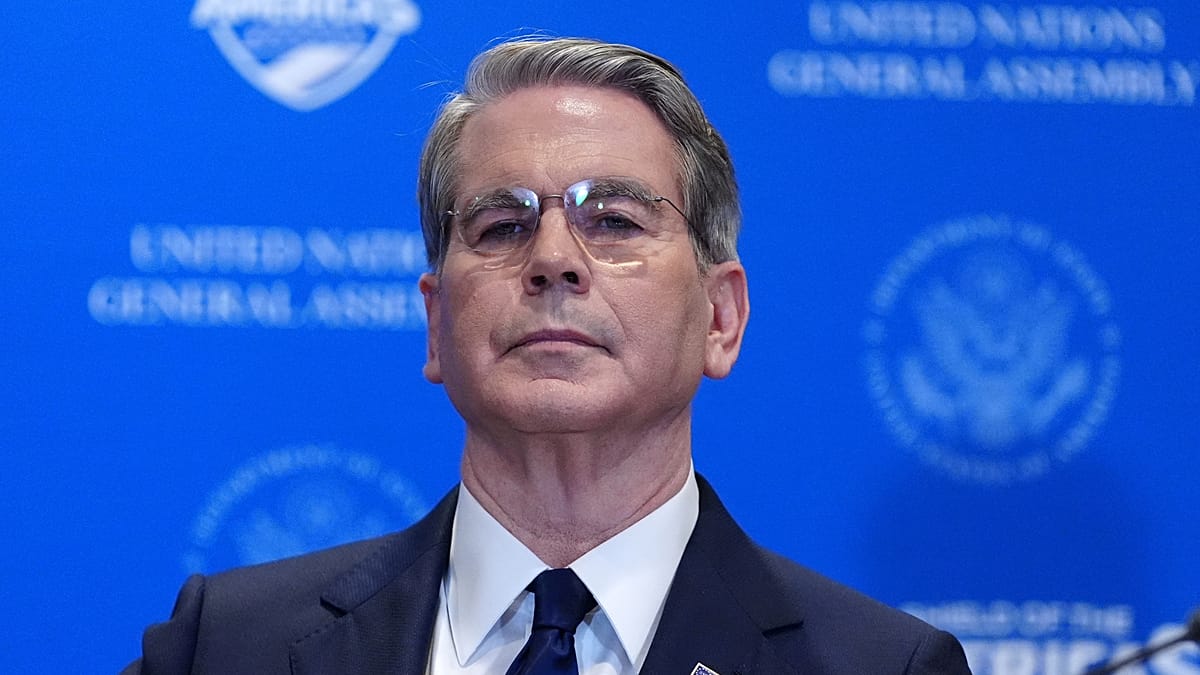
The US Treasury Department has imposed a $1.2 billion (€1.07bn) penalty on Bank of America for systemic failures in its anti-money laundering controls, marking one of the largest enforcement actions of its kind. The bank also agreed to a separate $11.6 million (€9.9mn) settlement with the Treasury's Office of Foreign Assets Control over apparent violations of sanctions programs targeting Iran, Russia, narcotics trafficking, and global terrorism.
Treasury Secretary Scott Bessent framed the action as a warning to the entire financial sector. "When a bank of this size fails to meet its anti-money laundering and sanctions obligations, the consequences extend far beyond its own walls, exposing the entire U.S. financial system to significant illicit finance risks," he said. "Today's actions send a clear message that even the biggest financial institutions are not above the law."
The penalty, announced on Tuesday, stems from the bank's failure to report more than $5 billion (€4.27bn) in suspicious transactions in a timely manner, including over $1 billion (€853mn) linked to national security risks. The Treasury's Financial Crimes Enforcement Network (FinCEN) identified gaps in the bank's monitoring of Chinese money laundering networks and illicit finance flows along the US southwest border.
Bank of America, the second-largest US bank by assets, admitted that it "willfully violated" the Bank Secrecy Act of 1970, which requires financial institutions to assist government agencies in detecting and preventing money laundering. The penalty includes a $750 million (€640mn) fine from the Office of the Comptroller of the Currency (OCC), the largest ever levied by that federal banking regulator.
European implications of a US enforcement action
While the case is centred on US regulation, its ripple effects extend across the Atlantic. European banks and financial institutions that maintain correspondent relationships with Bank of America—or that operate in the same international corridors—will be watching closely. The sanctions violations involving Iran and Russia are particularly relevant for European compliance teams, given the EU's own sanctions regimes and the ongoing scrutiny of Russian money flows since the full-scale invasion of Ukraine.
The action also underscores a broader transatlantic trend: regulators on both sides of the ocean are tightening the screws on financial crime compliance. In Europe, the EU has been pushing forward with its anti-money laundering package, including a new authority (AMLA) set to begin operations in Frankfurt. The Bank of America case serves as a reminder that even the most sophisticated institutions can fall short, and that the cost of non-compliance is rising.
Bank of America responded with a statement acknowledging the penalties and emphasising its remediation efforts. "Financial crime compliance is serious, and we are responsible for getting it right," the bank said. "We have invested billions of dollars in technology and dedicated thousands of employees to combat financial crime, and our team is far along with and committed to completing the work required to address the issues raised by our regulators."
The bank noted that the penalties relate to violations cited in a previously reported 2024 consent order from the OCC and FinCEN's investigation. It said it had cooperated with regulators to reach the resolutions.
This enforcement action is the third-largest ever issued by the US Treasury, trailing only the roughly $4 billion (€3.41bn) settlement with Binance in 2023 and the approximately $3 billion (€2.56bn) settlement with Canada's TD Bank in 2024. Both of those cases were part of a broader US push to combat money laundering, which also targeted the cryptocurrency industry. In 2024, Binance founder Changpeng Zhao was sentenced to four months in prison after pleading guilty to failing to prevent money laundering on the platform, which prosecutors said had been used to move funds linked to child sex abuse, drug trafficking, and terrorism. US President Donald Trump pardoned Zhao in October 2025.
For European readers, the case highlights the importance of robust financial oversight in a globalised economy. As the EU strengthens its own anti-money laundering framework, the lessons from Bank of America's failures—and the scale of the penalty—are likely to inform regulatory expectations on both sides of the Atlantic. The EU's recent moves to support Ukraine and its sanctions against Russia make the sanctions angle particularly pertinent for European compliance officers.
The Treasury's action also comes at a time when US foreign policy is shifting, and European banks are reassessing their exposure to US sanctions enforcement. The message is clear: financial crime compliance is not a box-ticking exercise, and the consequences of failure are severe.