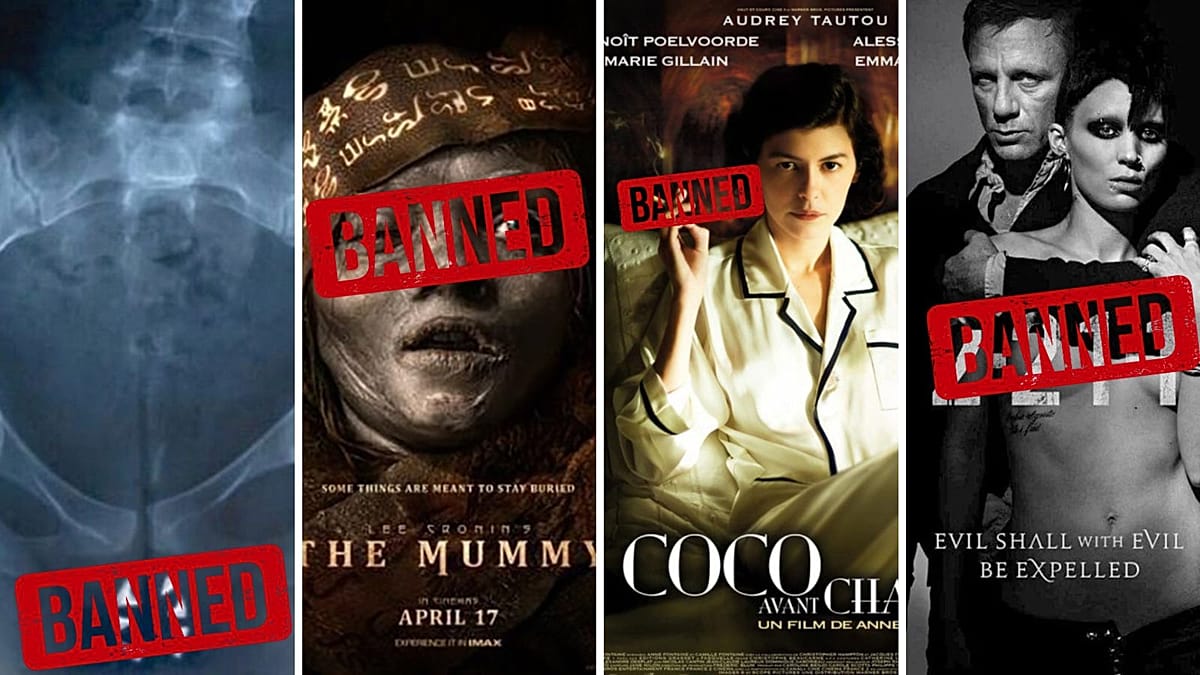
Movie marketing is a delicate art. A poster can make a film iconic or spark a backlash that overshadows the release. The latest example is Lee Cronin's The Mummy, whose poster has been pulled from the London Underground after the UK's Advertising Standards Authority (ASA) received multiple complaints.
The ASA ruled that the close-up of a mummified child, with its “sunken and lifeless” features, gave a “realistic impression of a dead child.” The poster must not appear again in its current form. For some, the ban was appropriate; for others, it misses the point of a supernatural horror film where the girl is successfully revived.
This is not the first time a movie poster has been censored. Since 2000, several films have faced bans or modifications, often for graphic imagery, sexual content, or political sensitivity. Here is a chronological look at some of the most controversial.
Post-9/11 Sensitivity and Offensive Comedy
Sam Raimi's Spider-Man (2002) originally featured the Twin Towers in its teaser poster. After the September 11 attacks, Sony Pictures withdrew the material and replaced the towers with other New York landmarks.
Sacha Baron Cohen's Ali G Indahouse (2002) faced complaints over its poster, which showed the comedian in a suggestive pose with a woman. The ASA deemed it offensive and pornographic, ruling against the ad.
In contrast, the poster for The Rules of Attraction (2002), which featured stuffed animals in suggestive poses, was banned in the US by the MPAA but kept in the UK and other European territories, where it was seen as a joke.
Horror and Gore: When Posters Go Too Far
Horror films often push boundaries. Creep (2004) showed a bloodied hand emerging from a London Underground carriage, which Transport for London refused to display. Saw II (2005) had its poster rejected by the MPAA for showing severed fingers; a revised version made the amputation less explicit.
The documentary This Film Is Not Yet Rated (2006), about censorship in cinema, ironically had its own poster vetoed by several US newspapers. The Road to Guantanamo (2006), about the “Tipton Three” held at Guantanamo Bay, was banned by the MPAA because the burlap sack over a detainee's head suggested torture—a decision some saw as hypocritical.
Teeth (2007), a comedy horror about vagina dentata, used an X-ray of the lead character revealing a hidden set of teeth. The image was deemed too disturbing by authorities in the US and UK, and the poster was banned.
In 2009, South Korea's Five Senses of Eros, an anthology about love and lust, made history as the first movie poster banned in that country.
These cases show that movie posters can be as controversial as the films they promote. While some bans are seen as overreach, others reflect genuine public concern. As research on mummies continues to reveal historical truths, the debate over what is acceptable in public advertising is likely to persist.