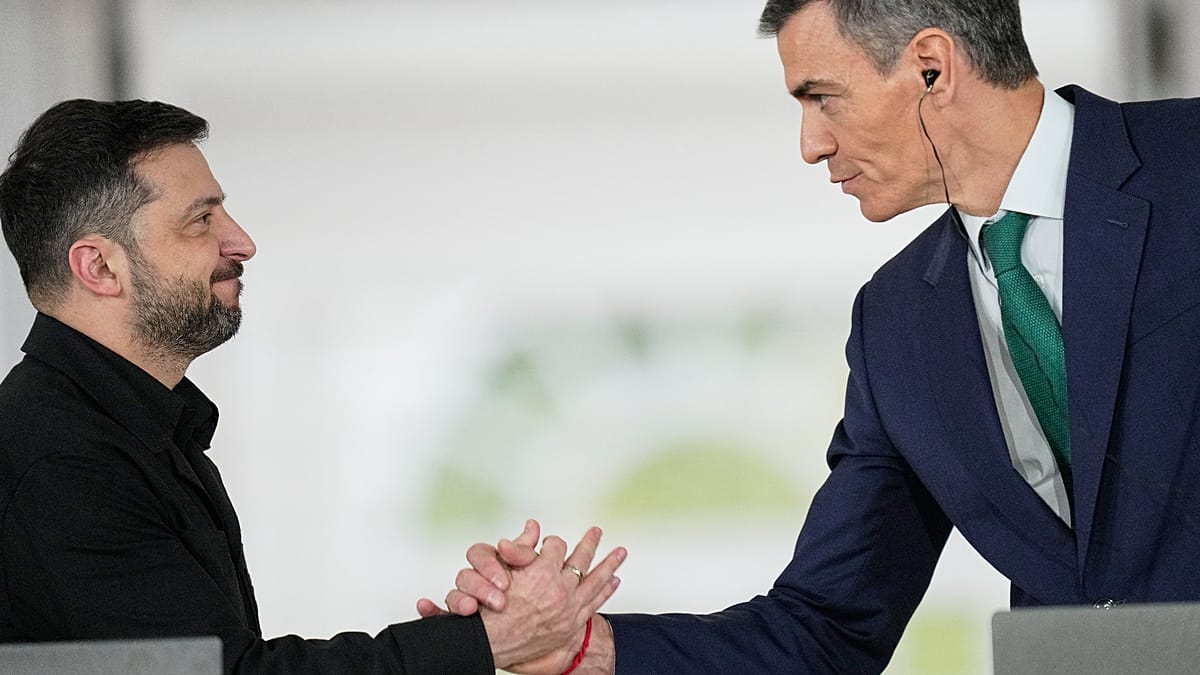
Ukrainian President Volodymyr Zelenskyy landed in Madrid on Wednesday for an unannounced visit, his schedule kept under wraps until the plane touched down. The trip coincides with the Ibero-American Summit, offering Kyiv a rare chance to court Latin American leaders who have been divided over Russia's full-scale invasion.
On Thursday, Zelenskyy is set to join a meeting with several heads of state and international officials gathered in the Spanish capital, including UN Secretary-General António Guterres and European Council President António Costa. He will also hold bilateral talks with Spain's Prime Minister Pedro Sánchez and meet King Felipe VI.
For Ukraine, the summit is an opportunity to strengthen ties with a region where the war has sparked contrasting reactions. According to Spanish government sources, Zelenskyy plans to hold one-on-one meetings with representatives of several of the 22 Ibero-American delegations present in Madrid.
Air defenses and cooperation at the top of the agenda
Confirming his arrival on social media, Zelenskyy said: "Our top priority is strengthening Ukraine's air defences, protecting our people, and expanding defence cooperation and production." He added that "further support steps are being prepared," without specifying which leaders he would meet or what measures were in the pipeline.
The Ukrainian leader's presence adds a geopolitical layer to a summit already marked by political tensions. Among the Latin American presidents in Madrid are Argentina's Javier Milei and Chile's José Antonio Kast, both far-right figures, as well as Bolivia's conservative Rodrigo Paz. Milei, who has made several unofficial trips to Spain since taking office in 2023, has never met Sánchez; instead, he has backed the conservative and far-right opposition and repeatedly attacked socialism. Two weeks ago, during a visit to Madrid, he called Sánchez a "disgraceful dictator" and urged Spaniards to "kick out" his Socialists in the next election.
The Ibero-American format has lost influence in recent years, and reversing that decline is a central goal of this 30th summit. At the previous gathering in Ecuador in 2024, only four heads of state showed up, and participants failed to adopt a final declaration. This year, seven Latin American presidents are attending, reflecting the region's recent shift to the right after a wave of electoral victories for allies of Donald Trump.
For Sánchez, the absence of his leftist allies from the region's largest economies complicates the picture. Mexican President Claudia Sheinbaum and Brazil's Luiz Inácio Lula da Silva, who was re-elected last year, are both staying away.
King Felipe VI: Open economies over protectionism
Against a backdrop of economic uncertainty and international tensions, King Felipe VI used the summit to argue for open markets. "The best response does not lie in protectionism, but in an open economy based on equal rules for everyone," he told Ibero-American business leaders in Madrid. He rejected the idea of closing off national economies or raising trade barriers, instead advocating greater cooperation between countries that share values and objectives.
The Spanish monarch highlighted Ibero-America's potential as a space to deepen ties and generate new economic opportunities, pointing to the region's significant energy resources and strategic raw materials, including critical minerals and rare earths. To capitalize on these, he stressed the need for "stable environments, legal certainty and solid, transparent institutions." He added: "Trust is one of our most valuable assets and, allow me to say, also one of those we can most easily lose."
Felipe VI also called for closer ties between the European Union and Latin America and the Caribbean, a relationship he described as essential for tackling today's economic challenges and seizing opportunities in a rapidly changing international landscape.
Spain downplays absences
Foreign Minister José Manuel Albares sought to play down the empty seats. "It is absolutely not a forum in decline," he insisted on Wednesday before a meeting of foreign ministers. He argued that all 22 countries have representation in Madrid, at least at ministerial level, and that those not attending either rarely travel or face internal problems that prevent them from being away for several days.
Besides Lula and Sheinbaum, Venezuela's Delcy Rodríguez is also absent, leaving Sánchez without several of his closest ideological allies. Instead, he finds himself alongside Kast and Milei, at the opposite end of the political spectrum. Albares chose to look back: only three heads of state attended the Cuenca meeting in 2024, and compared with that, ten seems a success.
Zelenskyy's visit comes as European allies continue to discuss long-term support for Ukraine, including reconstruction efforts and security guarantees. The Ukrainian president's push for stronger air defenses is likely to feature in his conversations with Spanish and Latin American leaders, even as the region's political landscape shifts.