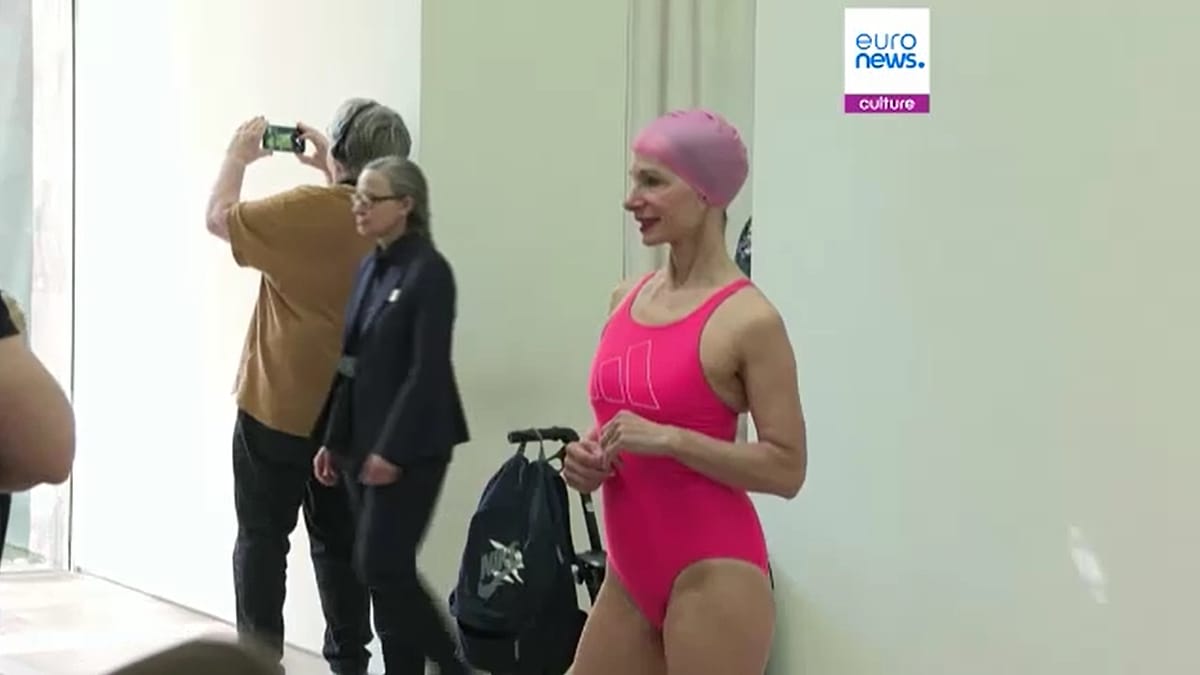
On a sunny May Day, the Fondation Beyeler near Basel turned its galleries into a stage for playful rebellion. Visitors who arrived in bikinis, swimming trunks, or one-piece suits were granted free admission to the museum’s current exhibition of works by the French post-impressionist Paul Cézanne. The entrance fee of 25 Swiss francs (around €27) was waived for anyone bold enough to come in swimwear.
The event, dubbed the “Day of the Bathers,” was conceived by the renowned Italian artist Maurizio Cattelan. It was designed to complement the museum’s exhibition of Cézanne’s famous series The Bathers, which depicts nude figures immersed in natural landscapes, their bodies and surroundings tightly interwoven. By inviting visitors to wear swimwear, the museum aimed to create a dialogue between art and audience, injecting a dose of humour and freedom into the typically solemn museum experience.
Some art enthusiasts took the concept further, donning swimming caps, walking barefoot, and lounging in the museum garden under the warm spring sun. The atmosphere was one of light-hearted defiance against traditional museum etiquette.
Graphic artist Julien Rondez, 34, admitted initial scepticism. “I think it’s pretty absurd, but I actually quite like the idea and I think it’s a bit daring for a museum to organise something like this,” he told AFP. “Then I thought to myself: well, I’ll just play along and come.”
Art, Nature, and the Body
For many visitors, the swimwear theme resonated deeply with Cézanne’s artistic vision. Ana Lopes, a Portuguese architect living in Basel, attended in a one-piece swimsuit. “You can sense in Cézanne’s paintings that he was inspired by nature and wanted to express this organic experience of nature and people,” she said. “Wearing swimwear comes close to this, as you are almost naked.”
The event successfully challenged conventional museum rules, according to numerous attendees. Organisers hope the experience will encourage people to step outside their comfort zones and engage with art in fresh, unexpected ways. The Cézanne exhibition at the Fondation Beyeler runs until 25 May 2026.
This playful approach to art appreciation is part of a broader trend across Europe, where museums increasingly experiment with immersive and participatory experiences. For example, an Amsterdam artist recently launched a museum of edible earth exploring geophagia, while new cultural institutions are rising in places like Uzbekistan, where Tadao Ando is designing a museum in Tashkent set to open by 2028.
Meanwhile, Cézanne’s work has occasionally been entangled in more serious controversies. A recent fake BBC report falsely linked Ukrainian President Volodymyr Zelenskyy to a stolen Cézanne, highlighting how art can become a pawn in disinformation campaigns.
For now, the Fondation Beyeler’s “Day of the Bathers” stands as a reminder that art can be both profound and playful—and that sometimes, the best way to understand a painting of bathers is to become one yourself.