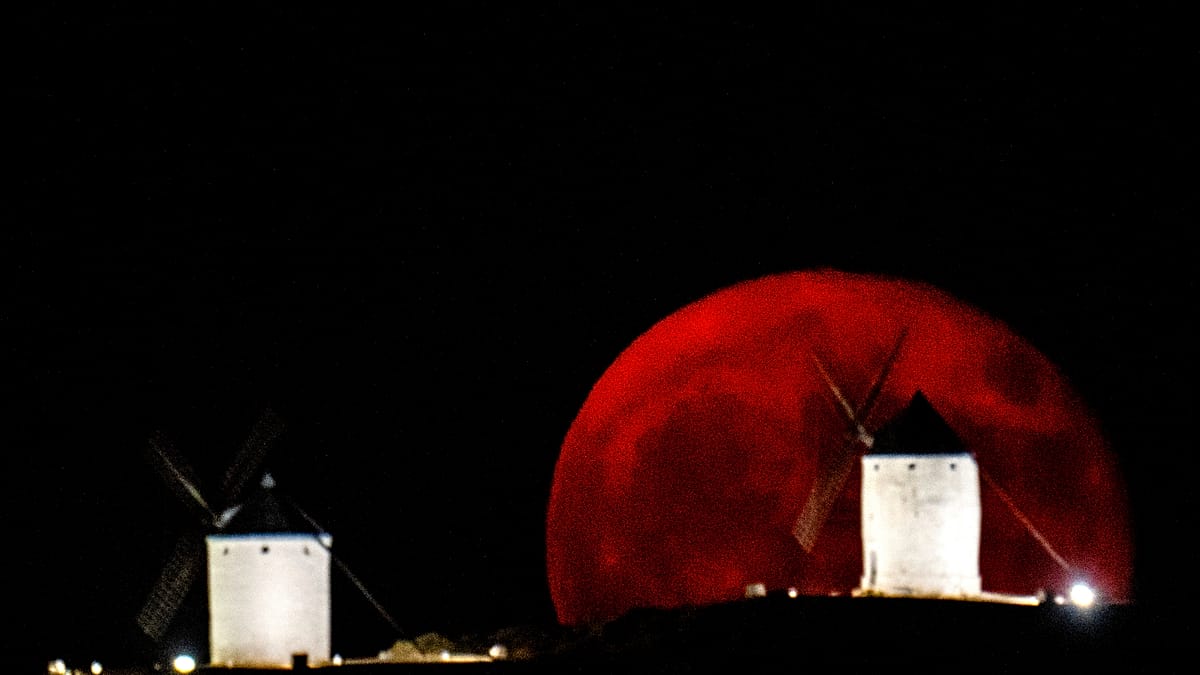
Skywatchers across Europe are in for a treat tonight as the Beaver Supermoon rises, appearing larger and brighter than a typical full moon. The spectacle, which peaks on the night of 24–25 November, is the second-to-last supermoon of 2026.
November's full moon has long been called the 'Beaver Moon', a name rooted in the seasonal behaviour of beavers as they stockpile food and reinforce their lodges before winter sets in. This year, the moon also coincides with perigee—the point in its orbit when it is closest to Earth—making it a supermoon.
Why does a supermoon look so big?
The moon's orbit around Earth is not a perfect circle but an ellipse, so its distance from us varies. When it reaches perigee, it can appear up to 14 percent larger and 30 percent brighter than when it is at apogee, its farthest point. The technical term is a perigee full moon.
According to William Alston, an astronomer at the University of Hertfordshire in the UK, the effect is most striking near the horizon. "When you have a supermoon, that effect is just slightly more striking," he said, referring to the well-known 'moon illusion' that makes the moon appear larger when it is low in the sky—a visual trick that scientists still cannot fully explain.
When and where to see it
No special equipment is needed to enjoy the supermoon, provided the skies are clear. The best views are from elevated, open locations, such as a hill or a wide park, where you can see the horizon unobstructed.
For most of western Europe, moonrise will occur between 4 and 5 pm local time on 24 November. In cities like Paris, Berlin, and Madrid, the moon will climb above the eastern horizon shortly after sunset, offering a dramatic view. In eastern Europe, including Warsaw, Budapest, and Bucharest, moonrise will be slightly later, around 5 to 6 pm.
If you miss the exact moment of moonrise, don't worry—the supermoon will remain impressive throughout the night and into the following evening, 25 November. The moon will be visible from all parts of the continent, weather permitting.
What about the tides?
Supermoon's stronger gravitational pull does affect tides, but the difference is minimal—only a few centimetres compared with a regular full moon, according to Royal Museums Greenwich. However, full and new moons in general produce higher 'spring tides' because the sun's gravity adds to the moon's pull.
On the US west coast, the Beaver Supermoon is expected to cause unusually high tides that could break 40-year records and flood low-lying coastal areas, complicating travel during Thanksgiving week. European coastal regions may also see slightly higher tides, but no significant flooding is anticipated.
What's next?
Supermoon's occur in clusters because the lunar month from one perigee to the next is about two days shorter than the synodic month from one new moon to the next. This means if a full moon falls near perigee one month, it is likely to do so again the following month.
After tonight's event, the final supermoon of 2026 will rise on 24 December—Christmas Eve—which could be a particularly magical sight for many Europeans. Then, in 2027, supermoons will appear on 22 January and 20 February.
For those interested in lunar phenomena, a separate project is exploring how to grow fresh food on the moon, which could one day support long-term human presence there. And if you're looking for other celestial events, keep an eye on the night sky—there's always something to discover.