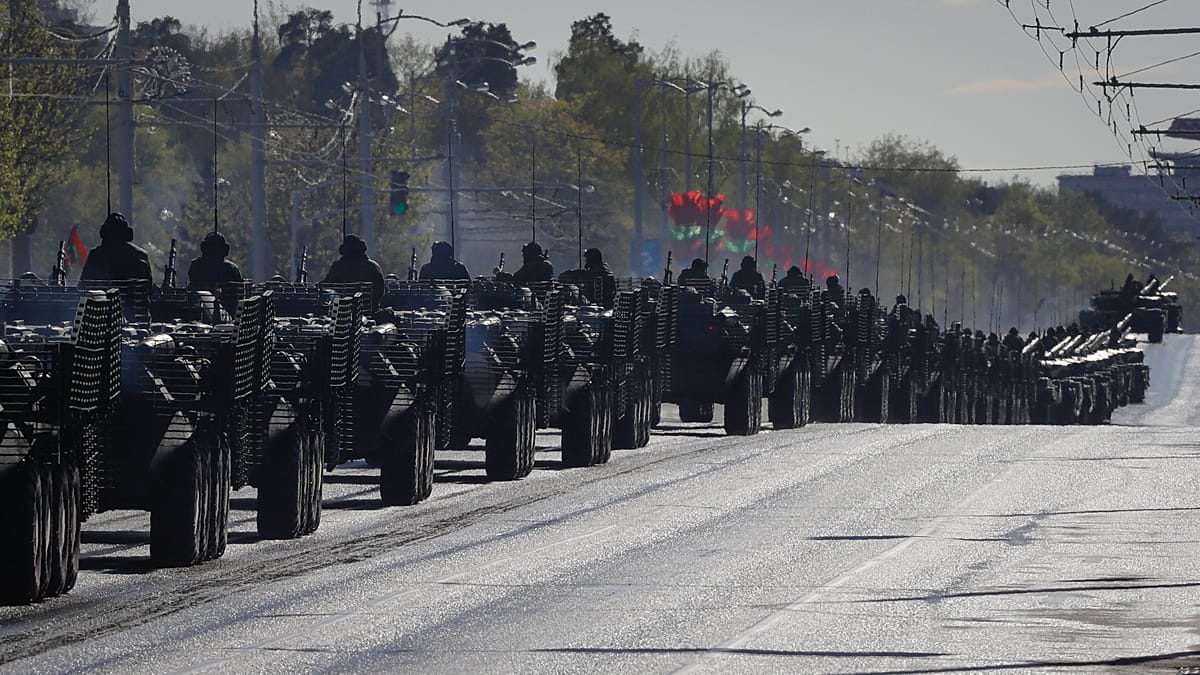
Belarus has kicked off four-day military exercises near its borders with Poland and Lithuania, according to the Belarusian service of Radio Free Europe, citing the defence ministry in Minsk. The manoeuvres involve mechanised and tank battalions, with troops training in border protection, counter-sabotage operations, and defence against drone and light aircraft attacks.
The location is significant. Some exercises are taking place near the Suwałki Gap, a narrow corridor between Poland and Lithuania that NATO considers strategically critical. The Hoża training ground sits on the Lithuanian border, while the Brzeski and Różański ranges are roughly 15 and 60 kilometres from the Polish border, respectively.
A sensitive point on NATO's eastern flank
The Suwałki Gap is one of the most strategically sensitive areas in this part of Europe. This 104-kilometre stretch of the Polish-Lithuanian border provides a land link between the Baltic states and the rest of NATO, while at the same time separating Belarus from Russia's Kaliningrad region. Any disruption here could isolate the Baltics from their allies, making it a focal point for military planners on both sides.
Minsk insists there is no cause for concern, and the Belarusian defence ministry describes the exercises as "purely defensive". The authorities also claim that the number of participants and the amount of weaponry being used do not exceed the thresholds set out in the 2011 Vienna Document, which would require prior notification of other states. However, no precise figure has been given for the number of soldiers taking part in the drills.
The timing adds to the unease. NATO jets have recently intercepted drones over Lithuania, and the alliance has been reinforcing its eastern flank. The exercises come as Belarus re-emerges as a launchpad for Russian drone strikes on Ukraine and NATO territory, raising questions about Minsk's role in the conflict.
Belarus: manoeuvres in the shadow of the war in Ukraine
The exercises now underway form part of broader efforts to test the readiness of Belarus's armed forces. On 11 September, Alyaksandr Lukashenka visited the Obuz-Lesnowski training ground near Baranavichy. The Belarusian leader said at the time that he wanted to review the functioning of the entire national security sector.
Minsk has for years been holding military exercises close to NATO's borders, and in the past Russian troops have often taken part in them. In 2020, the "Slavic Brotherhood" manoeuvres were held at a training ground in the Brest area, followed a year later by the Zapad 21 exercises. The current situation, however, lends such activities an additional dimension.
Belarus remains one of Russia's closest allies. In February 2022, the authorities in Minsk allowed Russian forces to use Belarusian infrastructure and territory to conduct operations against Ukraine. Belarus has not, however, deployed its own armed forces in direct combat on Ukrainian territory. Radio Svaboda points out that, for this reason, Minsk is not considered a party to the conflict under the humanitarian law criteria cited. However, the extent of the support provided to Russia, which includes logistical and military aspects, among others, continues to draw international criticism.
In recent days new information has also emerged about cooperation between the two countries. The drills are a reminder that Belarus remains a key piece in Russia's strategic calculus, and that the border region with Poland and Lithuania is a potential flashpoint. For NATO, the Suwałki Gap is a vulnerability that requires constant vigilance, and exercises like these only heighten that concern.
As the war in Ukraine grinds on, the presence of Belarusian troops near NATO's borders is a signal that Minsk is willing to play a supporting role for Moscow, even if it stops short of direct involvement. The international community will be watching closely to see whether these drills remain purely defensive, or whether they are a prelude to something more.