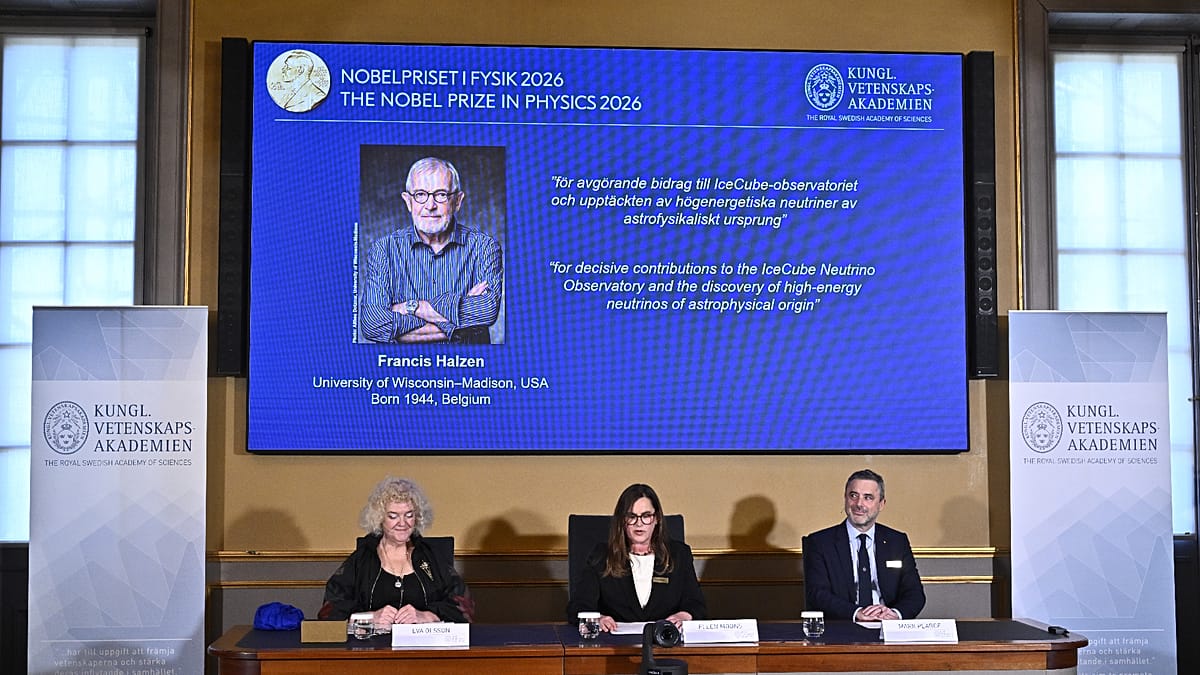
Francis Halzen, a Belgian-born physicist, has been awarded the 2026 Nobel Prize in Physics for his pioneering work on the IceCube Neutrino Observatory, a detector that uses a cubic kilometre of Antarctic ice to capture some of the most elusive particles in the universe.
The Royal Swedish Academy of Sciences announced the prize on Tuesday, honouring Halzen “for decisive contributions to the IceCube Neutrino Observatory and the discovery of high-energy neutrinos of astrophysical origin.” The academy described the observatory as “a cubic kilometre of ice that is equipped with light sensors,” and said his work had “paved the way for a new kind of astronomy.”
Speaking by phone from Italy shortly after the announcement, Halzen, 82, said: “It was a great surprise, and I obviously didn't expect it. But it's a great pleasure to hear about this prize.”
A giant eye in the ice
Neutrinos are subatomic particles that travel through space in straight lines, unaffected by magnetic fields, and arrive at Earth intact. They are produced in some of the most violent cosmic environments, such as supernovae and black holes. Because they rarely interact with matter, they are extremely difficult to detect. “Cosmic neutrinos with extremely high energies are very rare, so an enormous volume of ice is needed to observe an adequate number of collisions,” the jury noted.
Halzen first proposed the idea of using Antarctic ice as a neutrino detector in 1988. After preliminary tests, the IceCube observatory was completed in 2011 at the Amundsen-Scott South Pole Station. It is now the world's largest neutrino detector, with thousands of optical sensors embedded deep in the ice.
“For me, the main pleasure of it, besides winning the Nobel Prize, is that I hope this reflects on the really courageous people who joined me in the beginning of this project,” Halzen said.
Born in Tienen, Belgium, Halzen earned a master's degree in physics from KU Leuven in 1966 and a doctorate in 1969. He has been a professor at the University of Wisconsin–Madison, where he directs the Institute for Elementary Particle Physics. He has also served on advisory committees for the Sudbury Neutrino Observatory in Canada and Germany's Max Planck Institutes.
The Nobel Prize in Physics is the second of the 2026 season, following Monday's medicine award to Karl Deisseroth, Peter Hegemann, and Georg Nagel for their work in optogenetics. The chemistry prize is due on Wednesday, with literature on Thursday and the peace prize on Friday. The economics prize will close the season on Monday 12 October.
Each Nobel comes with a diploma, a gold medal, and 12 million Swedish kronor (€1.1 million), shared if a prize has more than one winner.
Halzen's achievement highlights the importance of international collaboration in science, with European researchers playing a key role in projects like IceCube. As Europe continues to invest in fundamental research, the recognition of such work underscores the continent's contribution to understanding the cosmos.