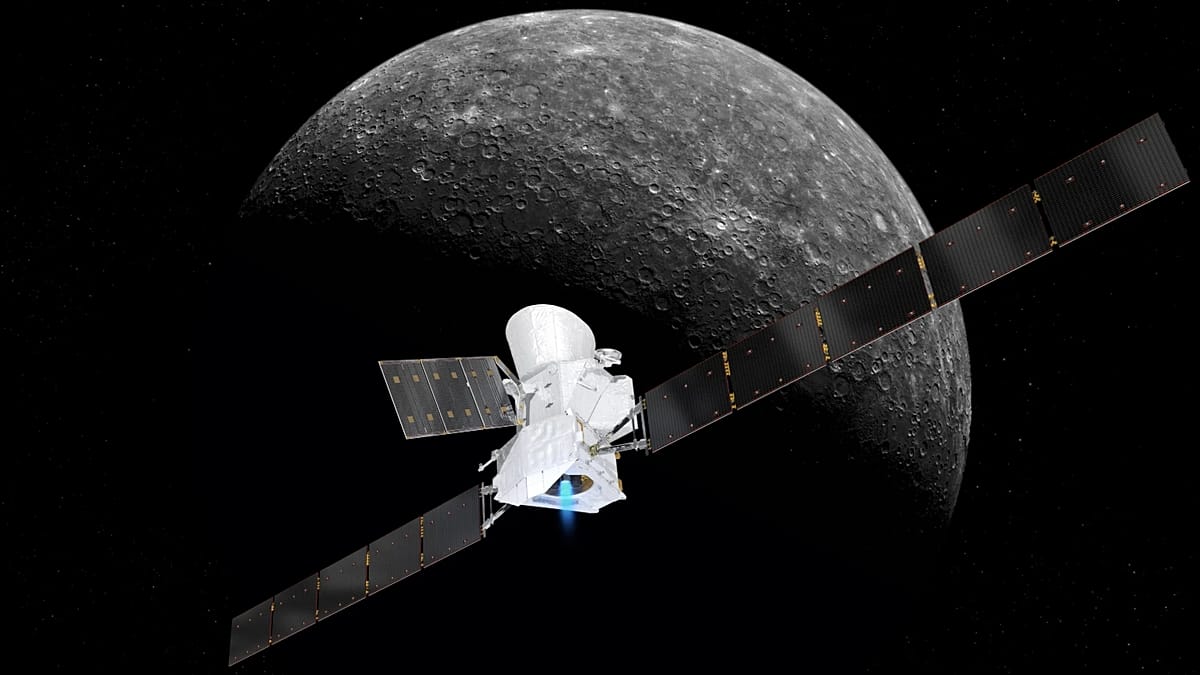
After an eight-year journey spanning billions of kilometres, the BepiColombo spacecraft has finally slipped into orbit around Mercury, the smallest and least explored planet in our solar system. The European Space Agency (ESA) confirmed early Sunday that the probe had achieved orbital capture, a delicate manoeuvre that required precise navigation in the intense gravitational pull of the Sun.
“We’ve heard back from Bepi — the spacecraft is now in contact with Ground and the teams at ESOC are busy assessing the telemetry, but Flight Dynamics already has confirmed it achieved orbital capture around Mercury,” the ESA announced on X. The agency said it would release a more detailed update early next week.
BepiColombo is a joint venture between the ESA and the Japan Aerospace Exploration Agency (JAXA), launched in 2018 from French Guiana. The mission is designed to study Mercury in unprecedented detail, from its cratered surface and tenuous exosphere to its magnetic field and internal structure. Scientists hope the data will shed light not only on the planet itself but also on the broader evolution of the inner solar system.
A complex mission to a hostile world
Mercury is a world of extremes. It experiences temperature swings from 430°C in direct sunlight to -180°C on its night side. It is also surprisingly difficult to reach: despite being the closest planet to the Sun, an orbiter must shed enormous orbital energy to avoid being pulled into the Sun’s gravity well. As the ESA notes, “BepiColombo will be the second and most complex mission ever to orbit Mercury. Close to the Sun and more difficult for an orbiter to reach than Saturn, this small desert world is the least explored planet of the inner Solar System.”
The mission comprises two scientific orbiters: the Mercury Planetary Orbiter (MPO), built by ESA, and the Mercury Magnetospheric Orbiter (Mio), developed by JAXA. They will separate on 9–10 December, after which they will begin their primary science phase in April 2027. Until then, the spacecraft will continue to refine its orbit and perform calibration checks.
BepiColombo’s arrival marks a significant milestone for European space exploration. It follows in the footsteps of NASA’s Mariner 10 and Messenger missions, but with a far more comprehensive instrument suite. The mission’s findings could help answer fundamental questions about how rocky planets form and evolve, and why Mercury has such a large iron core relative to its size.
The success also underscores the growing role of European institutions in deep-space science. The ESA has been a key player in missions like Rosetta, Gaia, and the ExoMars programme, and BepiColombo adds another feather to its cap. Meanwhile, the European space sector is seeing increased commercial activity, as evidenced by Finland’s Iceye bidding for Italy’s Avio to create a major space industry player.
For now, mission controllers at the European Space Operations Centre (ESOC) in Darmstadt, Germany, are poring over telemetry to ensure the spacecraft is healthy. The next critical phase will be the separation of the two orbiters, a step that will test the years of careful planning that have gone into this ambitious project.
As BepiColombo begins its work, it joins a growing list of European-led scientific endeavours that are pushing the boundaries of knowledge. From the icy moons of Jupiter to the scorched surface of Mercury, Europe’s space agencies are proving that even the most extreme destinations are within reach.