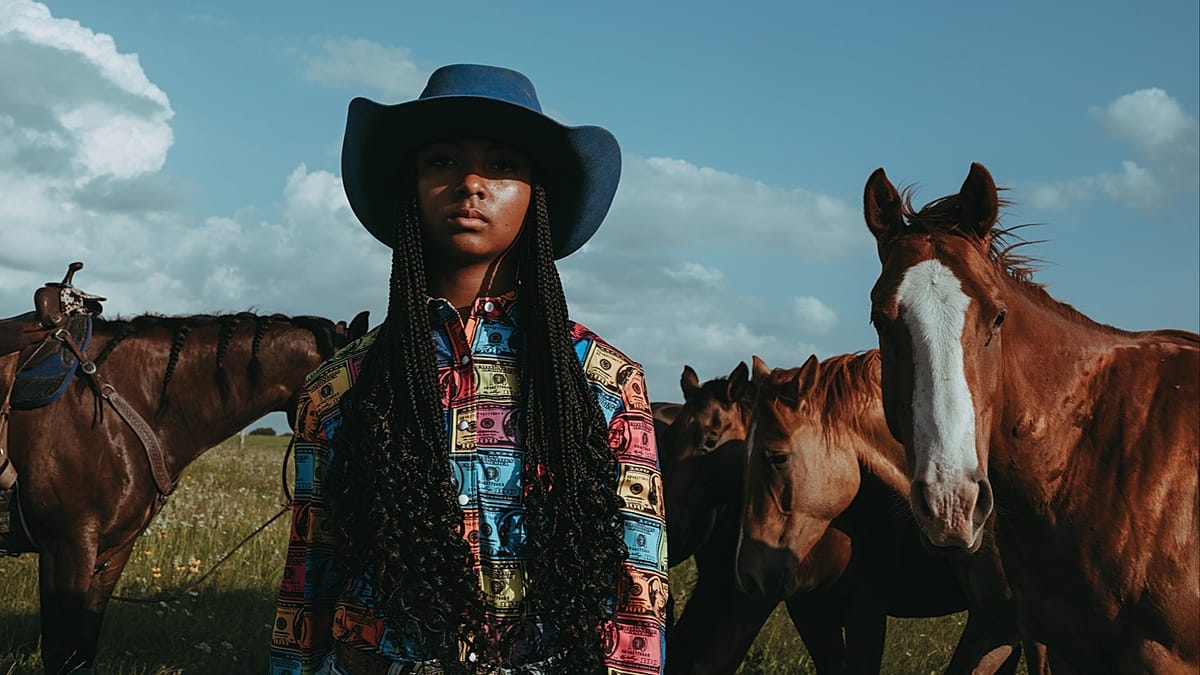
Few figures loom as large in the American imagination as the cowboy—a symbol of independence, grit, and self-reliance, immortalized in films like The Searchers and The Good, the Bad and the Ugly. Yet for generations, that image has been overwhelmingly white.
Photographer Ivan McClellan grew up in Kansas City, where a neighbor, Mr. Wills, raised cattle. But Mr. Wills was Black, wore a ball cap and overalls, and looked nothing like John Wayne or Val Kilmer in Tombstone. So McClellan never thought to call him a cowboy. The gap between the screen and his own life was simply too wide.
That changed in 2015, when McClellan drove four hours to a rodeo in Oklahoma. There, he found thousands of Black cowboys and cowgirls who looked far more like the people he had grown up with than anything Hollywood had shown him: men in gold chains and Jordans, women with long braids and acrylic nails riding at 50 miles an hour, with gospel, R&B, and hip-hop filling the air.
That moment sparked a decade-long obsession. McClellan began traveling across the US, photographing Black cowboy and cowgirl culture at rodeos, ranches, homes, and events. His 2024 project, Eight Seconds—named after the time a bull rider must stay mounted for a qualified ride—became a celebrated book. He has since organized his own rodeo under the Eight Seconds banner, channeling significant prize money to Black competitors, while continuing to document a culture he believes has been overlooked.
Now McClellan is releasing a new edition, Eight Seconds: Legacy in Motion, featuring 91 additional images that he describes as more “precious” and “urgent” than the first batch. In an interview with Euronews Culture, he discussed his journey, the allure of Black cowboy culture, and why he has moved from photographing rodeos to building his own.
A decade of immersion
Reflecting on the new edition, McClellan said the first book felt like “a nice bow on nearly a decade of work, hanging on fences and chasing down cowboys and dodging bulls.” He assumed the project was over, but instead it intensified. “I started doing my own rodeo and photographing there, and spending time at more rodeos at a velocity like I had never done in any other previous years.”
Two years later, he had accumulated thousands of photos from ranches, homes, and events—his own and others. “The portraiture had gotten a lot more intimate and a lot closer to the subject,” he said. “I felt like this work deserves a place in the world as well.” The result is a sequel that feels both familiar and distinct, with a deeper sense of intimacy and urgency.
Challenging the cowboy myth
Growing up in Kansas, McClellan was surrounded by country life—blackberry picking, tree climbing, chasing fireflies, and tornadoes. But none of it connected to the cowboys he saw on TV. “It didn't relate to that or connect to that in any way, mostly because everyone around me was Black,” he explained. Mr. Wills, the cattle-raising neighbor, didn't fit the John Wayne mold, and Junebug next door, who raised dogs and chickens and was in a street gang, didn't either.
It wasn't until that 2015 rodeo that McClellan realized the inaccuracy lay in the films, not in his environment. “I saw Black folks in cowboy hats and no shirt and gold chains, riding horses and basketball shorts. I saw women with long braids and acrylic nails riding horses 50 miles an hour. It felt very familiar. It felt a lot like home.”
For McClellan, the cowboy is more than entertainment—it's myth-building central to American identity. “These things that we attribute to cowboys—resilience, grit, independence—are core to our definition of self,” he said. “But that Black people have been excluded from that icon, that Black people have been excluded from that story, keeps us from attributing those things to ourselves.”
His work aims to correct that narrative, offering a fuller, more authentic picture of a culture that has always been part of the American West. As he continues to expand the Eight Seconds project, McClellan is not just documenting history—he is helping to rewrite it.