Boeing's stock dropped roughly 9% on Tuesday after the aerospace giant revealed a more conservative production timeline than investors had hoped, raising fresh doubts about how quickly recent certification wins and defence contracts will translate into profits.
Chief Executive Kelly Ortberg told analysts that the company does not expect to build 52 of its best-selling 737 MAX aircraft per month until the second half of 2027. Before that, Boeing must first "stabilise" output at 47 jets a month, a level it is still working to reach consistently.
Wall Street has long viewed higher 737 MAX output as the key driver of revenue and earnings growth. But Ortberg, who took over in August 2024 after a series of safety crises, insisted that a slower, more disciplined approach is the right one.
"We're making progress, but we still have more work to do, and I'm expecting it'll take us into next year to get fully stable at this rate," he said, pointing to the need for greater predictability in wing production and in the fuselage work done at Boeing's Kansas facility. "It's more important that we do this ramp right than what particular month we achieve a rate break."
Ortberg also set a clearer financial target: the company expects to reach $10 billion (€8.98bn) in annual free cash flow by 2029. That timeline, too, was longer than some analysts had anticipated, and shares extended their losses after the announcement.
"Everybody wants us to go faster. I get that, but we're going to stay disciplined as we ramp up here," Ortberg said.
Rebuilding trust after a turbulent period
Ortberg's comments come as Boeing continues to recover from two fatal 737 MAX crashes and a near-catastrophic incident in January 2024, when a door plug blew out mid-flight on an Alaska Airlines jet. The company has faced criticism that a culture focused on short-term gains compromised safety.
Aviation expert Richard Aboulafia of AeroDynamic Advisory described Boeing's progress as "slow but steady" in an email to AFP, but added that "the supply chain remains a major concern and one that's only partly in Boeing's control."
The cautious outlook accompanied Boeing's third-quarter earnings report, which showed a net loss of $116 million (€100m), a dramatic improvement from the $5.3 billion (€4.6bn) loss a year earlier, when delays in certifying the 777X wide-body jet weighed heavily. Revenue rose 4% to $24.2 billion (€20.9bn), helped by stronger deliveries in the defence, space and security division and higher sales in Boeing Global Services. Commercial aircraft revenue dipped slightly, with 161 planes delivered in the quarter, just one more than in the same period last year.
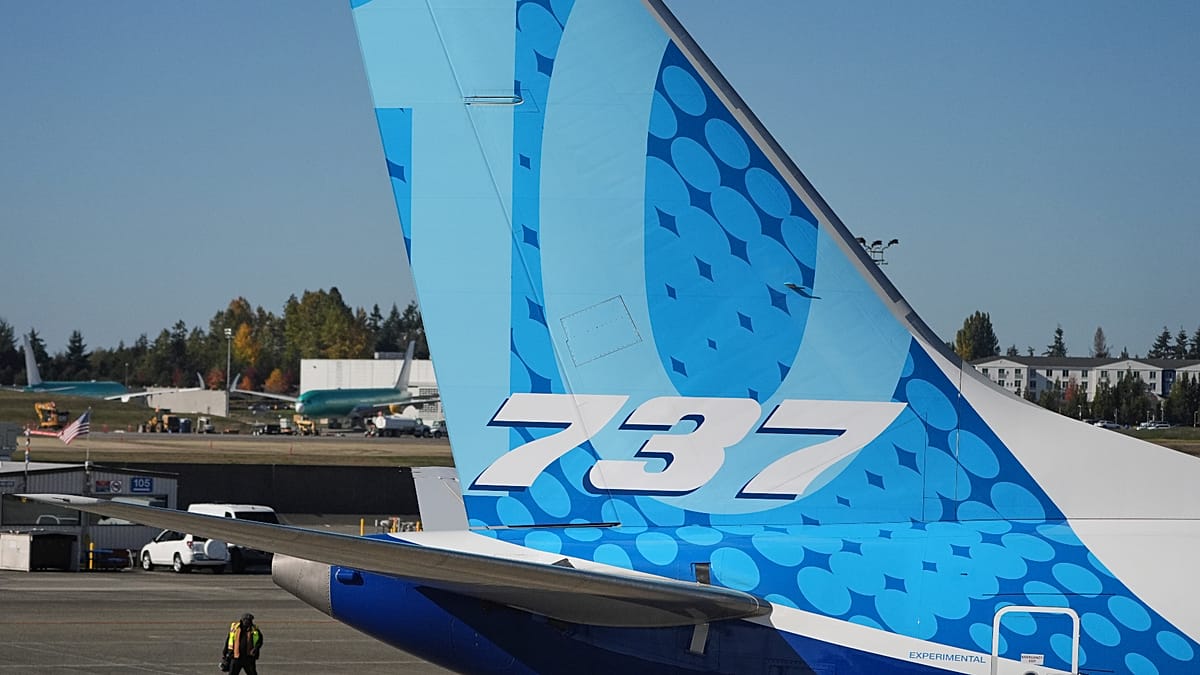
Ortberg pointed to recent milestones as evidence of momentum, including the Federal Aviation Administration's certification of the 737 MAX 7 and MAX 10, and a "transformational" Pentagon contract to build the US Navy's next-generation fighter jets.
On the much-delayed 777X, Boeing executives expressed confidence that it would be certified in 2027, with deliveries of 10 to 15 aircraft expected next year. "We're providing this with confidence that the team's ready to go execute," Ortberg said.
The company projects free cash flow will grow from about $2 billion (€1.7bn) in 2026 to $6 billion (€5.2bn) in 2028 and $10 billion (€8.6bn) in 2029, with higher levels thereafter.
"As I mentioned, over the last two years, we've made exceptional progress restoring trust, retiring risk, and transforming our culture and rebuilding the foundation of safety and quality that will help ensure durable success," Ortberg said. "We have also been deliberate about not getting ahead of ourselves, given the range of outcomes tied to the production ramp, certification timing, and other critical programme execution. But we appreciate that it's been difficult for shareholders to assess how our progress will translate into financial performance. We're now at a point where the range of outcomes is narrowing."
For European investors and airlines that rely on Boeing's aircraft, the slower ramp could mean continued delivery delays, affecting fleet planning and leasing markets. The company's struggles also contrast with the more upbeat tone from European aerospace rival Airbus, which has been increasing its own production rates. As Boeing works to stabilise its supply chain, the transatlantic competition for narrow-body orders remains intense.