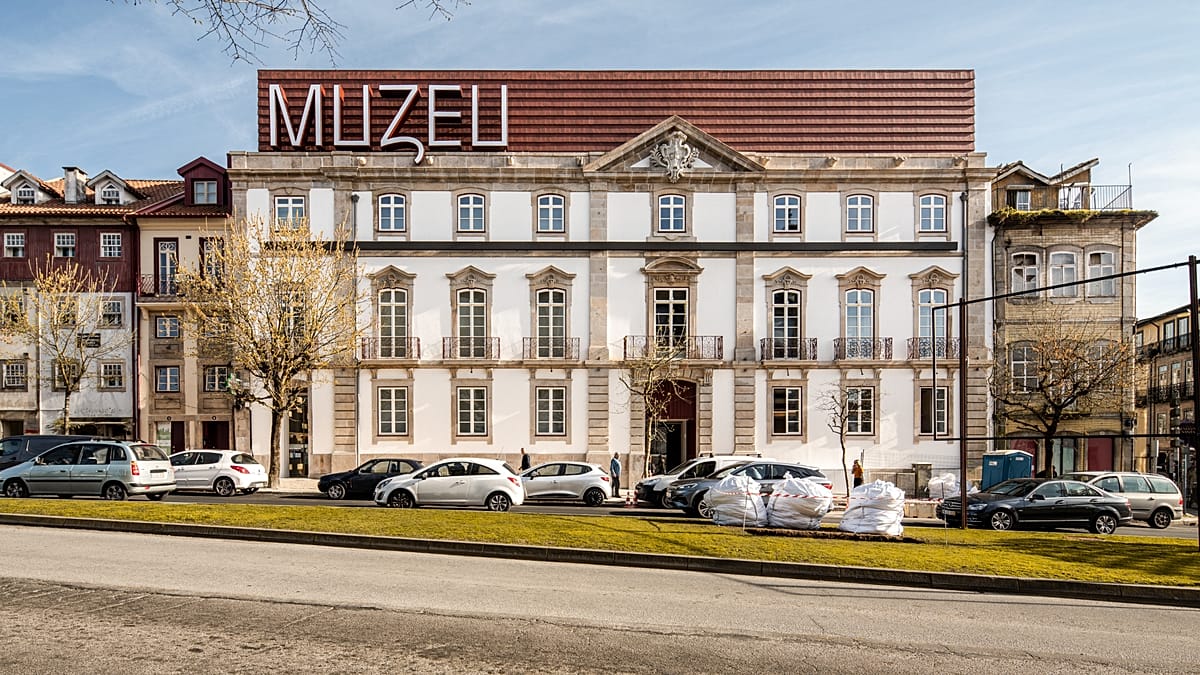
Braga, Portugal's third-largest city, has long been a hub of history and faith, but until this spring it lacked a dedicated space for contemporary art. That gap was filled in April with the opening of MUZEU, a museum that aims to do more than display works—it wants to provoke thought and foster a sense of community.
The museum's motto, “Be realistic, demand the impossible,” is borrowed from the famous graffiti photographed by Gérard-Aimé during the May 1968 protests in Paris. That slogan, scrawled on a bridge over the Seine, captured a moment of cultural and social upheaval that still resonates today.
José Teixeira, the founder of MUZEU and CEO of the Portuguese industrial group dstgroup, sees a parallel between that era and our own. “May of 1968 was a time of liberation within a country that sought a freedom of movement, not really political, but a freedom to break the social and moral walls of the time that existed,” he told Euronews Culture. “Nowadays we are living a new version of May 1968—morally, socially and ethically. A liberation that opens ourselves and opens the community to the communities and to a communal life.”
Teixeira, who is also one of Portugal's wealthiest individuals according to Forbes, argues that contemporary society's focus on meritocracy and individualism has created a need for new conversations about compassion and mutual understanding. “There is a need for a new debate about the communities and how comprehension and compassion should be brought to the table as a means to solve that as well,” he said.
A collection built over decades
MUZEU spans five floors and roughly 3,000 square metres of exhibition space. It houses more than 100 works by 84 artists—45 from Portugal and 39 from abroad—representing 16 countries. The gender balance, with 57 men and 27 women, reflects a broader industry trend, though the museum says it is committed to increasing diversity.
The collection includes pieces by Pablo Picasso, Alex Katz, Artur Lescher, Candida Höfer, Nan Goldin, and Eduardo Batarda. A dedicated gallery is reserved for the work of Anselm Kiefer, whose monumental, layered canvases explore memory and myth.
Photography holds a special place in the collection, reflecting Teixeira's belief that “photography captures the moment without taking it away.” This passion is evident in the range of photographic works on display, from intimate portraits to large-scale landscapes.
Teixeira, who has been collecting for four decades, sees his role as that of a “signal man,” guiding his employees and visitors toward a richer intellectual life. His company's campus in Braga is dotted with large-scale artworks, libraries, and sports facilities, all intended to encourage a holistic approach to work and leisure.
He cites the French philosopher Simone Weil as an inspiration. Weil, who worked in a Renault factory during the Nazi occupation to understand the lives of workers, later wrote about her experience. “If you want to speak about work, you need to know how to do it and do it like Simone Weil—ask the real questions,” Teixeira said. “Poets speak through metaphors, I speak through art works I collect.”
Art as a mirror of conflict
The museum's current exhibition, which opened last Thursday, includes a striking installation by Lebanese-Canadian artist Elias Nafaa. Titled Handle with care, it features 300 hand-cast glass replicas of weapons used in contemporary conflicts. The work, first shown at the Québec City Biennial, transforms instruments of destruction into fragile objects of contemplation.
“I want to make them out of a very fragile material so that they are as fragile as what they're destroying,” Nafaa explained. “I wanted to reverse the power dynamics, so instead of them looking down on me, I would look down on them, and I wanted to scale them down so they don't feel as strong or powerful as they are or destructive as they are.”
The installation is a sobering reminder of the human cost of war, a theme that resonates across Europe and beyond. Nafaa notes that over 20,000 weapons have been used in conflicts by the end of 2025, a figure that continues to climb.
MUZEU's opening comes at a time when Portugal is grappling with economic pressures, including a cost-of-living crisis and extreme weather events. Yet Teixeira remains optimistic about the role of art in society. “We need to read, to go to museums, to reflect and think about how to live in a community,” he said.
For those who cannot visit in person, MUZEU plans to expand its digital presence, offering virtual tours and educational resources. The museum also aims to collaborate with other European institutions, fostering a cross-border dialogue about art and society.
As Europe faces its own challenges—from political divisions to social inequality—MUZEU's message is clear: art can be a catalyst for change, if only we are willing to pause and reflect.