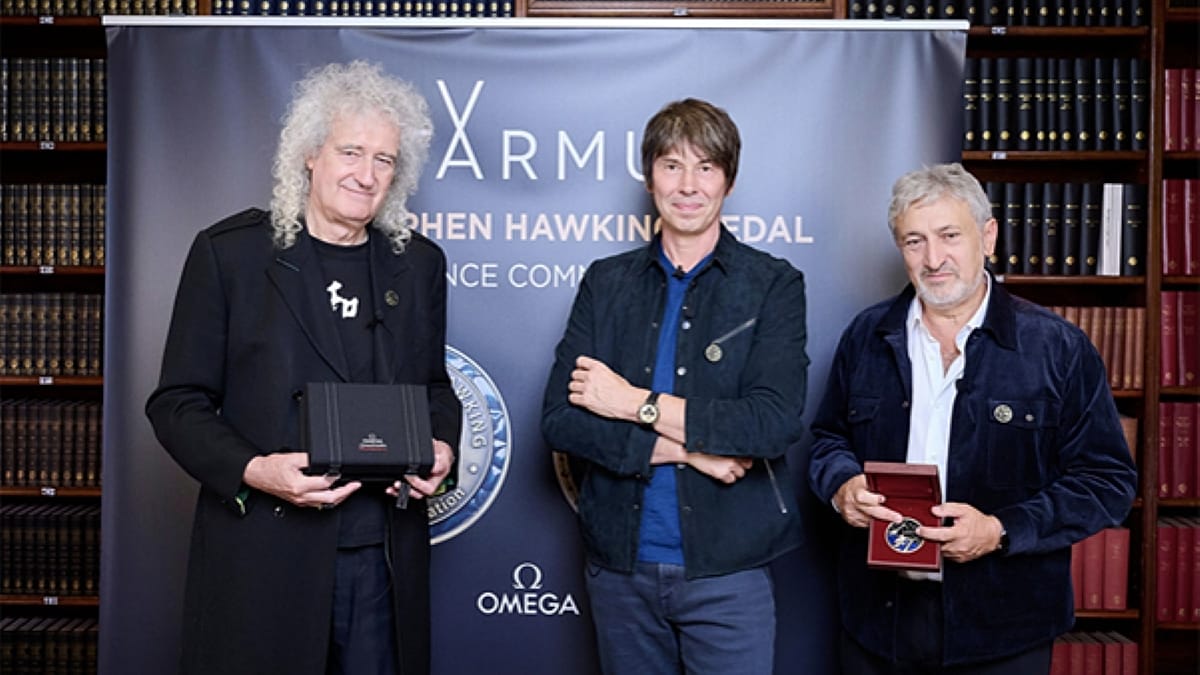
British physicist and broadcaster Brian Cox has been named the recipient of the 2026 Stephen Hawking Medal for Science Communication, an award that recognises his decades of work making complex scientific ideas accessible to audiences across the globe. The medal was presented at a private ceremony at the Royal Astronomical Society in London on 2 October, with Starmus co-founders Sir Brian May and astrophysicist Garik Israelian doing the honours.
Starmus, a platform that blends science, art, and human inspiration, established the medal a decade ago together with Stephen Hawking himself. It honours communicators working across literature, broadcasting, music, film, and art who help close the gap between science and society, spark curiosity, and make science open to everyone.
“It’s a great honour to receive the 2026 Stephen Hawking Medal from Starmus, and particularly poignant for me because I was there with Stephen when the Medal was first announced 10 years ago,” Cox said at the ceremony. “Astronomy is the oldest science, and in today’s fractured world I believe that striving to understand the Universe is more important than ever.”
Brian May, who co-founded Starmus, underlined the medal’s purpose: “The Stephen Hawking Medal was born from a shared belief that science should inspire people far beyond the scientific community.” He added that this message is especially vital at a time when “truth, evidence, and critical thinking are increasingly challenged.”
A career devoted to public engagement
Cox is one of Britain’s most recognisable science communicators. He has presented television series such as Universe and The Planets, authored books including The Quantum Universe, and delivered lectures worldwide. He currently serves as Professor of Particle Physics and Royal Society Professor for Public Engagement in Science at the University of Manchester.
His work spans topics from the smallest building blocks of matter to the origins and eventual fate of the Universe—ideas that are not always easy to explain while keeping an audience engaged. The award places him alongside a distinguished list of past recipients, including David Attenborough, Neil deGrasse Tyson, Sylvia Earle, Christopher Nolan, Hans Zimmer, and Brian Eno, as well as NASA’s communications office.
This year’s other medal winners include filmmaker Ridley Scott, the Artemis II crew, Nobel Laureate Geoffrey Hinton, and 17-year-old Valeria Corrales, who receives the Stephen Hawking Medal Junior. Christiana Figueres, a key figure in the 2015 Paris climate agreement, will receive the inaugural Jane Goodall Earth Medal.
The medal’s design reflects Starmus’s blend of science and culture: one side features a portrait of Hawking by Soviet cosmonaut Alexei Leonov, while the other depicts Leonov during his historic spacewalk alongside an image of Brian May’s ‘Red Special’ guitar, known from Queen.
During the London ceremony, Cox, May, and Israelian discussed astronomy, humanity, music, artificial intelligence, and Hawking’s enduring legacy. Cox was also presented with an OMEGA Speedmaster Moonwatch crafted in 18K Moonshine Gold.
Starmus VIII: ‘The Search for Truth’
The award will be celebrated as part of the Starmus VIII Festival, taking place on the Canary Islands from 17 to 22 October. Themed ‘The Search for Truth’, the festival will bring together scientists, astronauts, Nobel laureates, artists, and musicians across Tenerife and La Palma—both islands renowned for their dark skies and astronomical facilities, with La Palma protected as a Starlight Reserve.
The programme includes lectures, discussions, music, art, stargazing, and a science camp, aiming to extend the conversation beyond the lecture hall. Performances from Andrea Bocelli, Rick Wakeman, and Sarah Brightman will set the tone, alongside more than 40 speakers, including Nobel laureates May-Britt Moser, Donna Strickland, and Steven Chu, and astronauts Chris Hadfield, Victor Glover, Reid Wiseman, and Jeremy Hansen.
The festival will close in La Palma with a free public performance of Ilan Eshkeri’s Space Station Earth, a live orchestral work accompanied by footage from space that explores how seeing Earth from above can reshape human perspective.
Ten years after Hawking helped launch the medal, Starmus is recognising Cox for embodying its original ambition: not only to explain what we know about the Universe, but to inspire us all to look up and wonder. For those interested in how science communication is evolving, Thomas Pesquet's call to maximise ISS science offers a related European perspective.