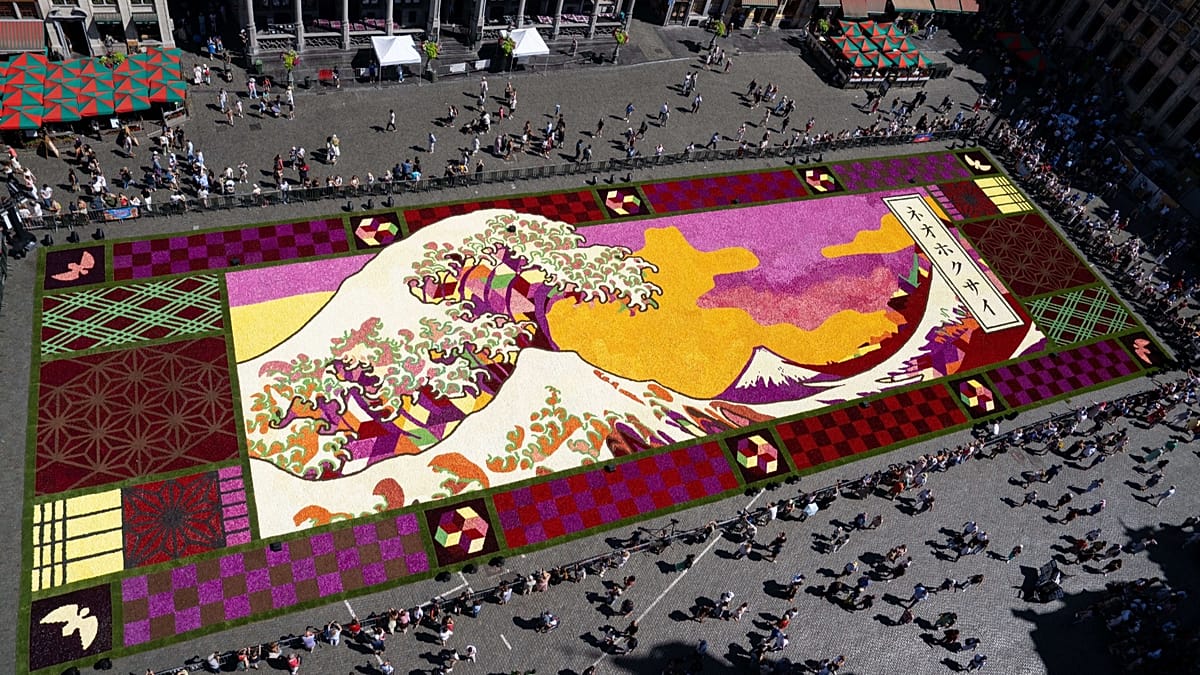
The cobblestones of Brussels' Grand-Place have once again been transformed into a vast floral canvas, as the Belgian capital hosts the 24th edition of its biennial Flower Carpet. This year's display, which opened on August 13, draws inspiration from Japan, marking a significant cultural exchange between the two nations.
Japanese artist Hiro Sugiyama designed the composition, a contemporary reinterpretation of Katsushika Hokusai's iconic woodblock print "The Great Wave off Kanagawa." The artwork, which spans approximately 70 metres in length and 24 metres in width, is made up of more than 700,000 flowers, predominantly dahlias—a classic choice in Belgian horticulture.
Sugiyama, who spent eight months developing the design, initially envisioned a more colourful palette but was constrained to 16 hues due to time limitations. "To be honest, at the beginning, I was pretty nervous about [the limited colours palette], but once I came here and saw the design and the flowers laid out, I was very excited and realised that I didn't need to worry about it at all, because it looks beautiful already," he said.
A celebration of 160 years of Belgium-Japan ties
The collaboration is particularly meaningful as it coincides with the 160th anniversary of diplomatic relations between Belgium and Japan. It also marks a decade since the first Flower Carpet collaboration in 2016. Richard Poncint, a member of the Brussels Flower Carpet Organisation, emphasised the event's broader significance. "Culture events show people that we can work together, we can do interesting things together and that's one of the things we do here also with our Japanese friends," he said.
The preparation for the carpet is a meticulous process. Once the theme is chosen, organisers calculate the required number of flowers and select a colour palette. Several days before assembly, a full-size design is drawn on a large cotton canvas laid out on the square. On Thursday, more than a hundred volunteers worked for approximately six hours to arrange the flowers according to Sugiyama's vision.
Japanese Ambassador to Belgium, Takeshi Osuga, also took part in the installation, helping to lay flowers. "A lot of Japanese sponsors contributed to this event and I wanted to contribute by laying out the flowers," Osuga said.
The Flower Carpet, which first appeared in 1971, returns to the Grand-Place every two years. This year's display consists of dahlias, begonias, grass, and bark. Visitors can view the carpet from ground level or from the balcony of the Town Hall for a full perspective.
The 2026 Flower Carpet will be on display until August 16. While online tickets have sold out, a limited number are available at the venue's entrance during opening hours.
This year's event also resonates with broader themes of cultural diplomacy and international relations. As Europe and Japan navigate complex geopolitical landscapes, such exchanges serve as a reminder of the ties that bind distant partners. For more on Japan's evolving role in regional security, see our analysis of Japan's nuclear debate. And for another example of ephemeral art in Europe, check out Saype's grass frescoes in the Swiss Alps.