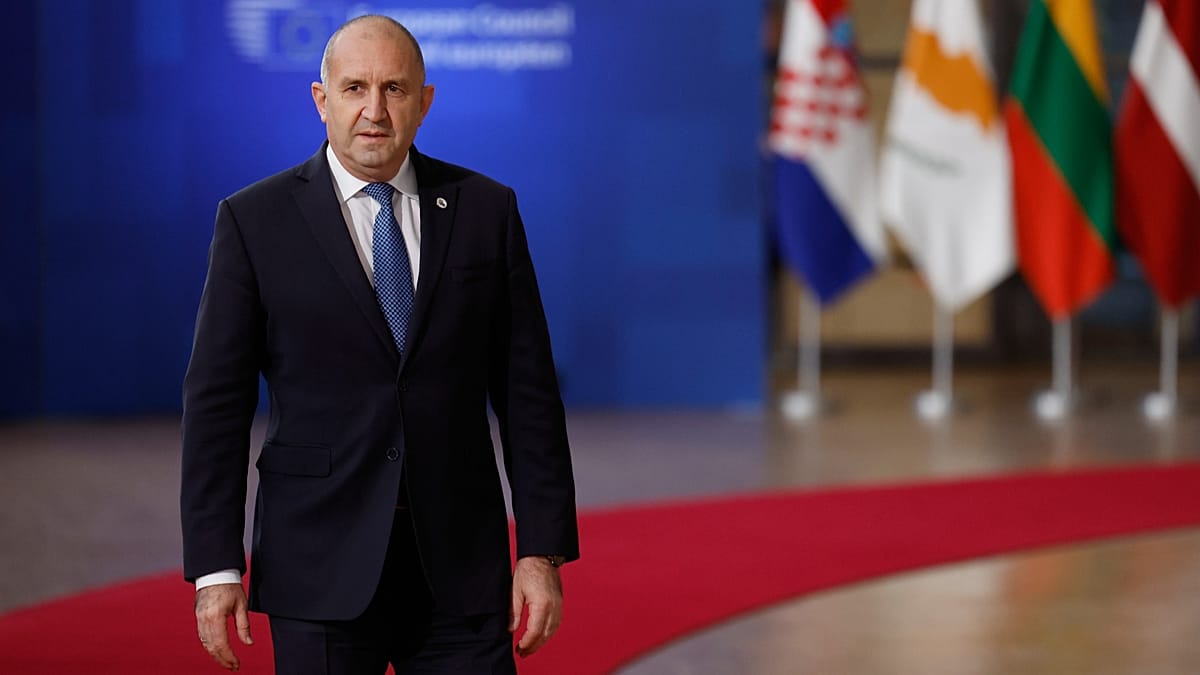
Bulgaria has reversed its earlier stance and will now take part in the European Union's €45 billion support loan for Ukraine, Prime Minister Rumen Radev announced on Thursday. However, Sofia will not contribute to the military component of the package, which is intended to cover weapons and ammunition purchases.
The loan, unveiled by the European Commission last week, is designed to cover two-thirds of Kyiv's projected budget deficit for 2027. It is split into €25 billion for military aid and €20 billion for budget support, with annual interest payments of €2 billion to €2.5 billion to be borne by member states. Kyiv will not be required to repay the principal until Moscow provides war reparations.
Radev, speaking at a summit in Brussels, said Bulgaria was "ready to join" the initiative, but reiterated that his country would not fund weapons. "We have a huge historical diaspora of 300,000 Bulgarians living in Ukraine," he said. "Our wishes and our request are to concentrate our support in the areas of the Bulgarian population in Ukraine."
He added: "So we are going to contribute, but again, no money from Bulgaria for weapons, no money for the war in Ukraine."
The Bulgarian leader had initially expressed reservations about the loan, citing the need to control public spending, which is under intense scrutiny. This placed Bulgaria alongside Slovakia, Hungary and the Czech Republic in the group of countries that opposed the scheme outright. But Radev's announcement on Thursday signals a shift, albeit with conditions.
An à la carte approach
European Commission President Ursula von der Leyen, who presented the loan last week, had publicly offered reluctant member states the option to opt in à la carte, depending on their preferences. She said she was "very confident" that all 27 countries would eventually back the proposal. Radev welcomed the dual structure and said Bulgaria would contribute to the €20 billion budget aid portion, which is intended to cover public services and salaries.
The Bulgarian prime minister said he would discuss the matter with von der Leyen during Thursday's summit, where support for Ukraine is high on the agenda. The summit comes amid clashing priorities over the EU budget, with leaders also negotiating the bloc's next multi-year financial framework.
Radev's confirmation increases pressure on the remaining holdouts—Slovakia, Hungary and the Czech Republic—to join the loan. Unlike Bulgaria, these three countries are already exempted from the previous €90 billion support loan and have shown little appetite to change their opt-out policy. The Czech Republic, however, has recently pledged support to Poland after Russian airspace violations, suggesting a potential shift in its stance.
Germany, the Netherlands, Sweden, Denmark and Ireland are among those who have said the next EU budget cannot be agreed until support for Ukraine is locked in for 2027. Dutch Prime Minister Rob Jetten stressed the importance of solidarity: "It's crystal clear that the Russian aggression in Ukraine is one of the biggest challenges that we face. And Ukrainians are fighting for their own freedom, but also for European democracy and values."
"We need to stand shoulder to shoulder with the Ukrainians, who will need more military and financial support in the years to come," Jetten added. "That is something that no EU country can opt out of. Everyone needs to be in solidarity with the Ukrainians."
Whether leaders can bring Slovakia, Hungary and the Czech Republic into the fold remains to be seen. The three countries have been steadfast in their refusal to participate in the previous loan, and their continued resistance could complicate efforts to present a unified front. Meanwhile, Bulgaria's decision, while conditional, is a notable step forward for the EU's financial support package.
For Bulgaria, the move also reflects domestic considerations. The country's salary levels remain among the lowest in the EU, and public finances are under close watch. Yet Radev's emphasis on the Bulgarian diaspora in Ukraine suggests a humanitarian and cultural rationale for participation, rather than a purely fiscal one.
The loan's structure, with its separation of military and budget aid, appears to have been a key factor in Bulgaria's decision. By allowing member states to contribute only to the civilian portion, the Commission has created a mechanism that accommodates national sensitivities while still delivering substantial support to Kyiv.
As the summit continues, all eyes will be on the remaining holdouts. The EU's ability to present a united front on Ukraine is seen as crucial, not only for Kyiv's immediate needs but also for the bloc's credibility on the world stage. With Bulgaria now on board, the pressure is mounting on the others to follow suit.



