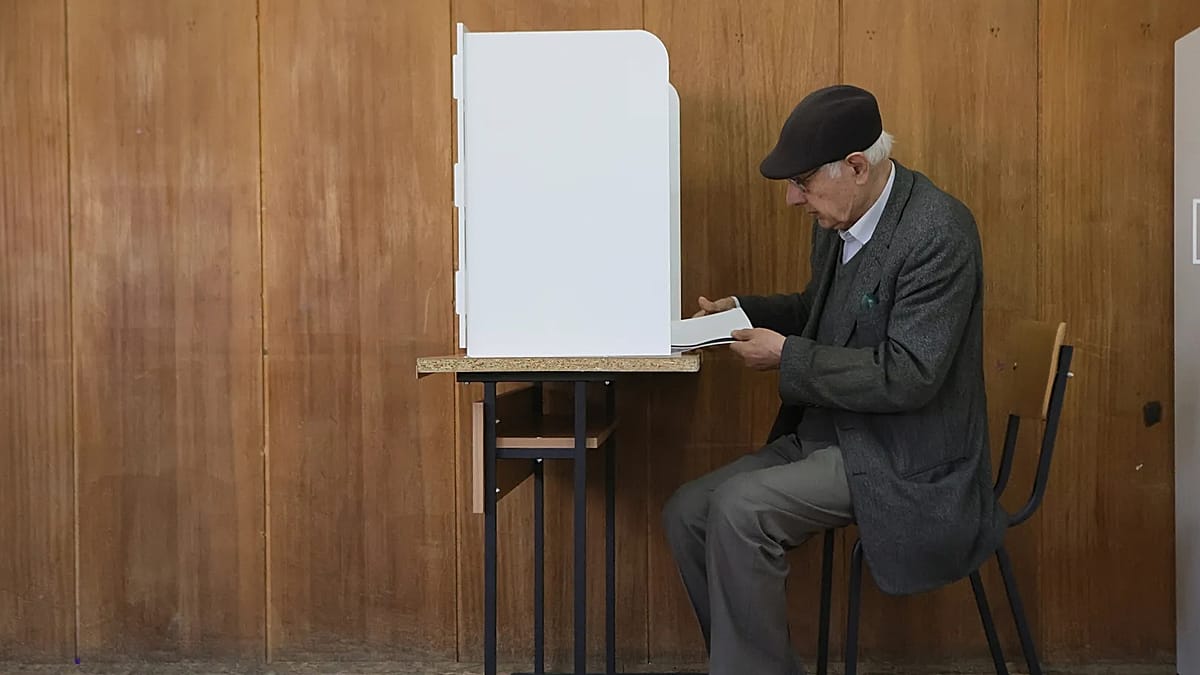
Bulgarians went to the polls on Sunday for the eighth parliamentary election in five years, with former president Rumen Radev's newly formed centre-left grouping, Progressive Bulgaria, leading in opinion polls. The vote comes amid deep political instability in the European Union's poorest member state, which has seen a revolving door of governments since 2021, when mass anti-corruption protests ended the long tenure of conservative leader Boyko Borissov.
Radev, a former air force general who served as president for nine years, stepped down in January to lead his new party. He has campaigned on a platform of ending what he calls the country's "oligarchic governance model" and has backed anti-corruption demonstrations that toppled the latest conservative-backed government in late 2025. Opinion polls suggest his bloc could secure around 35% of the vote, potentially giving it a strong position in the 240-seat parliament.
A Divided Electorate
Borissov's pro-European GERB party is projected to come second with roughly 20%, ahead of the liberal PP-DB alliance. Borissov, who dominated Bulgarian politics for nearly a decade, has dismissed Radev as offering nothing new. At a recent rally, he pointed to achievements such as Bulgaria's entry into the eurozone this year as proof that GERB had "fulfilled the dreams of the 1990s."
Voter sentiment reflects deep frustration. "I'm voting for change," said Decho Kostadinov, a 57-year-old Sofia resident, after casting his ballot. He added that corrupt politicians "should leave — they should take whatever they've stolen and get out of Bulgaria." Others, like Elena, an accountant in her 60s who declined to give her full name, expressed a desire for stability: "I'm voting to preserve what we have. We are a democratic country, we live well."
Turnout has been a concern in previous elections, falling to 39% in 2024. However, analyst Boryana Dimitrova from the Alpha Research polling institute expects higher participation this time, driven by Radev's mobilisation efforts. More than 3.3 million Bulgarians are expected to cast ballots, according to the Bulgarian News Agency.
Radev's Pro-Russia Stance
Radev's campaign has drawn sharp criticism from opponents for his overtures to Moscow. He has called for renewing ties with Russia, opposed sending Bulgarian arms to Ukraine, and denounced a 10-year defence agreement between Bulgaria and Ukraine signed last month. He has also criticised the EU's green energy policy as naive "in a world without rules." At his final campaign rally, he screened images of his meetings with world leaders, including Russian President Vladimir Putin, sparking outrage online.
"We need to close ranks," Radev told around 10,000 cheering supporters, presenting his party as a non-corrupt "alternative to the perverse cartel of old-style parties." Despite his rhetoric, he has said he would not use Bulgaria's veto to block EU decisions on Ukraine.
Bulgaria remains the EU's poorest member, with GDP per capita at 68% of the EU average in 2025, according to Eurostat. The country of 6.5 million people has struggled with corruption and political instability, factors that have eroded public trust in institutions. "The problem is that there is no one to vote for," said Miglena Boyadjieva, a 55-year-old taxi driver. "You vote for one person and get others. The system has to change."
Political parties have urged Bulgarians to vote to counter vote-buying, which has been a persistent issue. In recent weeks, police have seized more than one million euros in raids targeting vote-buying networks.
Polls close at 1700 GMT, with exit polls expected immediately afterward. Preliminary results are due on Monday. If Radev's coalition secures a majority, it could mark a significant shift in Bulgaria's foreign policy orientation, with potential implications for EU unity on issues such as sanctions against Russia and support for Ukraine. For more on the broader context of disinformation in European elections, see our coverage of misinformation targeting Hungary's Péter Magyar.



