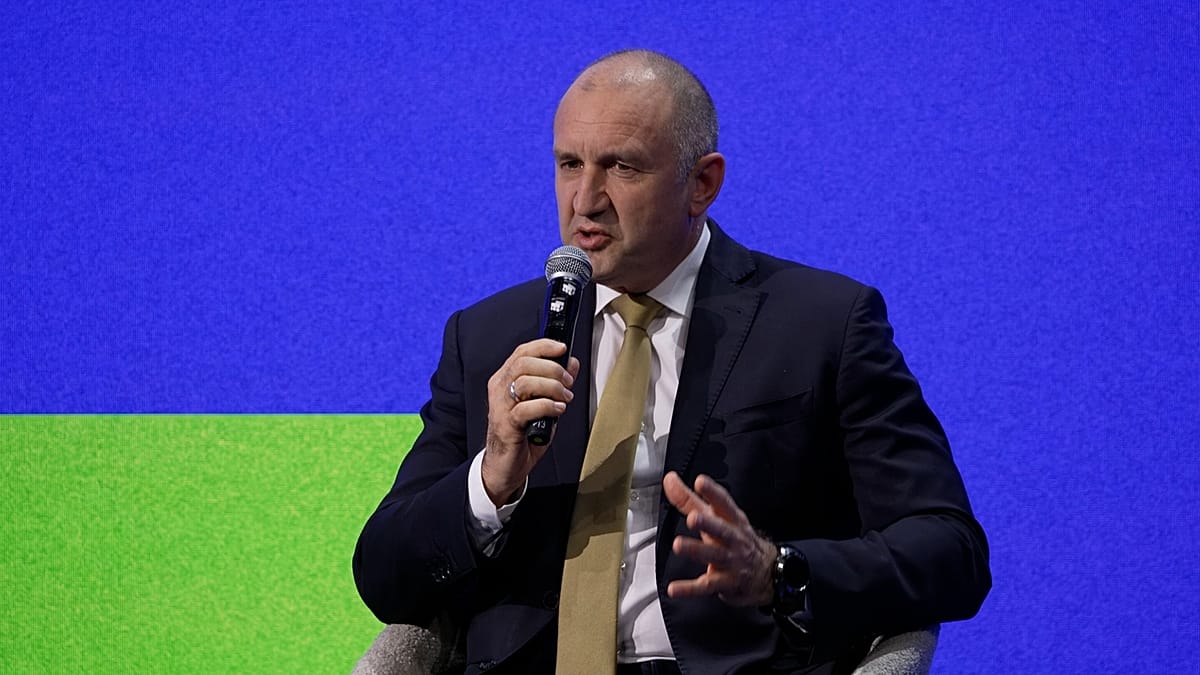
Bulgarian Prime Minister Rumen Radev has rejected accusations that he is "pro-Russian," arguing that his calls for direct EU dialogue with Moscow are being unfairly vilified simply because they deviate from the bloc's mainstream consensus.
Since taking office this summer, Radev has been one of the most vocal EU leaders advocating for renewed diplomatic engagement with Russia to end its full-scale invasion of Ukraine. His stance has earned him a pro-Moscow label, a charge he dismisses as a symptom of a political climate that punishes dissent.
"It is typical, and it is very sad, that if you divert from the political mainstream, you are labelled immediately as pro-Russian. This is not the reality," Radev said in an interview at Euronews' Defence and Space summit.
He added: "I don't care about supporting Russia. I care about a realistic approach and finding the road to peace as soon as possible, because this war drains our social and economic systems almost every day."
EU's approach too focused on weapons, says Radev
Radev insisted that Europe must rebalance its "military, economic and diplomatic instruments," arguing that the current strategy is too heavily weighted towards "weapons and money." He said he does not yet see the right balance in Brussels' approach.
"Our main priority should be to speak and to work for peace," he said, stressing that the power of diplomacy has not yet been exhausted.
His comments come at a time when the idea of appointing an EU envoy for direct talks with Moscow, floated earlier this year, has largely faded from mainstream debate. Most EU member states remain sceptical, pointing to Russia's continued military aggression and lack of genuine interest in peace negotiations.
The challenges of diplomatic engagement were underscored last week when a brief meeting between German Foreign Minister Johann Wadephul and his Russian counterpart Sergei Lavrov in New York ended in bitter recriminations. Meanwhile, US efforts to broker a temporary ceasefire have also failed to gain traction.
Radev's position is not without precedent. He has previously urged the EU to open dialogue with Russia over nuclear risk, a proposal that has been met with caution in Brussels. His latest remarks are likely to reignite debate over the bloc's strategy as the war enters another winter.
Critics argue that engaging Moscow now would reward aggression and undermine Ukraine's position. But Radev maintains that a purely military approach is unsustainable, particularly as European economies and societies feel the strain of the conflict.
"This war drains our social and economic systems almost every day," he said, echoing concerns across the continent about energy prices, inflation, and the broader cost of supporting Ukraine.
As the EU grapples with how to respond to Russia's ongoing attacks on Ukraine's infrastructure, including strikes that have crippled the power grid, Radev's call for a more balanced approach is likely to resonate with some leaders, even if it remains a minority view.
For now, the Bulgarian prime minister shows no sign of backing down. "I don't care about supporting Russia," he reiterated. "I care about peace."