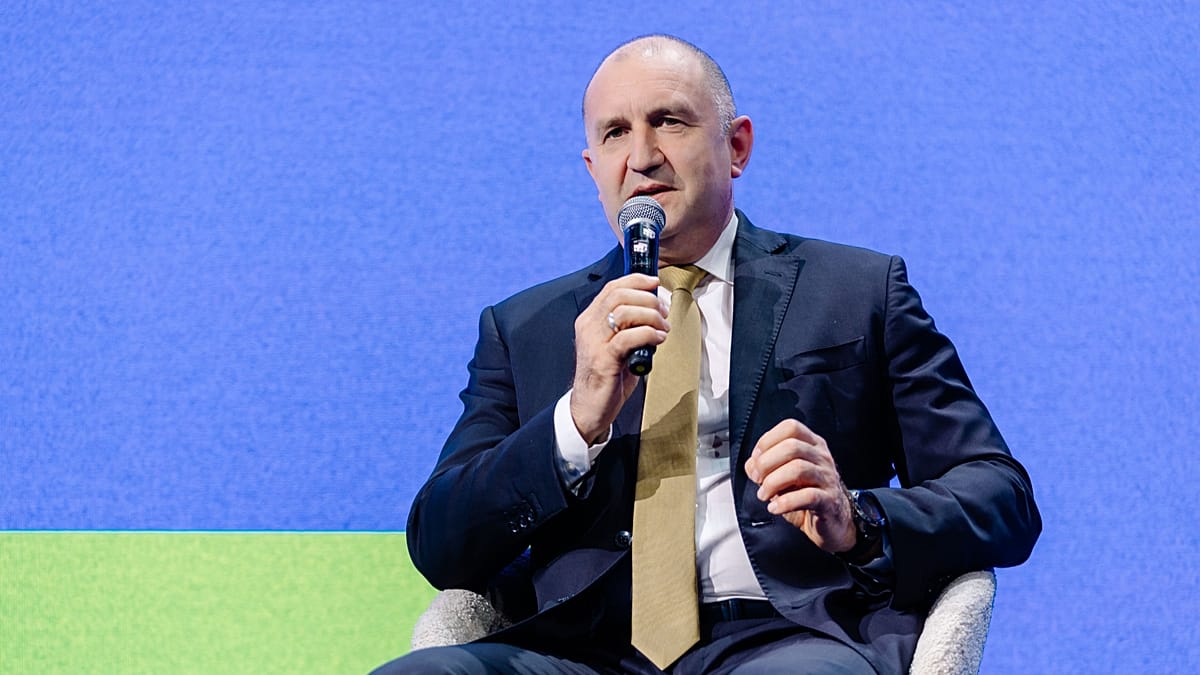
Bulgarian Prime Minister Rumen Radev has called on the European Union to engage in direct dialogue with Russia to end the war in Ukraine and reduce the risk of a nuclear escalation. Speaking at Euronews' Defence and Space Summit, Radev warned that Europe's current strategy of arming Ukraine without a parallel diplomatic track is dangerously incomplete.
Radev pointed to Russia's vast nuclear arsenal—the largest in the world, with an estimated 4,400 warheads, of which nearly 1,800 are deployed—and argued that European leaders are failing to factor this into their calculations. "There is a limit to just delivering weapons and supporting, because the final peace set-up will be done by diplomacy, not by delivering weapons," he said. "So our call is to listen more to each other, to open the lines of communication."
The Bulgarian premier criticised the EU's continued military support for Ukraine, which he dismissed as a failed "peace by force" approach. He stressed that the bloc must rebalance its "military, economic and diplomatic instruments" in favour of the latter. "We always need to think about the worst-case scenario," Radev said. "Are we prepared for this? Does anybody speak about risk assessment? Does it exist at all? Because we have been trying to achieve a conventional victory over the biggest nuclear power."
A nuclear card in play
Radev referenced a recent statement by Russian Foreign Minister Sergei Lavrov, who suggested that a war between Russia and Europe would be "completely different" and "very short"—a remark widely interpreted as a veiled nuclear threat. While rejecting such rhetoric, Radev urged his EU counterparts to consider where escalation might lead. "There is a nuclear card," he said. "We need to have this into account. We cannot close our eyes (to the fact) that there are nuclear weapons on our continent, there are nuclear weapons in the arsenal of Russia. And this is part of the game calculation."
His comments come amid rising tensions, as Moscow intensifies hybrid attacks against European countries—from sabotage to cyber operations—in an attempt to sow fear and deter continued support for Kyiv. Recent incidents, such as Estonia blaming Russian special services for arson at a defence firm, underscore the growing threat.
Radev, who took office earlier this year, has been a vocal advocate for diplomatic engagement with Russia, a position shared by Slovakia, the Czech Republic, and Austria. However, many EU leaders argue that the Kremlin has little interest in genuine negotiations, pointing to its maximalist demands and continued aggression. A brief meeting last week between German Foreign Minister Annalena Baerbock and Lavrov in New York ended in bitter recriminations, highlighting the deep mistrust.
The White House's attempts to broker a temporary ceasefire have also failed, with Russia blocking the Black Sea and launching non-stop airstrikes on Ukrainian cities. Russian strikes have killed civilians and cut power in Kyiv as winter approaches, further complicating any diplomatic overture.
Radev seemed undeterred by this track record, insisting that Europe must not abandon diplomacy. He also pushed back against the "pro-Russian" label attached to his government, which earlier this year vetoed EU sanctions against Patriarch Kirill, the head of the Russian Orthodox Church.
"The war in Ukraine challenged our critical thinking and realistic approach," Radev said. "It challenged our ability to assess the strategic centre of gravity of the opponent. It challenged most of all our ability to design feasible political objectives and to translate them into a sound military strategy and to define a desired end state."
His remarks reflect a growing divide within the EU over how to handle Russia. While some member states, particularly those in the east, advocate for a tougher stance, others see dialogue as essential to prevent a catastrophic conflict. As the war grinds on, the question of how to balance military support with diplomatic engagement remains one of the bloc's most pressing challenges.