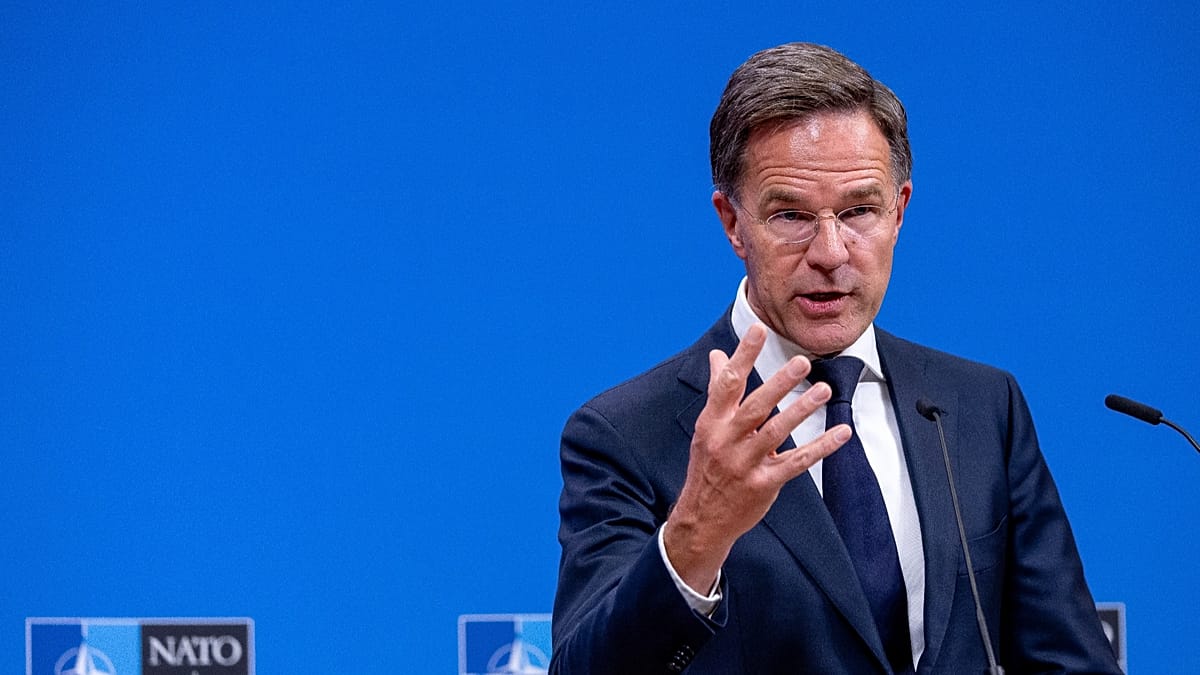
NATO Secretary-General Mark Rutte on Tuesday urged allied nations to remain calm in the face of Russian sabotage, insisting that Moscow's covert operations have not succeeded in eroding support for Ukraine. His remarks came after Estonia became the latest NATO member to formally attribute a hostile act to Russia, alleging that its intelligence services orchestrated an arson attack on a defence firm in August.
“Russia continues its reckless campaign of hostile actions against NATO allies. It is trying to weaken our resolve and stop our support for Ukraine. But Russia is failing. It is failing on the battlefield in Ukraine and it is failing to undermine our unity and support for Ukraine,” Rutte told journalists in Vilnius.
European governments have documented a growing pattern of sabotage, drone incursions, and cyber interference since Russia's full-scale invasion of Ukraine in February 2022. The latest incident in Estonia follows the discovery of an explosive-laden drone near an airport in Russia, which Berlin attributed to Moscow. These actions are widely seen as an attempt to distract and intimidate Ukraine's backers while Russian forces struggle on the front line.
Rutte acknowledged that Russian activities “can have an impact and sometimes they have an impact, clearly,” but he urged NATO countries to “stay calm, carry on and support Ukraine.” He added, “We should not be naive about Russia, but they know we are stronger.”
Speaking alongside Rutte, Lithuanian Prime Minister Mindaugas Sinkevičius said intelligence services had found no evidence that Moscow was preparing a major escalation in the near term. “It's a must to say if a threat is there for society, but you can't exaggerate and say something is happening in the upcoming months or weeks,” he said. “The risk remains, but it's not fluctuating... not increasing or decreasing.”
Estonia points finger at Moscow
Earlier on Tuesday, Estonian Foreign Minister Margus Tsahkna announced that an arson attack on the premises of Milrem Robotics, a defence technology company in Tallinn, was “an act of sabotage ordered by the special services of the Russian Federation.” Writing on X, he said the perpetrators had been apprehended and “no longer pose a threat,” and that Estonia had summoned the Russian ambassador.
“This act of sabotage is part of Russia's broader campaign across Europe, aimed at intimidating us and weakening our support for Ukraine,” Tsahkna wrote. Estonia, an EU and NATO member on the alliance's eastern flank, has repeatedly accused Russia of hybrid provocations since the invasion began. Along with Latvia and Lithuania, it has sharply increased defence spending and remains a staunch ally of Kyiv.
Solidarity messages came from across the continent. Germany's Foreign Minister Johan Wadephul condemned what he called “Russia's reckless act of hostility” and pledged Berlin's full support. Swedish Prime Minister Ulf Kristersson described the attack as “extremely serious,” adding: “This pattern of attacks is directed against Europe as a whole. The aim is to weaken our support for Ukraine and to intimidate us. It will not work.”
The Kremlin dismissed the accusation as baseless. Spokesman Dmitry Peskov told reporters: “Such statements are baseless, ill-considered, have absolutely no relation to reality and lack any form of reasoning. Consequently, we cannot and will not take such statements seriously.”
Estonian Prime Minister Kristen Michal likened Russian President Vladimir Putin to a “rat in the corner,” escalating activity in Europe to try to break Western support for Kyiv while Moscow is under pressure. Michal said Putin is testing NATO's collective defence pact with covert attacks that are hard to attribute, but he considered a conventional military assault on Europe “improbable” given the alliance's deterrent and Russia's commitments in Ukraine.
The high level of malign activity from Russia is “here to stay” until Putin changes his military goals, Michal said, adding that the best way to deter him is to “back Ukraine.” NATO's response, he argued, must be resilience and unity. The EU has also been moving forward on a hybrid threat protocol, though it remains wary of overlapping with NATO's mandate.
Estonia's defence sector, meanwhile, has been adapting to the new reality. The country's drone industry, which includes companies like Milrem Robotics, is scaling up with lessons from Ukraine, where unmanned systems have become central to modern warfare. The arson attack on Milrem underscores the vulnerability of such strategic industries to sabotage.
As Russia continues its campaign, NATO allies are walking a tightrope between acknowledging the threat and avoiding overreaction. Rutte's message of calm reflects a broader consensus that panic would play into Moscow's hands. But with incidents mounting, the pressure on European governments to respond decisively is growing.