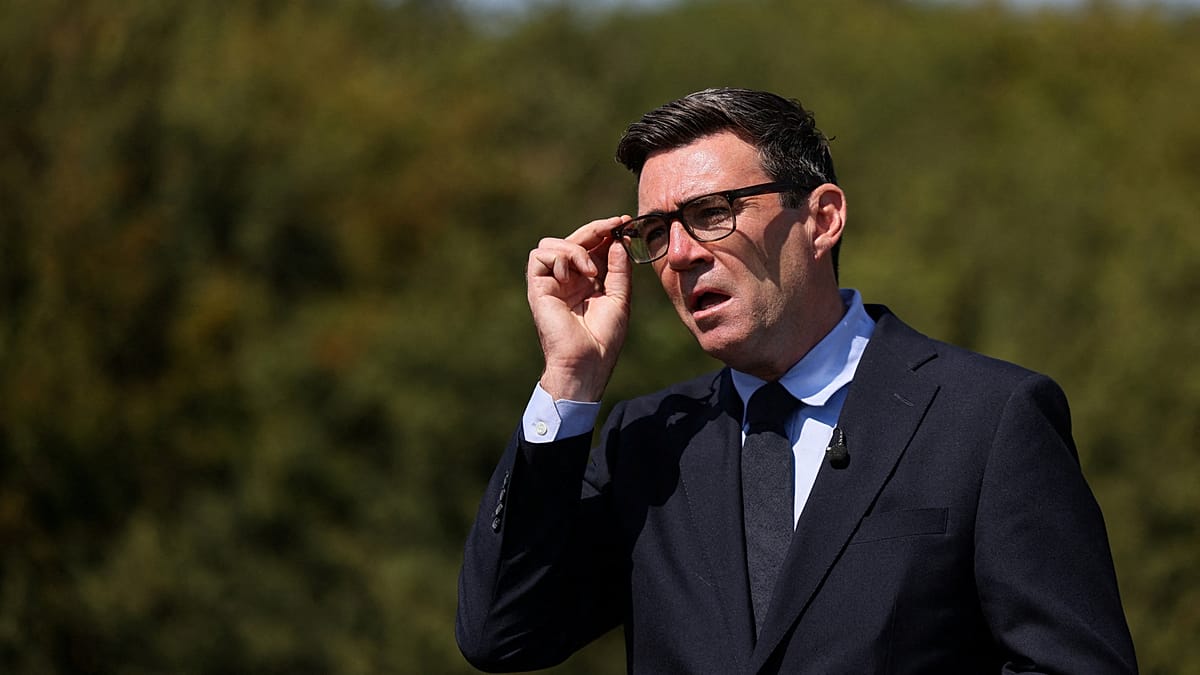
Since entering Downing Street, UK Prime Minister Andy Burnham has kept his focus firmly on domestic matters, unveiling policies from ending rough sleeping to curbing vape and betting shops on English high streets. His vision for the UK's future relationship with the European Union remains largely unspoken, leaving officials in Brussels to speculate about his ambitions.
Burnham has previously described himself as leading a "proudly pro-European" government and has expressed hope that the UK would one day rejoin the EU. Yet his path to power required winning a by-election in a strongly pro-Brexit Manchester constituency, forcing him to moderate his pro-EU language. As Matthias Matthijs, a senior fellow at the Council on Foreign Relations, put it, "Burnham is personally the most pro-European prime minister since Blair but will likely talk about Europe less than Keir Starmer did."
EU diplomats widely expect Burnham to continue Starmer's mission of placing the UK back "at the heart of Europe" by repairing the trade, economic, and political ties damaged by post-Brexit friction. Brussels and London were close to major agreements—including removing barriers on agri-food products and reintegrating the UK into the EU's internal electricity market—when Starmer abruptly announced his resignation in June, derailing plans to finalise those deals at a July summit, now rescheduled for later this year.
Continuity and pragmatism
In Brussels, there is cautious optimism that the new government will swiftly conclude these agreements and deepen cooperation. One European diplomat noted that it "makes sense" for Burnham to seek closer trade and economic ties "in today's world," expressing hope that pragmatism would prevail. The aggressive trade policy of US President Donald Trump and an increasingly unstable transatlantic relationship have strengthened the case for closer EU-UK relations.
Hamish Falconer, Burnham's lead EU negotiator, has set a positive tone by hinting at an even "deeper" and more ambitious relationship with Brussels than under Starmer. After a meeting on Monday between Falconer and Ireland's EU Affairs Minister Thomas Byrne, a UK official said both sides were determined to hold a summit before the end of the year to consolidate the deals and inject renewed pace into the reset.
Ireland holds the EU Council presidency for the rest of the year and is expected to use its influence to make tangible progress on the UK reset before 2027. But despite the positive optics, the negotiations ahead could still be fraught with difficulty.
Trade barriers and economic recovery
For London, removing barriers to trade and economic cooperation is key. Brexit is estimated to have slashed UK exports to the EU by 12% to 16%, dampening productivity and curbing job growth. Some economic estimates put the cost of Brexit to the UK economy at around 4% to 6% of GDP, a figure often contested by proponents of the UK's EU exit.
While Burnham has made economic recovery a key pillar of his premiership, his approach has focused more on domestic reform than the international agenda. "While Starmer and his Chancellor Rachel Reeves saw Brexit as the single biggest barrier to growth that needed to be overcome, Burnham's project for growth is based on devolution," Joel Reland, analyst at the think tank UK in a Changing Europe, told Euronews. "It's more about restructuring power within the UK rather than building bridges beyond the UK."
Despite his focus on internal reform, Burnham may find that some ideas driving his domestic agenda—including reviving the UK's "sovereign capabilities"—are also gaining traction in European capitals, where economic sovereignty and greater national control are back in vogue. The overlap in economic visions could help the UK secure inclusion in the "Made in Europe" industrial strategy, which aims to force companies to manufacture critical goods within the EU. France had been leading efforts to ensure UK manufacturers were given access to the Macron-championed plan.
"Burnham also seems more comfortable with the red lines in Labour's 2024 manifesto: he's not going to push to re-join the Single Market," Reland also told Euronews, referring to Labour's commitment not to take the UK back into the EU's Single Market, Customs Union, or free movement. This could reassure officials in Brussels who want to avoid the UK cherry-picking benefits of privileged EU access without subscribing to all its rules. The Starmer government's attempt to re-join the Single Market for goods only earlier this year was rebuffed quickly by Brussels.
Youth mobility deadlock
The reset talks have also focused on a youth mobility deal that would allow young people to move across the Channel to work, live, and study. The UK previously pushed for a cap of under 50,000 on the number of visas to be granted to young Europeans, while Brussels has pushed for significantly more—up to 150,000. There has also been disagreement over university tuition fees, with the EU pushing for EU students at UK universities to pay the same "home fees" as UK students.
With UK universities facing serious financial pressure, Burnham's government will have to navigate the talks carefully to avoid alienating Brussels while protecting its most prized educational institutions. While Labour figures broadly agree that the youth mobility scheme would bring huge cultural and economic benefits, the prospect of easing visa rules in any way also carries huge political risk.
As the autumn summit approaches, the UK and EU are set to engage in tough negotiations. The outcome will determine whether Burnham's premiership marks a genuine rapprochement with Europe or merely a continuation of the cautious reset initiated by his predecessor.